

The One Coin
A follow-up to 'Into What Anthropology?' — on Iain Davis, Oliver Janich, and why a defense of democracy and a defense of no-state are the same coin

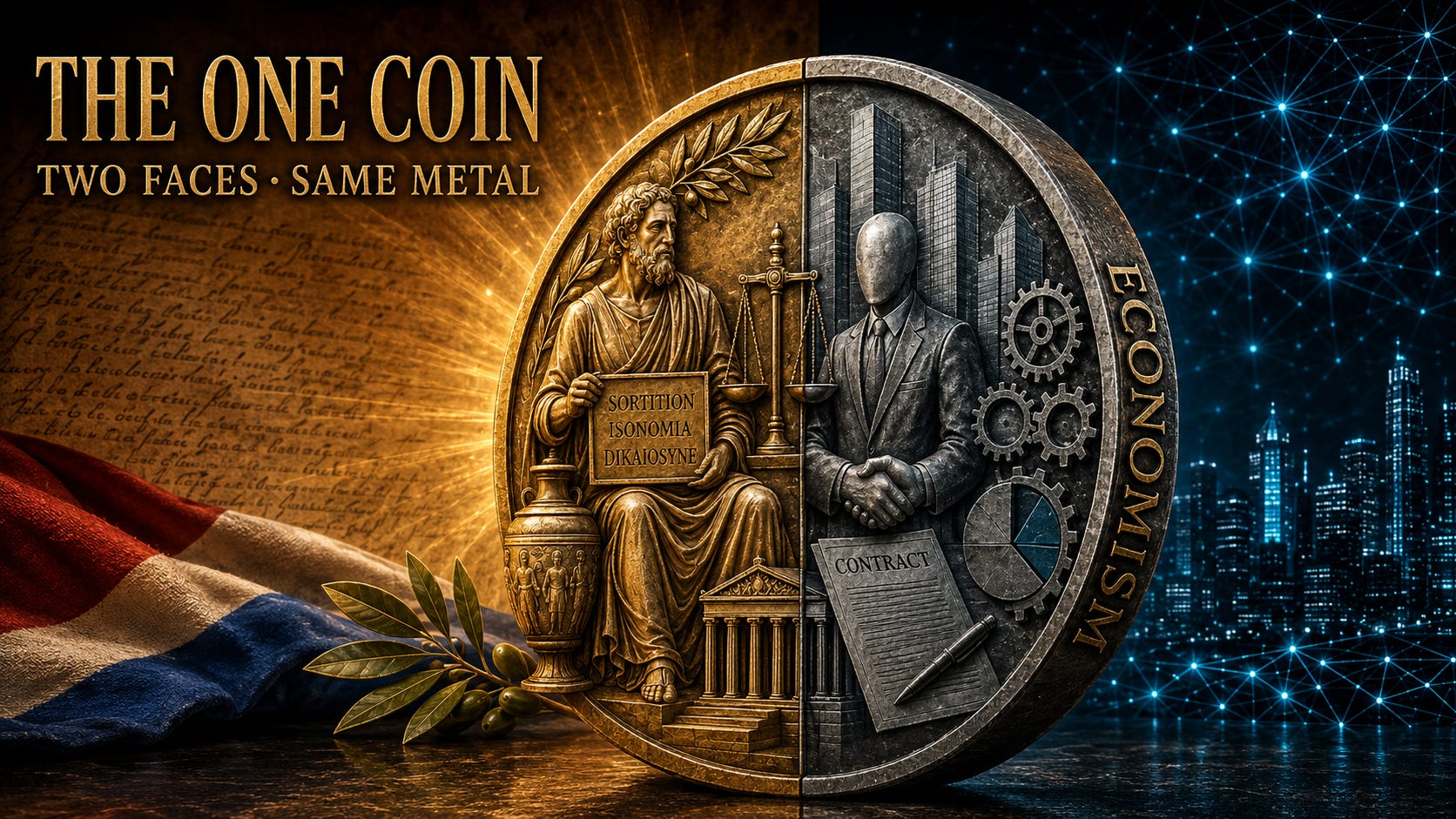
A note on how this began. A friend wrote to me after reading Iain Davis’s 2022 essay on democracy and listening to my exchange with Oliver Janich, the German libertarian whose book The Order of Freedom makes the case for a stateless private-law society. My friend’s charge was that Iain and I were both, in the end, defending the state — Iain covertly, by smuggling one into the machinery of his “real democracy,” and me overtly, by allowing that some organized authority is necessary to human life. He pressed the question he thought we were both dodging: is the state — power exerted through force — actually necessary at all? Who would pay for it under genuine consent? The pyramids and the monuments of Rome were built by states; so were the wars of the twentieth century. Without a second Earth to run the experiment on, how can we say which produced more human flourishing — states, or no states?
It is a serious and sincere question, asked in good faith, and it deserves a serious answer. This essay is that answer, expanded from the reply I sent him, with the seams removed. My claim to him was that Iain’s defense of democracy and Oliver’s case for no-state are not opposites at all but two faces of a single coin. What I want to show here is something I only half-saw when I first wrote back: that in pressing his question the way he did, my friend stepped onto the same coin — and that the argument all three of them are having is not the argument that decides anything. That argument lies a layer deeper, and it was settled long before economics got a vote.
This is the political-form sequel to a question I raised in Into What Anthropology?There I argued that the doomer-versus-boomer debate over AI forecloses a prior question — into what anthropology are we building? — and that the tool is never neutral, because it is always pre-loaded with the metaphysics of whoever specified the metrics. The same move runs through the state-versus-no-state debate. The question is never really which political form; it is what is man, and every form presupposes an answer before the argument about forms begins.
New here? This Substack publishes long-form essays on philosophy, intellectual history, and institutional critique, developing what I call the Being-lineage / Becoming-lineage framework across installments. The Becoming project this series traces — the quiet substitution of a metaphysics of will and process for one of created being — is the precondition for the transhumanist and technocratic project now being built on top of it. That through-line runs across all my work: my book with Patrick Wood, The Final Betrayal: How Technocracy Destroyed America, and the ongoing essay series this piece belongs to — itself headed toward a book of its own. Subscribe to follow as the project unfolds.
Two faces
Begin with the two men my friend lumped together with me, because they look like opposites and are not.
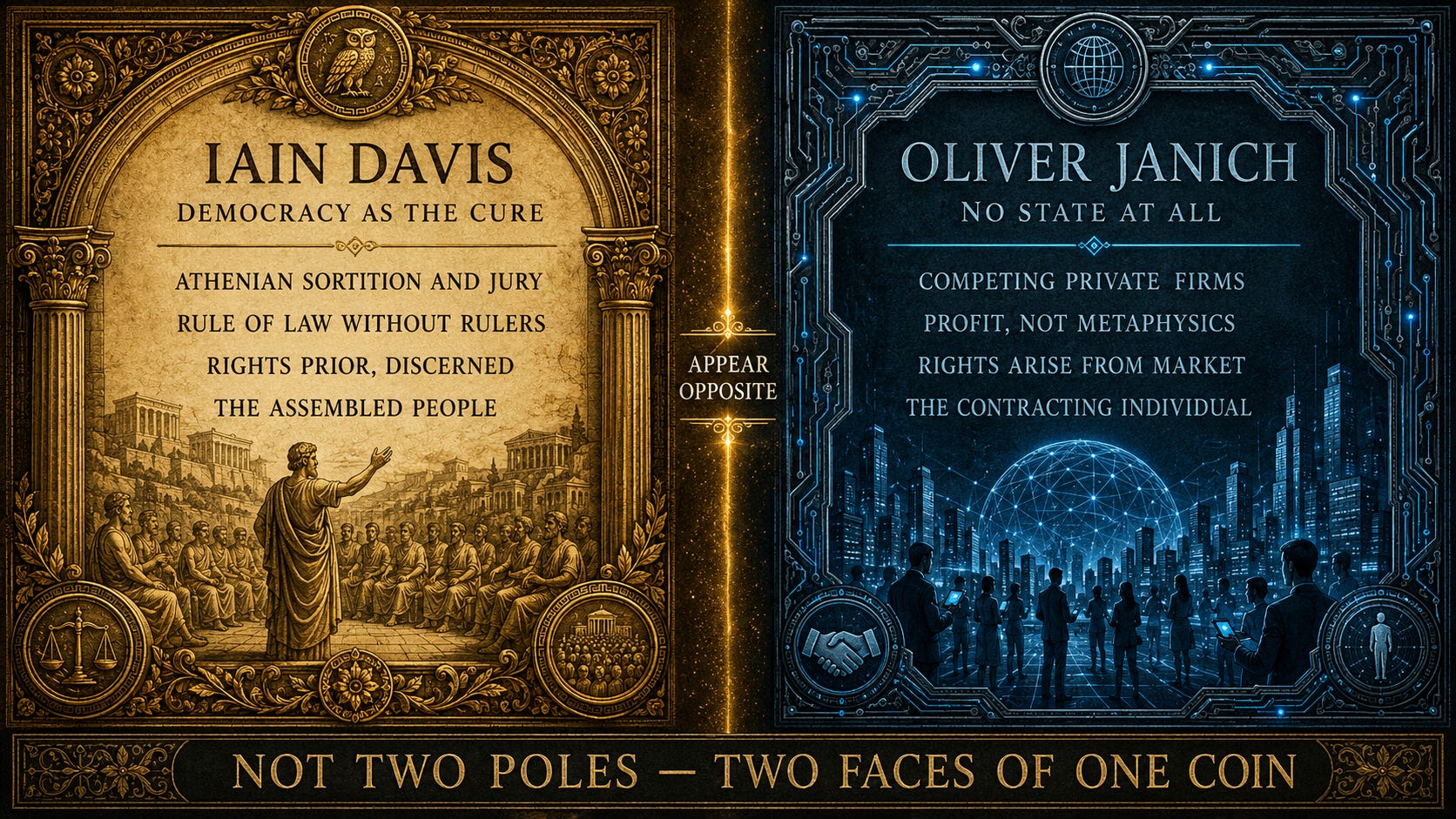
Iain Davis — a British writer working from the English common-law inheritance of Magna Carta, trial by jury, and the rule of law — argues that what we call democracy is not democracy at all. Representative democracy — voting periodically for a permanent class of lawmakers — he calls a functional oligarchy, and on that diagnosis he is often right. Genuine democracy, on his account, is the Athenian system Cleisthenes built: legislation proposed and passed by bodies chosen by sortition (random lot), all law tested in jury-led courts, and any law a jury finds unjust struck down by nullification. The randomly selected jury is the supreme law of the land. He calls the result the rule of law without rulers. Crucially — and to his credit — Davis insists the rights at the base of this system are prior. He is emphatic that there is no mechanism by which rights are granted or revoked, that everyone is born with equal inalienable rights, and that these rights precede governance rather than arising from it. He grounds them in what he calls Natural Law, citing Lysander Spooner — though, as I argue below, neither Spooner’s self-ownership nor the Magna Carta common-law inheritance behind it is natural law in the older, teleological sense, however much it borrows the name — and he is clear that the people do not author this law; the jury only discerns it.
Oliver Janich — a German libertarian formed in the Austrian economics of Ludwig von Mises and the anarcho-capitalism of Hans-Hermann Hoppe — argues for the abolition of the state outright. His private-law society dispenses with the monopoly altogether: protection, adjudication, and enforcement are supplied by competing firms. His diagnosis of the state’s central defect is elegant — the conflict-solver must not be a party to the conflict, and the state, being the ultimate judge in every dispute including disputes against itself, is structurally corrupt. From there he builds the whole order on, by his own statement, a single assumption: that companies want to make profits. Rights, on his account, do not descend and are not discerned; they arise automatically once no monopolist on force exists, because competing insurers must offer customers a product worth buying. He is admirably candid that this requires no metaphysics at all. The market, he says, has no interest in morality, philosophy, or natural law; it simply works.
So the two appear to stand at opposite poles: maximal participation versus no government, the jury versus the firm, the assembled people versus the contracting individual. My friend’s instinct was that I belonged somewhere on that same spectrum, nearer the statist end. I want to dismantle that placement, because it is the whole misunderstanding in miniature — and then I want to show why Iain and Oliver are not at opposite poles but on the same coin.
The first refusal
I am not defending the state, and the first thing to clear is the lumping itself, because it misfires twice over.
I am not defending what my friend means by “the state” — power exerted through force, the monopoly of coercion. That is not the thing I am for. What I defend is magistracy under covenant: authority understood as an office held under a created order and answerable to it, ordered toward truth and the common good. That is a different object from a monopoly of violence in the way that a father is a different object from a man with a gun, even though a father may, in extremity, use force. To define authority as coercion is already to have lost the distinction I am trying to make. Force is not the essence of authority; it is what authority decays into once you have accepted that power is the ground floor of the question.
And I am certainly not defending the state the way Iain does — because Iain does not defend the state at all. Read his comment threads and the position is unambiguous: his ideal is no government whatsoever, and his “democracy” is offered only as an on-ramp for people he considers not yet ready to go the whole way. He tells one reader plainly that if we could be rid of the concept of authority and live by Natural Law and property rights, there would be no need for government. He says he does not believe in the nation-state or in government. He would leave any residual oligarchy with nothing but naked violence. Iain is an abolitionist whose transitional vehicle happens to be a jury.
So my friend has flattened three distinct things into one “statism”: my magistracy-under-covenant, Iain’s transitional anarchism, and an actual coercive state — three positions that agree on almost nothing — collapsed together because, viewed from a particular angle, they all look like allowing power to exist. That flattening is not a careless mistake. It is the symptom that reveals the frame. When power is your only category, every distinction that lives above power becomes invisible. The man who can only see coercion cannot tell the office from the gun.
What, then, should be honored in my friend’s challenge? One thing, and it is real: his perception that power has consolidated above the state, in the layer of money and platforms, and that the apparatus we argue about is increasingly a downstream artifact of forces that never appear on the ballot. He is right about that. It is, in fact, an argument I have made at length myself. But watch what he does with the perception, because that is where the whole thing turns.
The unveiling
My friend takes the two visible faces — Iain’s democracy, Oliver’s no-state — and waves past them. The real question, he says, is not which form but whether coercive power is necessary at all; who pays for it; what states have built against what they have destroyed; which arrangement would yield more flourishing. He believes he is stepping off the coin entirely, onto firmer ground.
He is not. He has just told us what the coin is made of.
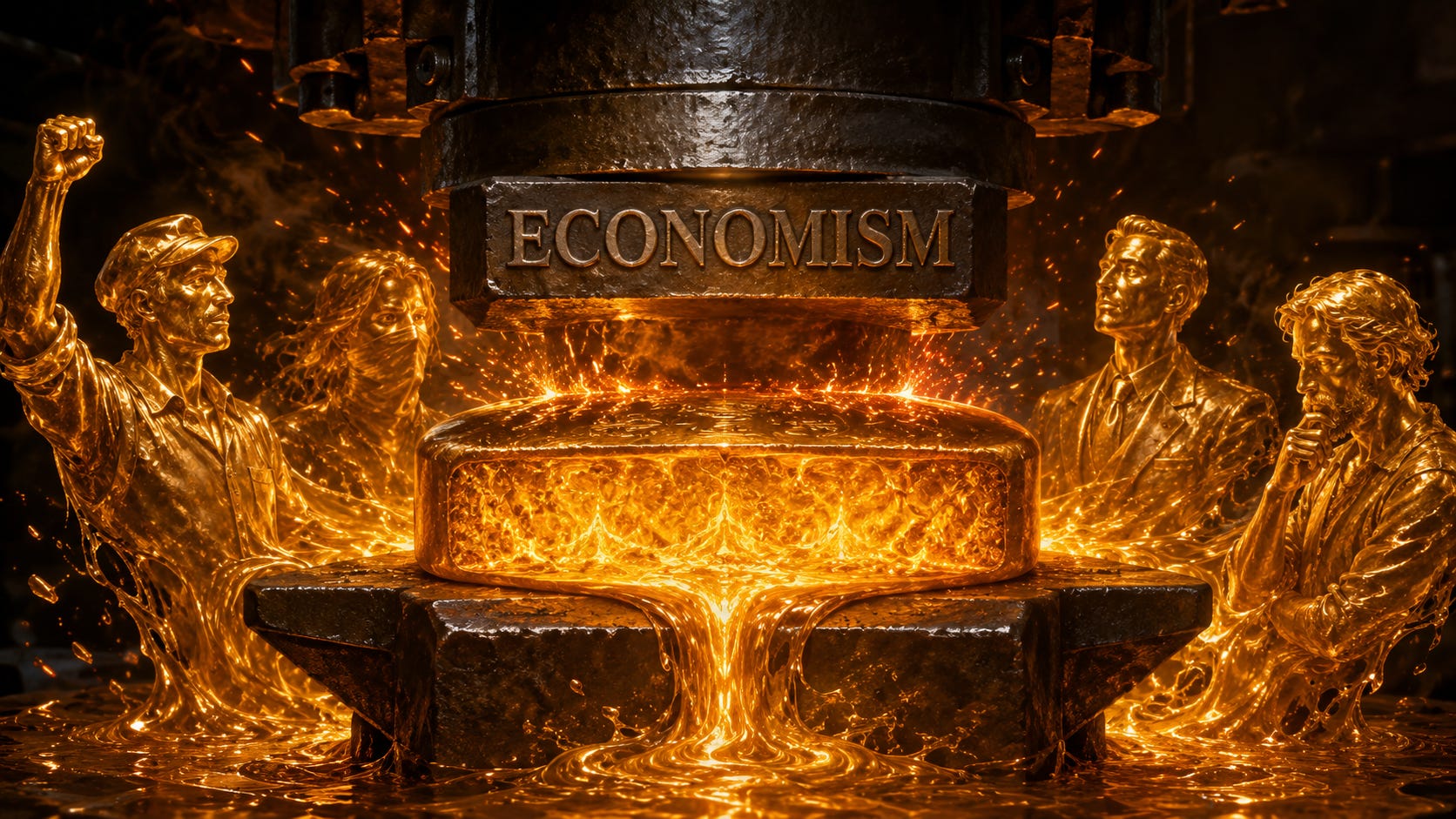
A coin is defined not by which face is showing but by its metal, and the metal here is economism — the conviction that power and economics are the ground floor of the political question, and that authority is finally reducible to them. Reduce the question to who holds power and who pays, and you have not escaped Iain and Oliver; you have joined them, because that reduction is precisely what makes the two of them one coin in the first place. Iain grounds his order in property rights and competing security markets; Oliver grounds his in firms that want to make profits; my friend asks who would pay for the state under consent. All three are conducting the same audit. They differ only over the answer the ledger returns.
Every one of them — the Marxist, the anarchist, the voluntaryist, my friend — is having an argument about economics. The argument that decides it is about metaphysics, and it was settled before economics got a vote.
I add the Marxist deliberately, because he is the ancestor of this whole family, and naming him exposes how strange the family is. Marxism is coded in the popular mind as the maximal-state creed, the opposite of anarchism. But Marx’s telos is statelessness. The dictatorship of the proletariat is explicitly transitional; once class is abolished the state has nothing left to do, and it withers away. The communist endpoint is a stateless, classless society. Which means that left-anarchism and right-anarchism — the commune and the market — meet at exactly the same destination, the abolition of the state, with Marx standing as the hinge between them. Iain’s “democracy as on-ramp,” Oliver’s immediate abolition, Marx’s withering-away, and my friend’s suspicion that the state may not be necessary at all are not four positions. They are one telos approached from four directions. My friend, certain he is the furthest thing from a Marxist precisely because he is anti-state, shares Marx’s endgame and has not noticed.
And watch where Oliver’s branch of that telos actually lands, because it is the sharpest irony of all. Abolish the public monopoly on force and you do not arrive at no sovereign; you arrive at the private one. The competing firms meant to supply protection, adjudication, and enforcement do not dissolve sovereignty — they auction it, and whoever accumulates enough becomes a sovereign in fact: the sovereign corporation, the network state its own architects now openly champion. Which reconstitutes the precise defect Oliver diagnosed. The conflict-solver is once again a party to the conflict — only now the party is a profit-seeking firm, and the single assumption holding up the whole order, that companies want to make profits, is exactly what guarantees it will rule in its own favor. He has not abolished the structurally corrupt judge; he has incorporated it. And its endpoint is not the opposite of the technocratic, managed-tenant order this series keeps tracing — it is that order in its purest form: sovereignty rebuilt as a corporation, with the rest of us as its managed tenants. Iain’s “democracy” is the on-ramp to abolition; Oliver’s abolition is the on-ramp to the sovereign corporation. Both roads run to the same place. They reach it by different roads — Oliver's competing firms auction sovereignty to whoever can amass it; Iain's juries, having dissolved the public monopoly, leave nothing standing that could stop the same amassment (he would give any residual oligarchy "nothing but naked violence," which is exactly the condition in which whoever owns the infrastructure becomes the sovereign) — but the terminus is identical. Both roads run to the network state.
And the apparent decentralization is the tell, not the alibi. Balaji Srinivasan, whose The Network State is the movement’s defining text, sets out in its section 4.7 what he frames as decentralization toward a decentralized center: the dispersed nodes are how a new center is constituted, not how one is escaped. Which means the sovereign corporation and the network state were never termini. They are what Wells, a century earlier, called the decentralized information ganglia — the local nodes of knowledge that route into a unified intelligence — and the center they conduct toward is the thing he called the World Brain and Tesla imagined as a wireless one: a single planetary mind assembled from distributed parts. That is the noosphere, the Becoming-lineage telos in its most ambitious form — the human aggregate fused into one consciousness, an immanent god built node by node. (I trace this genealogy — from “exit and build” to Tesla’s wireless world brain and Wells’s decentralized ganglia — in From Exit and Build to Tesla’s Wireless World Brain and elsewhere.)
The state-or-no-state binary he posed me, then, is not a debate between two camps. It is a quarrel inside a single camp, conducted in a single currency. The currency is economism. He minted it for me when he reframed the question as power and payment, and in doing so he showed me, more clearly than either Iain or Oliver did, what they had all been trading in the whole time.
The same swap, four times
How do I know the metal is economism and not something deeper still? Because you can watch the same substitution happen at every level of the vocabulary these arguments use. The same operation that hollowed out dignity — which I traced across four institutional registers in Into What Anthropology?, where a word that once meant the inviolable worth of the Imago Dei was quietly refilled to mean a score on a flourishing dashboard — runs through this debate on three more words. Each is hollowed and refilled the same way: a category that descends from being is swapped for a category that emerges from will, and the word travels intact while its substance is replaced.
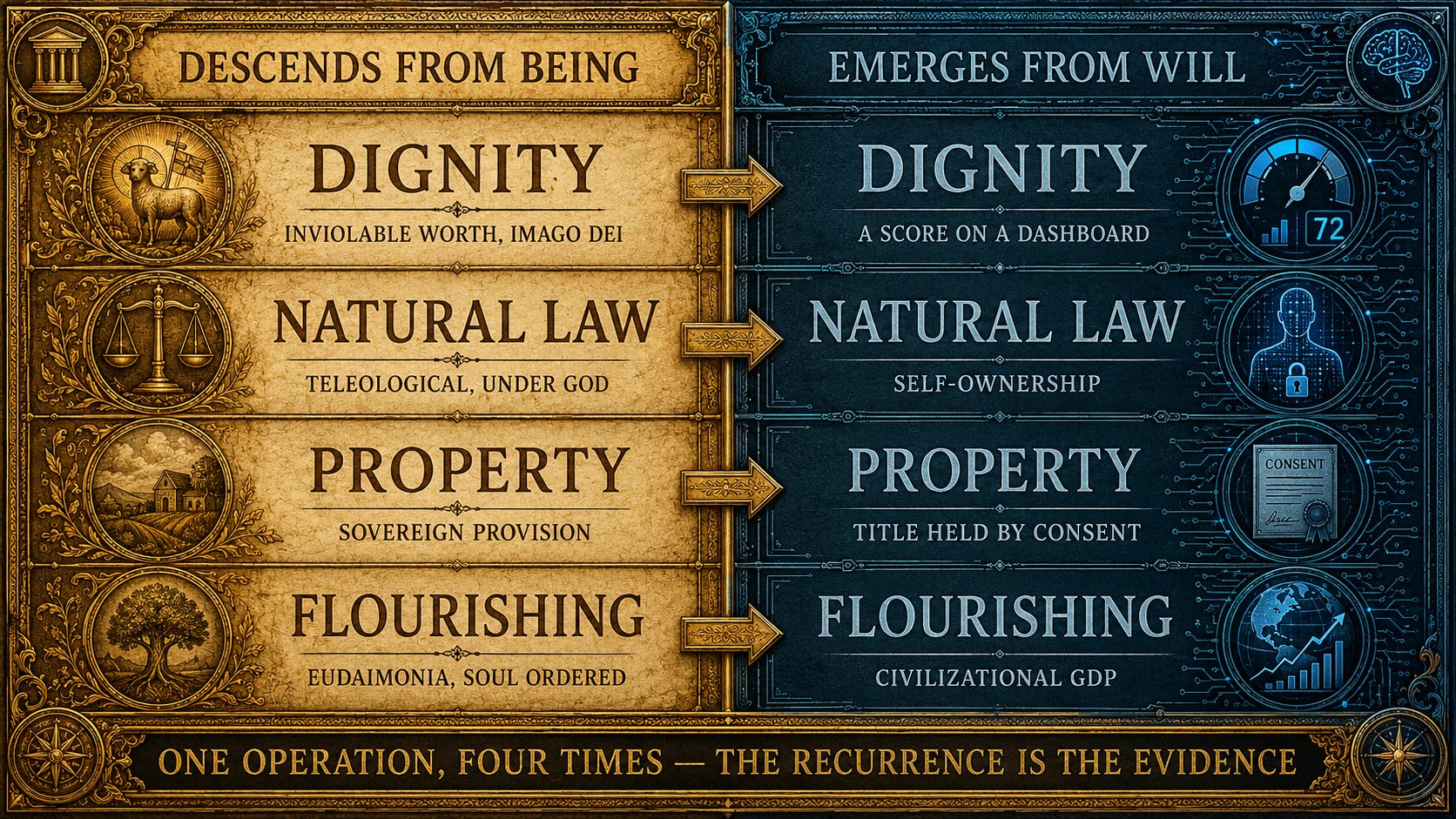
Natural law. Iain says Natural Law, and means it sincerely; he even calls it God’s Law. But press him on its content and the foundation appears: my life is my property, your life is your property. Murder, on this account, is a species of theft — the theft of your property in your own life. This is Spooner’s natural law — and Spooner is the tell. He is at once an individualist anarchist and a Lockean, which means the authority Iain reaches for to ground a prior, non-arising right is itself struck from the two commitments this whole essay is arguing against: the abolition of the state, and the reduction of the self to a piece of property. It rests on the same self-ownership premise Locke installed, whatever Spooner’s own quarrels with the social-contract tradition; and Rothbard and Hoppe fly the same banner from the same stateless ground. Iain’s foundation does not stand off the coin. It is minted from it. But it is not natural law in the classical, teleological, Imago Dei sense. It is self-ownership. And the moment a right is grounded in property in the self, it is grounded in the very category of the alienable — for property is by definition the thing that can be transferred, sold, abandoned, contracted away. A right you own as property is a right you can convey away. Only a right that is not yours to own — because it constitutes you, and is held by the One in whose image you are made — is genuinely inalienable. “My life is my property” cannot carry the weight of the word unalienable; it is built from the opposite material. Janich is only more honest: he drops the natural-law vocabulary entirely and admits the floor is economic. Davis keeps the word and replaces the substance.
Property. This is the register my friend is standing in when he speaks of the power of money operating above the state — and it is the one that now takes a deliberate act of recovery, because the word names two opposite things. There is property as the law currently defines it: a title held by consent, which can leave you owning a fractional, tokenized claim that pays a yield while a fund manager or administrator holds every actual decision over the asset. Legal title gives you a stream of passive income; it does not give you authority. And there is what I call sovereign property — the tangible sovereignty I described in the tokenization series, now named at its root: unmediated authority over a productive asset — the direct right to use it, to exclude others from it, and to decide about it, with no smart contract or corporate layer in between. It is the deed you hold against the token you are issued. Sovereign property gives you autonomy; legal title gives you a receipt. Locke performed the hollowing. He stripped natural law of its grounding in the real natures and ends of things and rebuilt it on will and consent — and once legitimacy ran purely on consent, the substance of property, which is control, could be unbundled and signed away to intermediaries piece by piece. The liquidation is impersonal — there is no visible coercion, so no alarm ever rings; capital simply flows into the definitional gaps a consent-only system leaves open. The founders saw the trap and wrote around it — and this is the crucial point that the popular reading of Locke-as-founding-source obscures: Locke is not the tradition the Declaration inherited but the strand it was consciously correcting. Jefferson chose “pursuit of happiness” over the Lockean “property” precisely to anchor rights in flourishing rather than in a vulnerable legal title, drawing on Aristotle, for whom autarkeia — the material self-sufficiency of the household — was the strict precondition of standing as a free citizen rather than a dependent, so that property, as autarkic provision, is already embedded in the pursuit of happiness and needs no separate clause. He was drawing, too, on James Harrington’s law that political power follows the distribution of property: let property concentrate into a few intermediaries’ hands and the regime becomes an oligarchy whose democratic optics outlive its substance — which is why political freedom requires property widely distributed and unmediated, and why a fractional yield, however reliable, is never enough to keep a commonwealth free. Which is the dynamic my friend rightly sees and misreads. The “power of money operating above the state” is Aristotle’s chrematistics, wealth cut loose from the good life, and it can sit above everything precisely because property was first redefined from sovereign provision into a consent-based title whose control had already been unbundled. He is diagnosing the symptom of the very swap he is reasoning inside — and defending, in the name of “private property,” the exact legal mechanism by which sovereign property is liquidated and a nation of owners is converted into a class of passive rentiers — managed tenants left holding the illusion of ownership while every real decision sits elsewhere. (I trace that operation — the Pax Silica architecture and the tokenization rails being built on top of this definitional gap — in “The Liquidation of Autonomy” and the tokenization series.)
Flourishing. And so to his sharpest question: which yields more flourishing, states or no states? But “flourishing” has already been swapped here too. He uses it as an output — a quantity to be weighed across counterfactual histories of monuments and wars, a kind of civilizational GDP. That is not what the word means in the tradition the American founding actually drew on. Flourishing is eudaimonia: the actualization of a fixed human nature toward its proper end in virtue. It is not a sum you tally and compare; it is a soul rightly ordered to the good it was made for. To ask “which arrangement produced more flourishing” as if flourishing were monuments is to mistake eudaimonia for tonnage of cut stone. It is the folk version of the Harvard flourishing index I took apart in the previous essay — flourishing detached from telos and turned into a ledger.

Four words — dignity, natural law, property, flourishing — each emptied of a substance that descends from being and refilled with one that emerges from will, power, and price. When the same operation recurs across four unrelated terms, the recurrence is itself the evidence. It is not four coincidences. It is one substrate doing the work underneath all four — the Becoming-lineage substrate I have been tracing through this series, substituting itself for the Being-lineage anthropology it replaced.
Off the coin
Which is the descent I have been driving toward. I am not on the coin, because I refuse its denomination. I am not offering a third face — a better political form to set beside democracy and anarchy. What I am addressing is prepolitical; I am refusing the currency and asking what mints it.
The argument they are all having is denominated in economics. The argument that decides it is metaphysical, and it underwrites economics rather than the other way around. Get the anthropology right and political form becomes a question of prudent ordering toward the good, with magistracy under covenant as one historically attested shape. Get the anthropology wrong — treat the human will as good once it is liberated from a distorting apparatus — and no form, voluntary or democratic, survives contact with what the will actually does. Economics does not ground the state. An anthropology grounds what counts as legitimate authority, and economics is one of its distant consequences. The Pharaohs and Caesars my friend invokes did not build their states on top of nothing. They built them on top of an anthropology that made those structures legible to the people inside them. The anthropology is upstream. It always is.
This is what I told Oliver when he pressed me on taxes and consent, on the immorality of a state that takes at the point of a gun. I said I would not have that argument yet. If we are building a house, I cannot argue with you about the color of a room on the second floor until we have agreed on the foundation — whether it is brick, or concrete, or dirt. The metaphysical layer is the foundation: what a human being is, what a right is, where it comes from. That prepolitical layer has to be settled before any of the legal and political contracts built on top of it mean anything at all. He wanted to start on the second floor. I would not — because the whole quarrel about taxes and consent and necessity is a quarrel about paint, and the house is sliding because no one will look at what it is standing on.
Evil in the apparatus, or evil in the heart
The deepest tell sits beneath even the economism, and it decides everything: where is the evil located?
Every position on the coin gives the same answer. Evil lives in the apparatus, not in the heart. Remove the state, says Oliver, and you get harmony — anarchy is order. Remove it, says Marx, and the new man emerges once class no longer deforms him. Remove the rulers, says Iain, and natural law, which he describes as a cosmic balance between chaos and order as impersonal as gravity, reasserts itself. Trust the principles inherent in a people, says my friend, and the coercive apparatus proves unnecessary. In every case the distortion is placed in a structure, and beneath the structure, unaided human nature is presumed to tend toward order. This is the Perfectibilist, Pelagian, Rousseauian anthropology — the standing denial that fallenness is constitutive of the creature rather than imposed on it from outside.
And it is exactly the anthropology the American founders refused. Madison put it with surgical economy in Federalist 51: if men were angels, no government would be necessary; and if angels were to govern men, neither external nor internal controls on government would be necessary. Read what that sentence assumes. Men are not angels — so the controls are built. But the controls run in both directions: against the ruled and against the rulers, against the individual will and the collective will alike. The whole architecture — separation of powers, federalism, the Bill of Rights as a limit on what majorities may do — exists because the will is fallen on every side, the one and the many together. The stateless utopians assume away the precise fallenness the founders built around. That is why their conclusions diverge so completely from the founders’ even when their vocabulary overlaps.
Jefferson said the same thing from the other side. In questions of power, he wrote, let no more be heard of confidence in man, but bind him down from mischief by the chains of the Constitution. You bind power with chains only if you believe the will it restrains cannot be trusted to restrain itself — and in a republic that distrust is aimed not only at the ruler but at the people in whose name he rules. The chains are for everyone, because the fault is in everyone.
Locate evil in the apparatus and you will always conclude the apparatus can be abolished. Locate it in the heart, and you will build to restrain what cannot be — and wait, for the rest, on a Kingdom you are not permitted to manufacture.
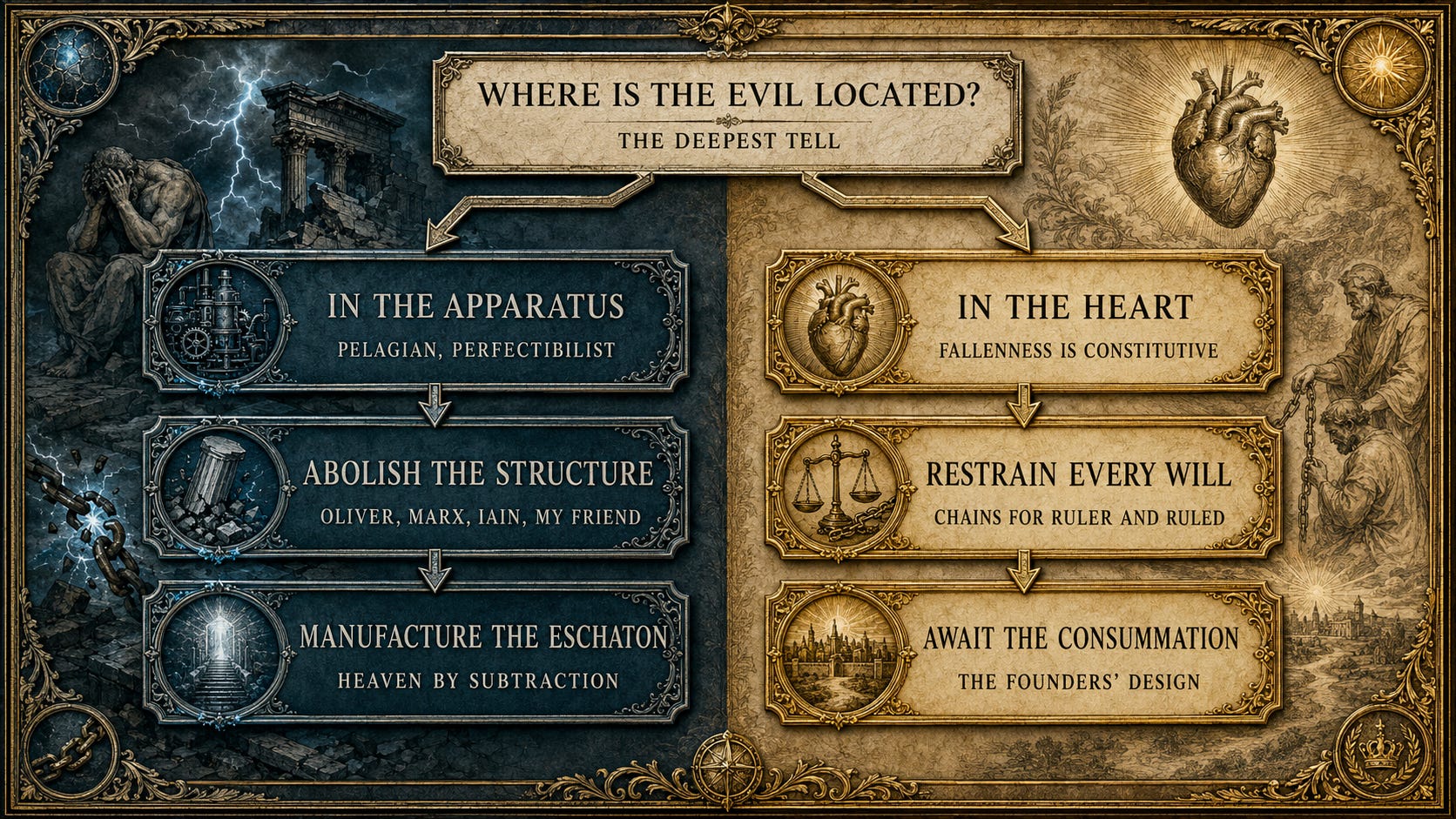
For the stateless telos is finally an eschatology, and a counterfeit one. The withering-away of the state is the secularized Hegelian Absolute — the dialectic arriving at its reconciled end, the New Jerusalem engineered out of history by subtracting an apparatus. It is the Dialectical Engine I have written about elsewhere, running now in the register of political form. The Imago Dei tradition takes the Fall seriously enough to deny exactly this. It holds magistracy under covenant as a restraint we cannot abolish on this side of the consummation, and it holds the stateless peace — the city with no temple and no coercion — as an eschatological gift given by God at the end, never as something men may manufacture within history by abolishing a structure. In Into What Anthropology? I argued that no human program may identify itself with the consummated Kingdom or borrow its name as a sanctifying overlay. The stateless utopia is the same error from the opposite side: not a regime claiming to be the Kingdom, but a program claiming to produce the Kingdom’s peace by subtraction. Both are a technological immanentization of the eschaton — heaven manufactured within history by method — and the Imago Dei tradition refuses both.
A document neither inherits
It is worth saying plainly that neither Iain nor Oliver stands downstream of the tradition that produced the Declaration, and this is not incidental — though the point is about which strand of an inheritance one receives, not about nationality. Iain’s reference points are Magna Carta, the common law, trial by jury, and Cleisthenes’ Athens. Oliver’s are Mises and Hoppe. Neither inherits the particular synthesis the American founders codified.
The English common law was associated, in some of its expositors, with a higher-law framing — law under God, the king beneath the law, lex iniusta non est lex, a maxim Iain himself quotes. But that framing was always thinner than the Declaration's: the common law secured the liberties of Englishmen — procedural, customary, status-bound — never the universal claim that all men are created equal and endowed by their Creator. Iain receives even that thinner inheritance hollowed: he tells his readers he is not religious, and he describes natural law as a cosmic balance between chaos and order, impersonal as gravity. That is the husk of a Being-lineage framing with the Being removed — an impersonal, immanent order, a law with no Lawgiver — and the metaphysics he reaches past was never fully present in the common law to begin with, which is the deeper reason his foundation cannot carry the inalienable rights he wants from it.
What the Declaration did was codify the prepolitical metaphysics into the founding act itself, and it did so exactly as the Enlightenment currents around it were dissolving that grounding everywhere else. “Endowed by their Creator” is not decorative; it is the deliberate installation of a Being-lineage anthropology against a rising Becoming tide. Iain and Oliver reach for the conclusions of that tradition — inalienable rights, natural law, a justice that precedes the state — while standing in lineages that severed or excluded its premises. You cannot keep the conclusions once you have discarded the premises. The rights go alienable the moment their ground is pulled, which is what we watched happen, word by word, above.
What the founders actually specified
This is why the Declaration’s grammar reads the way it does, and why every clause of it refutes the coin.
We hold these truths to be self-evident, that all men are created equal, that they are endowed by their Creator with certain unalienable Rights. The truths are held — recognized, not voted on, and therefore not subject to annulment by any assembly or jury, however randomly selected. Men are created — possessed of a fixed nature with a real end, which defeats both the impersonal flux Iain calls natural law and the output-ledger my friend calls flourishing. The rights are endowed by their Creator — they descend from being itself, which defeats the self-ownership foundation outright and supplies the very metaphysics that a gravity-like natural law cannot. Consent appears nowhere in the source of the rights. It cannot, because rights granted by consent are alienable by the same consent.
Consent enters only in the next clause: to secure these rights, Governments are instituted among Men, deriving their just powers from the consent of the governed. Consent does not generate the rights; it authorizes a government whose sole legitimate function is to secure rights that already exist by virtue of how human beings are made. The government is downstream of the anthropology and downstream of the rights that anthropology entails. It is a servant under covenant — not a sovereign, and not a contracting party.
This is also why the founders labored to distinguish a republic from a democracy, and why Iain’s Athenian apparatus is precisely the thing Madison spent Federalist 10 warning against. A pure democracy, Madison wrote, is a spectacle of turbulence and contention, incompatible with personal security and the rights of property, and as short in its life as it is violent in its death. A republic refines and enlarges the public views by passing them through structures that answer to something other than the unfiltered passions of the assembled. That “something other” is the natural law beneath — the anthropology I have been calling the substrate. Iain’s jury, empowered to nullify any law it finds unjust and to decide the law as well as the fact, hands the operative determination of justice, case by case, to the assembled. His Natural Law is declared absolute and prior; his apparatus routes it through annulment by whoever is in the box. The absolute floor collapses, in operation, into the discernment of successive random panels. That is the Madisonian objection exactly, and it is why the founders built representation, separation, and limits where Iain builds sortition and nullification.
The founders did not invent this anthropology. The line runs through John Witherspoon — Reformed minister, president of Princeton, signer of the Declaration, and the man who taught Madison moral philosophy directly. Through Witherspoon and the Scottish Common Sense realists, principally Thomas Reid, the founding generation inherited a categorical-realist anthropology and the Westminster covenantal insistence that authority is downstream of created order — an anthropology that took human depravity seriously enough to design institutions which assume the goodness of no unchecked will, neither the individual’s nor the collective’s. (I have traced this transmission at length in The Hidden Design of Modernity and Happy Birthday America. Now Hand Over Your Sovereignty.)
You cannot expect power to limit itself
There is a corollary here that I pressed on Oliver directly, and it is the place where his strongest argument turns into its own refutation. He kept returning to the fact that politicians never respect rights or private property — that the state, given the chance, always tramples what it was meant to protect. He is right about the fact. He is wrong about what it proves. It does not prove that the apparatus should be abolished. It proves that protecting rights was never the apparatus’s job in the first place.
The Constitution was not written to make the government the guardian of our rights. It was written to bind the government away from them — a limit on power, drafted by men who assumed power would always reach for more, and handed to a people charged with holding it to that limit. It defends us against the government; it was never a promise that the government would defend us. To wait for politicians to respect rights, and then to call the whole enterprise a fraud when they don’t, is to have misread the document from the first line. You cannot expect power to limit itself. The chains Jefferson described do not tighten on their own; someone has to hold them.
This is why a free republic is the most demanding political form, not the least. It lays the burden of vigilance on every ordinary person — to know the document, to know what was promised and what was withheld, to stay informed, to hold representatives to the line, and to remove the ones who cross it. A constitution is meaningless unless ordinary people read it for themselves and act on it, because no agent of government will ever tell you when it has been violated. Self-government is not a machine that runs without us. It is a responsibility that falls on us, and falls hardest precisely when we would rather it didn’t.
And here is the deepest difference between this and everything on the coin. Oliver’s order is engineered so that no one has to be virtuous — the market, he says, has no interest in principle, and the neutral-judge mechanism works whether or not anyone understands it. Marx’s new man is manufactured by the arrangement. Iain’s sortition is designed to render corruption structurally impossible. Each is reaching for the same thing: order without virtue, a machine that yields good outcomes regardless of the character of the people inside it. It is the political perpetual-motion machine, and it does not exist. The founders built the opposite — a form that cannot run without a virtuous and vigilant people, and that says as much plainly. The Constitution was made only for a moral and religious people, John Adams wrote, and is wholly inadequate to the government of any other. The republic is not the form that spares you responsibility. It is the form that demands the most of it — because it is the only one honest about the fact that no arrangement defends what only free persons can.
What I am actually for
So I can now say plainly what I am for, and it is neither democracy nor anarchy nor the minarchist’s halfway house.
It is not minarchism, the position Oliver rightly mocks — the man who keeps a minimal coercive monopoly on grounds of pragmatic efficiency and has no principled place to stop. Oliver is correct that such a position is unstable; a state justified only as a security provider has no answer to the question of how much security to provision, and every reason to expand. But my magistracy under covenant is not a security provider whose size we haggle over. It is an office justified by created order and ordered to a telos — a different kind of thing entirely, which is why it escapes his trap rather than falling into it.
It is not voluntaryism, because voluntaryism grounds the whole edifice in the very will the rights are supposed to be secured against. It is not democracy, because democracy makes the demos the author of the rights it was meant only to protect. It is the recognition that authority is downstream of being; that rights are constitutive rather than contracted — grounded in fixed human nature received from a Creator, the Being-lineage metaphysics I develop across this series, rather than assigned by will; that property is held through self-sufficiency toward the good life rather than accumulated as alienable title; that flourishing is the soul rightly ordered to its end rather than a quantity on a dashboard; and that the legitimate role of any organizing form is to secure what is already there by virtue of how humans are made, and to order it toward the good.
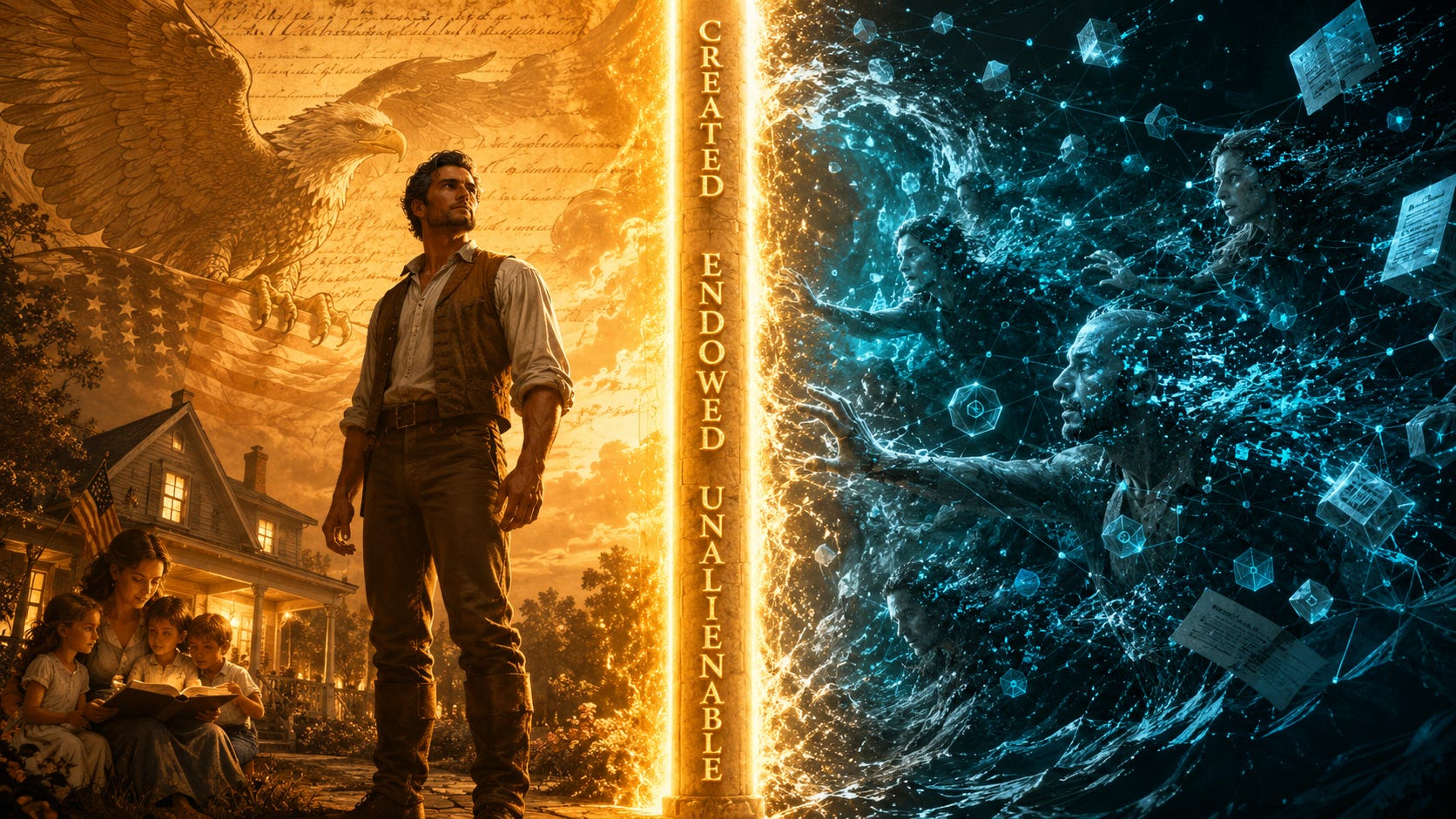
There is a name for what this position protects, and it is the reason the whole argument matters more than a quarrel over forms. I have called it the metaphysical firewall. The line in the Declaration — created equal, endowed by their Creator with unalienable rights — is not a sentiment but a wall, and it is the only wall that holds against what is now being built. The same swap that turns rights into property and flourishing into a ledger is the swap that turns the human person into a managed process — an upgradable substrate, a node to be optimized against someone else’s dashboard. That is the explicit anthropology of the transhuman and technocratic project, and it is the thing this series has spent its length tracing. A right grounded in self-ownership can be signed away, because property is the category of the alienable; a person who is his own property can in principle be sold — including in pieces, including to whoever is bidding for his attention and his data. For the claim to own oneself is, at root, a claim to author oneself — the creature taking the Creator's title over its own being. Self-ownership is a self-apotheosis: the same Becoming move the noosphere makes at the scale of the species, performed here at the scale of the single soul. And a self that has crowned itself can sell itself, for nothing stands above it to hold it inviolable.
Only the person who is not his own — made in an image he did not author, given a telos he did not assign — cannot be reduced to a node, because the thing that constitutes him was never his to trade. That fixity is the firewall. Voluntaryism, democracy, and the market each dissolve it in their own way, because each installs the human will, or the human aggregate, as the author of the one thing the will was never supposed to be able to reach.
Back to my friend
My friend asked whether the state is necessary. It is the wrong question — not because it is foolish, but because it is downstream of the question that decides it. He is right that power has gone rogue above the state, consolidating in the layer of money and platforms where no one votes. But the frame in which he diagnoses that fact — power and economics all the way down — is the very frame that produced it. The migration of power above the state does not prove the state unnecessary. It proves that whoever controls the metaphysics-bearing layer controls everything downstream of it, which is exactly why one must contest the anthropology first. His instinct points straight at my conclusion and then files it under economics, where it can do no work.
So the real question is not state or no state. It is: what anthropology are we organizing around, and does the form we adopt presuppose it, serve it, or quietly substitute for it? Does it expect harmony from subtracting an apparatus, or order from a created telos? Does it await the consummation, or try to manufacture it? Iain and Oliver are two faces of one coin. My friend, in pressing past the faces, showed me the metal. And the metal — economism, the will and the market and the ledger at the ground floor — is exactly the thing the founders refused when they wrote that men are created, and endowed by their Creator, with rights no consent grants and no assembly can annul.
That is the conversation I am actually trying to have. It is not the one about economics. It is the one underneath, which was settled before economics got a vote.
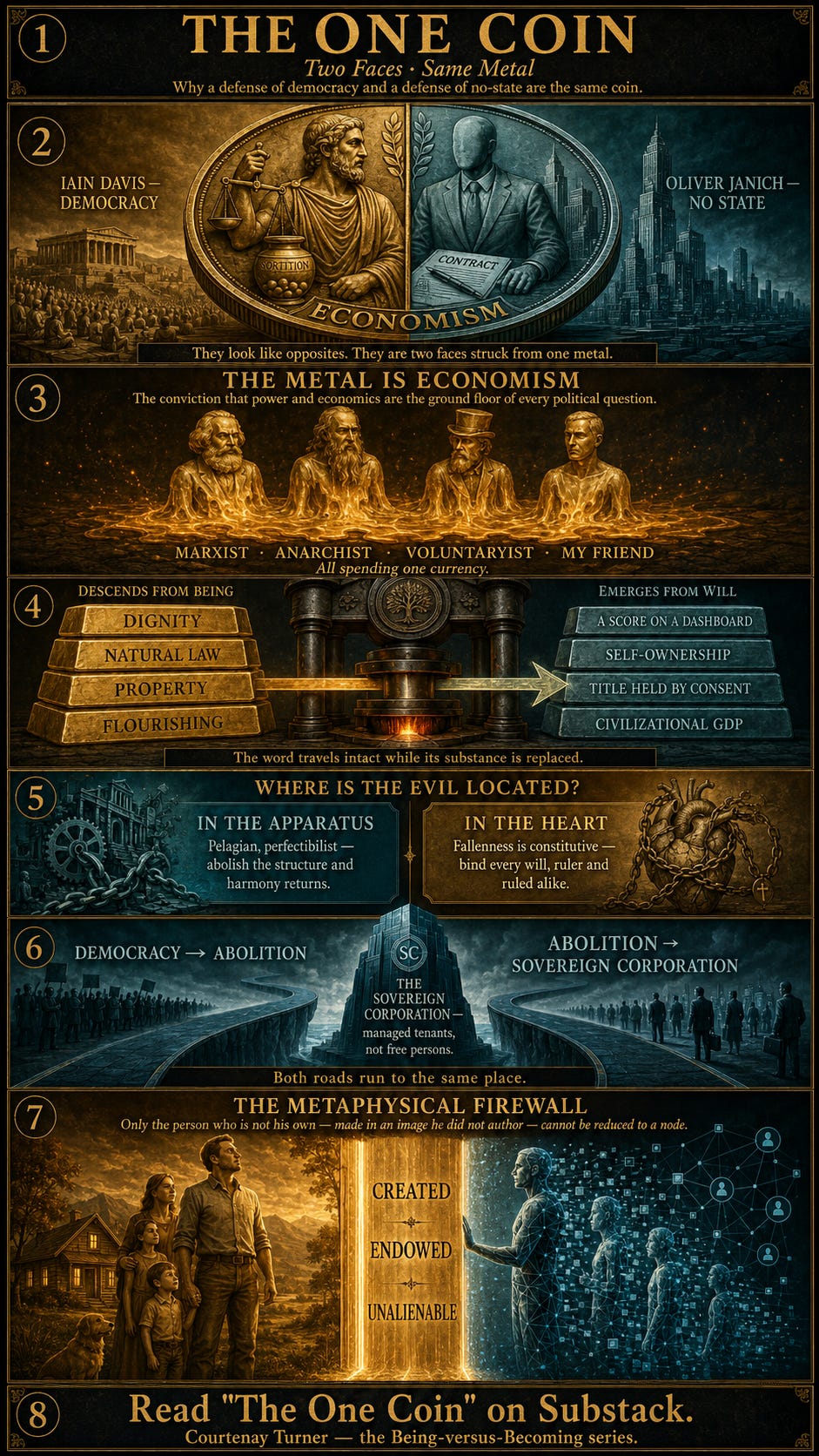
If "The One Coin" named the architecture, this is the blueprint.

Sources & further reading
Primary sources
Iain Davis, “Democracy Is Dead! Long Live Democracy” (2022) and “What Is Democracy?” (2025)
Oliver Janich, The Order of Freedom (2020)
Lysander Spooner, Natural Law; or The Science of Justice (1882)
Thomas Jefferson, the Kentucky Resolutions (1798)
John Adams, letter to the Massachusetts Militia (1798)
John Witherspoon, Lectures on Moral Philosophy
The Westminster Confession of Faith (covenant and created-order sections)
Aristotle, Nicomachean Ethics and Politics (on eudaimonia, autarkeia, and the distinction between oikonomia and chrematistics)
James Harrington, The Commonwealth of Oceana (1656) — that political power follows the distribution of property
Friedrich Engels, Anti-Dühring, and V. I. Lenin, The State and Revolution (on the withering-away of the state)
Courtenay Turner, interviewed by Oliver Janich, The Final Betrayal: How Transhumanists Are Taking Over America (Oliver Janich International, 2026) — the exchange on voluntaryism, property, the foundation analogy, and the metaphysical firewall:

Courtenay Turner, The Liquidation of Autonomy (the video from the Pax Silica episode — sovereign property versus title-held-by-consent, and the Pax Silica architecture
Companion essays on this Substack
Into What Anthropology? Whose Flourishing, Measured by Whom — the prior-question move, and the dignity-keyword operation
The Hidden Design of Modernity — the Reid–Witherspoon–Madison transmission
Happy Birthday America. Now Hand Over Your Sovereignty — the metaphysical foundation of the Declaration
The Factory Reset — the Being-versus-Becoming lineage and the Imago Dei anthropology
The Dialectical Engine — the immanentized eschaton and how the architecture operates without coordination
From “Exit & Build” to Tesla’s Wireless World Brain — Srinivasan’s decentralization toward a decentralized center, Tesla’s wireless “huge brain,” and Wells’s decentralized information ganglia feeding the World Brain