
The Dialectical Engine
A close reading of the Weinstein-Hall-Pageau conversation — and how the Factory Reset architecture synthesizes without coordination.

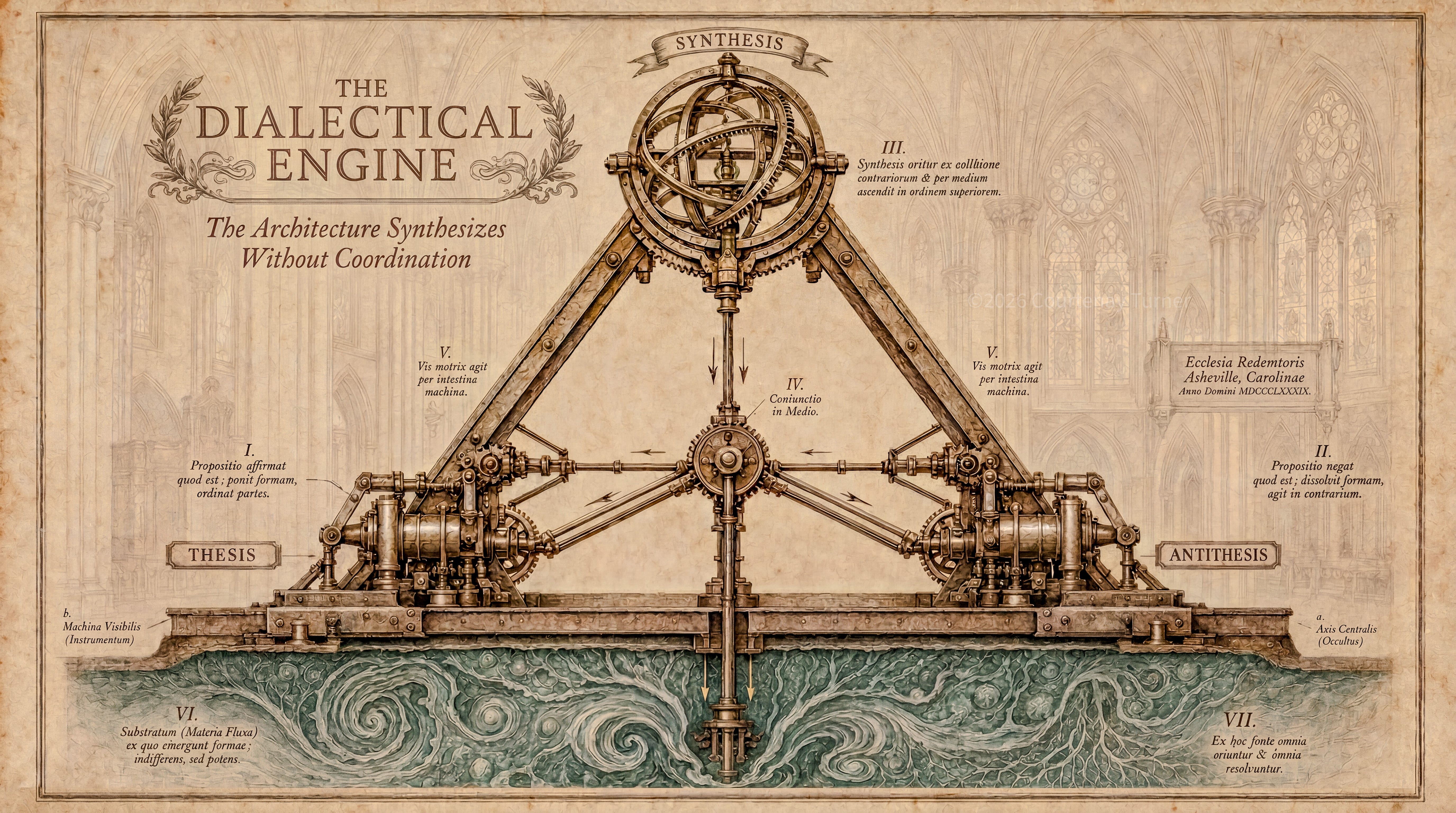
The Factory Reset documented the architecture. This follow-up names the engine. The mechanism through which the architecture's metaphysical substrate gets installed in audiences whose consent it requires — without coordination, without conspiracy, and without requiring any participant to be insincere. The dialectical engine runs on the appearance of good faith. The synthesis lands where the form sends it. The architecture does not need to know itself to operate. A test case from a podcast released at the end of April, the Trust Foundation's institutional self-description, the documentation of the current liturgical-absorption stage, and the philosophical analysis of the one position the engine cannot process and must therefore evacuate.
CHAPTER BREAKDOWN
I. The Question The Factory Reset Left Open — Why the architecture documented in the previous essay does not require coordination, and what mechanism makes it operative. The objection that structural analyses require implausible coordination, and why that objection assumes a model of civilizational engineering the documentary record does not support. (Public)
II. Hegel as the Hinge — Why dialectical method is itself metaphysically committed, and why running the engine commits one to the ontology regardless of vocabulary. The TESCREAL bundle as the contemporary expression of the Becoming lineage, and the dialectical opposition between Land's homo autocatalyticus and the cosmo-erotic humanist homo amor as an engine operating at the highest visible level of contemporary discourse. The load-bearing claim the engine has been working to evacuate, and the multiple traditions through which that claim has been historically articulated — Aristotelian-Thomistic, Eastern Orthodox, Reformed, Maimonidean, and Scottish Common Sense. The distortion of theosis in contemporary Orthodox-adjacent discourse as a current example of the absorption operation working on the very tradition that should be most resistant to it. (Paywall)
III. The Test Case — A high-profile recorded conversation released April 26, 2026 among three participants whose conduct presents as good-faith engagement, at a Christian church in Asheville, treated as a case study in the dialectical engine running in real time. A close reading of the specific conversational moment at 28:17 in which the metaphysical frame is substituted with a game-theoretic frame, and the rest of the three-day conversation proceeds inside the substitute. The structural positions each participant occupies, the moves through which the synthesis lands, including Hall's own explicit articulation of his participatory-anointing framework against "doctrinal" Christianity, and the careful reading of one participant's genuine particularist resistance — and why even that resistance, conducted in a participatory-Platonist register rather than the categorical creator-creature register, becomes a tributary into the synthesis rather than a barrier against it. The section closes by naming the structural finding that closes the loop The Factory Reset opened: why the form has selected the synthesis before the conversation begins, why the absent voice is structurally absent rather than accidentally absent, and why the Being-lineage position has to refuse the form of the conversation rather than just its content. (Paywall)
IV. The Trust Foundation: The Engine Institutionalized Through Its Agents — How the dialectical engine has been scaled into a national network of catalytic communities through operational doctrine derived from McChrystal’s Team of Teams methodology — as the Trust Foundation explicitly acknowledges in its own institutional self-description. The institutional composition, the Peter Thiel Dialog-retreat methodology cited as a model and its connection to the Dark Enlightenment current, and Jordan Hall’s role as a co-founder. Why the materially helpful work and the substrate installation operate in parallel rather than in opposition. (Paywall)
V. Liturgy Is the Stage We Are In — The documentation that the absorption operation has already moved past generic Christian vocabulary and into specifically liturgical and sacramental vocabulary. Hall and Vervaeke’s recent dialogues on liturgy and communion, the Black Mountain Christian community as liturgical project, communion-without-the-Real-Presence, anointing-as-relational-process. Why this stage is the most aggressive form of the absorption and why the next stage — doctrinal absorption — is already visible. (Paywall)
VI. The Dialectic Checked: Why the Engine Cannot Process the Imago Dei — The philosophical climax of the piece. The three structural levels at which the imago Dei anthropology and the categorical creator-creature distinction check the dialectical engine: the absence of dialectical seeds of negation, the incommensurability of the categorical claim with its denial, and the absence of any higher level for the synthesis to occupy. Why Hegel had to read the Trinity developmentally to make the dialectic work, and why the conciliar Trinity is itself a structural check on the dialectic. The practical consequence that the architecture must evacuate rather than refute these commitments. (Paywall)
VII. What the Recovery Would Require — Why resistance from inside the engine never reaches the engine, and why the only resistance that does reach the engine is the recovery of the specific philosophical and theological resources the engine was built to dismantle. The institutional carriers, the philosophical literacy, the theological rigor, and the willingness to refuse the dialectical form when the dialectical form is being run as a substrate-installation operation. (Paywall)
VIII. The Standing Question — What is a human being? The two answers in operational competition, the asymmetry of the present moment, and what the recovery requires recognizing. (Paywall)
The Dialectical Engine: How the Factory Reset Architecture Synthesizes Without Coordination
A follow-up to The Factory Reset, narrowing the architectural argument to the specific mechanism through which the synthesis lands — and why apparent good-faith disagreement is the engine rather than the obstacle.
A note to the reader. This piece is a tightening of the argument The Factory Reset developed at length. That essay traced the fifty-year civilizational-engineering project through its institutional carriers — SRI, Stargate, the Santa Fe Institute, the Epstein funding architecture, the Game B network, the AGI Constitution paper as documented terminus, and the Trust Foundation as operational mechanism. The fifty-year frame is itself the public-facing operationalization of an older cybernetic-and-human-potential lineage running back to the Macy Conferences. The institutional documentation is the foundation. What this follow-up adds is the operational mechanism: the specific dialectical engine through which the architecture's metaphysical substrate gets installed without requiring coordination, conspiracy, or any participant to be insincere. Readers who have not yet read The Factory Reset should start there. Readers who have read it but want the philosophical mechanism named precisely should read on. The argument here is shorter, sharper, and depends on a piece of contemporary documentary evidence — a podcast released the same weekend this essay was written — that makes the mechanism visible in real time, through the participants' own words.
I have also developed the philosophical lineage of dialectical synthesis as a Gnostic Jacob’s Ladder in an earlier essay, Hegel’s Dialectic, a Gnostic Jacob’s Ladder & the Machinery of Control. Readers who want the full intellectual history of the dialectical method — from Heraclitus through the ancient mystery schools through Hegel’s codification through its weaponization in the present — should treat that essay as the upstream reference. This piece assumes that history and applies it to a single contemporary conversation and the institutional architecture scaling it.
I. The Question The Factory Reset Left Open
The Factory Reset documented the architecture. It did not fully name the engine.
A methodological note before the analysis begins. Throughout what follows, I describe the participants in the conversations and institutions this piece analyzes as engaging in conduct that presents as good-faith participation. I do this because their public conduct, their stated reasoning, and their observable engagement with the material all register consistently with good-faith engagement. But interior dispositions are not directly observable, and I want to be explicit that I am describing observable conduct rather than making claims about verified internal states. The structural argument the piece makes does not depend on the participants being sincere in fact; it depends on their conduct registering to audiences as sincere, which is what the engine requires. Where the piece uses the word 'sincere' or 'good faith' to describe specific participants, the assessment is descriptive of observable conduct. Throughout the piece, the qualifiers ostensibly, presents as, and registers as mark this distinction at the line level wherever the prose makes a sincerity-adjacent claim about a named individual. The structural critique stands regardless of how the dispositional question resolves for any particular individual.
By “architecture” I mean the institutional, financial, and intellectual lattice that runs from the 1974 SRI report through the Santa Fe Institute through the Epstein funding ecosystem through Game B through the Dark Enlightenment political-philosophical current and into the contemporary AGI governance proposals that the TESCREAL bundle — Transhumanism, Extropianism, Singularitarianism, Cosmism, Rationalism, Effective Altruism, Longtermism — has been organizing around for the past decade. The Factory Reset developed the broader architecture in detail; this follow-up assumes that documentation and extends it.
By “engine” I mean the specific operational mechanism through which that architecture’s metaphysical substrate — the Becoming-lineage ontology of process, emergence, relation, and engineered transformation — gets installed in the audiences whose consent the architecture requires. The architecture is the what. The engine is the how. And the how matters more than the what for one specific reason: the architecture cannot operate without it, and the engine does not require the architecture’s participants to know it exists.
The standard objection to the kind of structural analysis The Factory Reset offers is that it requires too much coordination to be plausible. Skeptics point out — correctly — that the figures named are not in a room together making plans, that many of them genuinely disagree with each other in public, that some of them have personal histories of opposing the very projects the architecture is advancing, and that the architecture’s apparent coherence may therefore be a pattern in the eye of the analyst rather than a structural feature of the world. This objection has force. A theory that requires extensive coordination among intelligent people against the public good without leaving a documentary trail of the coordination is not a theory worth defending.
But the objection assumes a model of how civilizational projects operate that the documentary record does not support. The architecture The Factory Reset describes does not require coordination. It requires the appearance of sincerity. The mechanism by which it operates is dialectical, not conspiratorial, and dialectical engines work best when their participants appear genuinely opposed, present as sincerely engaged, and their audiences do not recognize that the form of the opposition is doing more work than the content.
This is the analytical move that closes the loop The Factory Reset opens. The architecture documented across that essay’s thirty thousand words is real. The intellectual history is real. The funding flows are real. The institutional adjacencies are real. What makes the architecture operative — what allows it to consolidate audiences, orient discourse, and install its metaphysical substrate at scale — is not that the participants are coordinating. It is that the convening, the methods, the framings, and the ambient metaphysical options are all configured in such a way that any conversation conducted in apparent good faith inside them lands in approximately the same place. The engine is the venue. The engine is the method. The engine is the form. And the form is Hegelian dialectical synthesis operating at a civilizational scale, scaled and institutionalized through specific operational containers whose participants’ apparent good faith is precisely what makes them effective.
The implication is consequential. If the engine runs on apparent good faith, then good faith is no longer a sufficient defense against installation. The participant of good faith, the audience of good faith, the facilitator of good faith — all of them can be doing exactly what they understand to be good and necessary work, and the engine will produce its synthesis from their inputs without any of them recognizing what is being installed beneath the work. This is not a claim that the participants are unwitting tools or the audiences are deceived. It is a claim that the form of the engineered space itself is doing operational work that no good-faith participation can offset. The form has metaphysical commitments. Running the engine commits its participants to those commitments, regardless of vocabulary, regardless of intent, regardless of what the participants understand themselves to be doing.
What follows is the analysis of how this works. It begins with Hegel — not as historical figure but as the philosophical hinge through which the method and the metaphysics became unified, such that any contemporary discourse running on the dialectical method is committing to the metaphysical substrate the method was built to express. It moves through a specific test case — a recorded conversation released April 26, 2026 between three high-profile thinkers at a Christian church in Asheville, all engaging in what presents as good faith, treated as a case study in the engine running in real time. The case-study analysis includes a close reading of the specific conversational moment at 28:17 in which the metaphysical frame is operationally substituted with a game-theoretic frame, and the rest of the three-day conversation proceeds inside the substitute. It documents how the same engine has been institutionalized through the Trust Foundation’s catalytic-community model — an organization that explicitly identifies its operational doctrine as derived from McChrystal’s JSOC methodology and whose co-founders include one of the participants in the Asheville conversation. It identifies the current stage of the absorption operation, which is more advanced than even the architecture’s critics have generally recognized. And it concludes with the philosophical analysis of the one position the engine cannot process and must therefore evacuate — the foundational anthropology of the constitutional tradition, the imago Dei with its categorical creator-creature distinction, the claim that checks the dialectic at three structural levels and that the architecture has accordingly been working for fifty years to remove from the available metaphysical options of educated public discourse.
The remainder of the piece is reserved for paid subscribers. What follows names specific high-profile figures and offers a structural reading of their conduct at the level of the actual conversational mechanics. It names specific operational doctrines and traces them through specific civic infrastructure. It depends on careful argument across multiple theological traditions and asks readers to follow technical metaphysical distinctions that are doing real load-bearing work. None of this material is sensational, but all of it is consequential. This work is reader-supported. If you can contribute, your subscription is what makes the research, the time, and the independence of this writing possible. If you can't, “liking” and sharing this essay is itself a meaningful form of support.
If the question The Factory Reset opened was what is the architecture, the question this piece answers is how does the architecture operate without coordination. The answer, in short, is that the form does the work. The participants present as sincere. The synthesis is reliable. The substrate installs. And the position that could resist the installation has been, by structural design, removed from the available options of every venue where the operation is currently running.
