The Simulation State
How the FY27 NDAA Builds the Cognitive Layer of Pax Silica

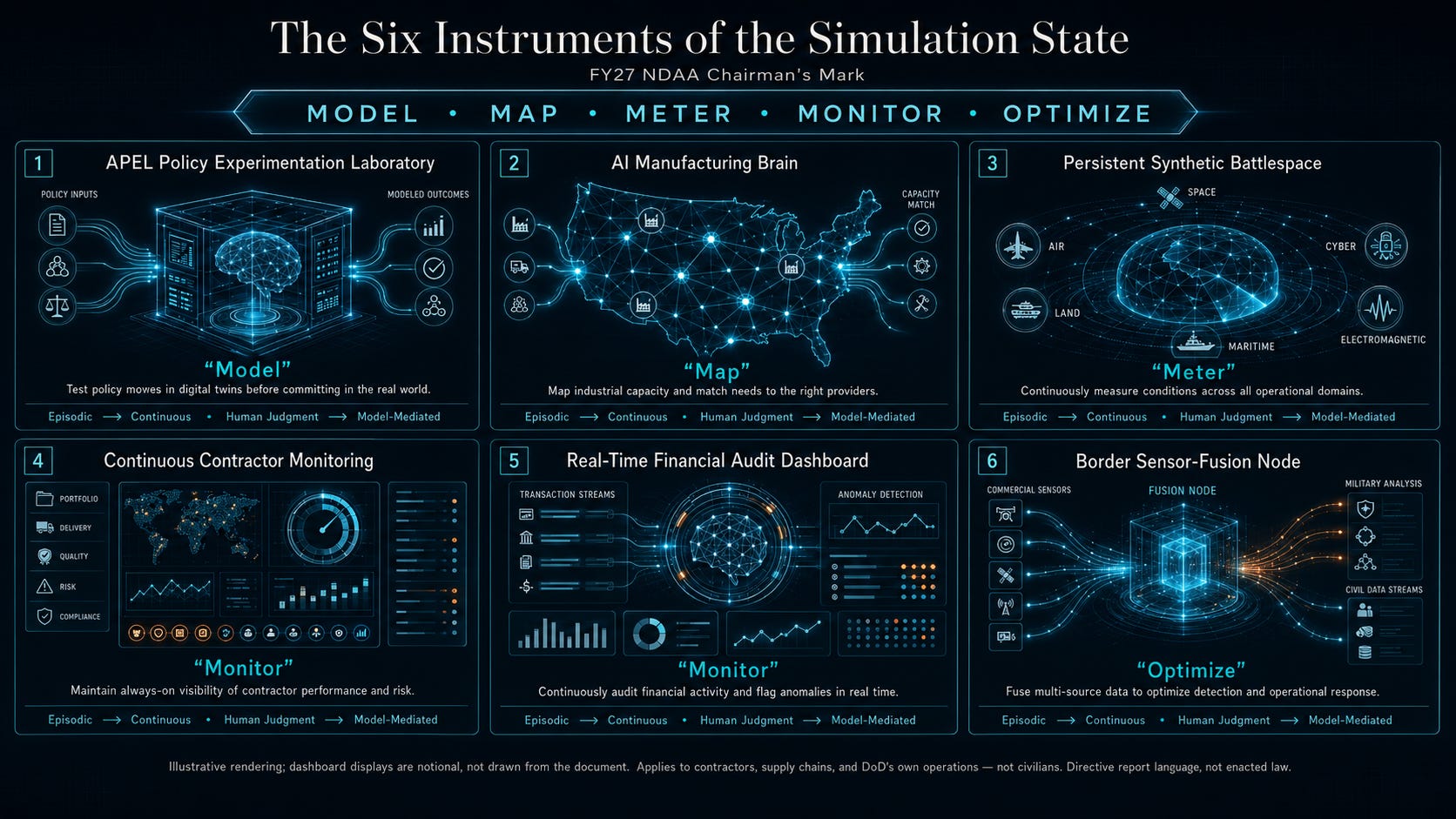
A government does not need to announce a sweeping control system to begin governing by model. First it models. Then it maps. Then it meters. Then it monitors. Then it calls the result readiness.
There is a particular kind of document that hides its most important sentences in the place no one is trained to look.
We are conditioned to read legislation for its dramatic provisions — the named program, the new agency, the explicit mandate. We scan for the title that says Artificial Intelligence in capital letters, the section that announces a digital identity scheme, the line that admits a central bank digital currency into law. When those headline provisions are absent, we exhale. We assume nothing happened.
That instinct is precisely the blind spot the officials who run the modern administrative state have learned to exploit.
The FY27 National Defense Authorization Act Chairman’s Mark — a 505-page markup document, not yet enacted law — contains no sweeping AI title.1 It announces no civilian digital ID. It creates no social-credit program. If you went looking for a smoking gun, you would close the file relieved.
You would also have missed the architecture.
Because the most revealing language in this document is not in its statutory text at all. It is in the directive report language — the “Items of Special Interest,” the committee’s instructions to the Department of Defense to study, brief, model, and assess. This is the connective tissue of governance, the place where intent is recorded before it hardens into program. It is non-binding. It directs briefings, not budgets. And it is, for exactly that reason, where you can watch an institution think out loud about what it intends to become.
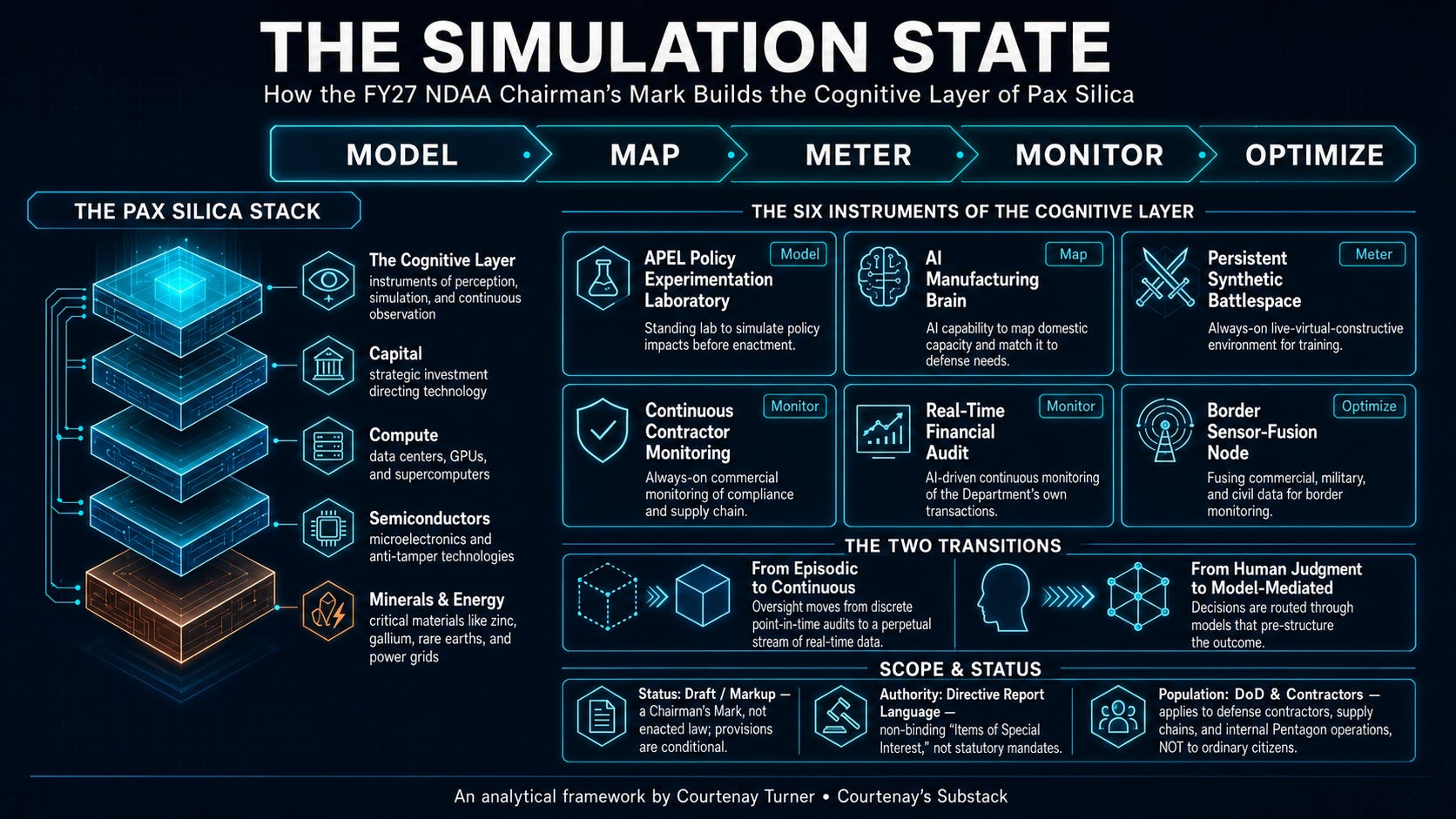
Read that language carefully, and a coherent method emerges across a dozen scattered provisions. Not a single master program. A method. The committee asks the Pentagon to build a laboratory that can model and simulate industrial-base policy before enacting it. It directs the development of an artificial-intelligence capability to map the nation’s manufacturing base and match its capacity to defense needs. It funds a persistent synthetic environment that runs continuously across every operational domain. It encourages a shift from “point-in-time” audits to continuous monitoring of contractors, run by commercial vendors. It asks for real-time AI auditing of the Department’s own financial transactions. It points toward fusion centers that integrate commercial sensor data along the borders.
Model. Map. Meter. Monitor. Optimize.
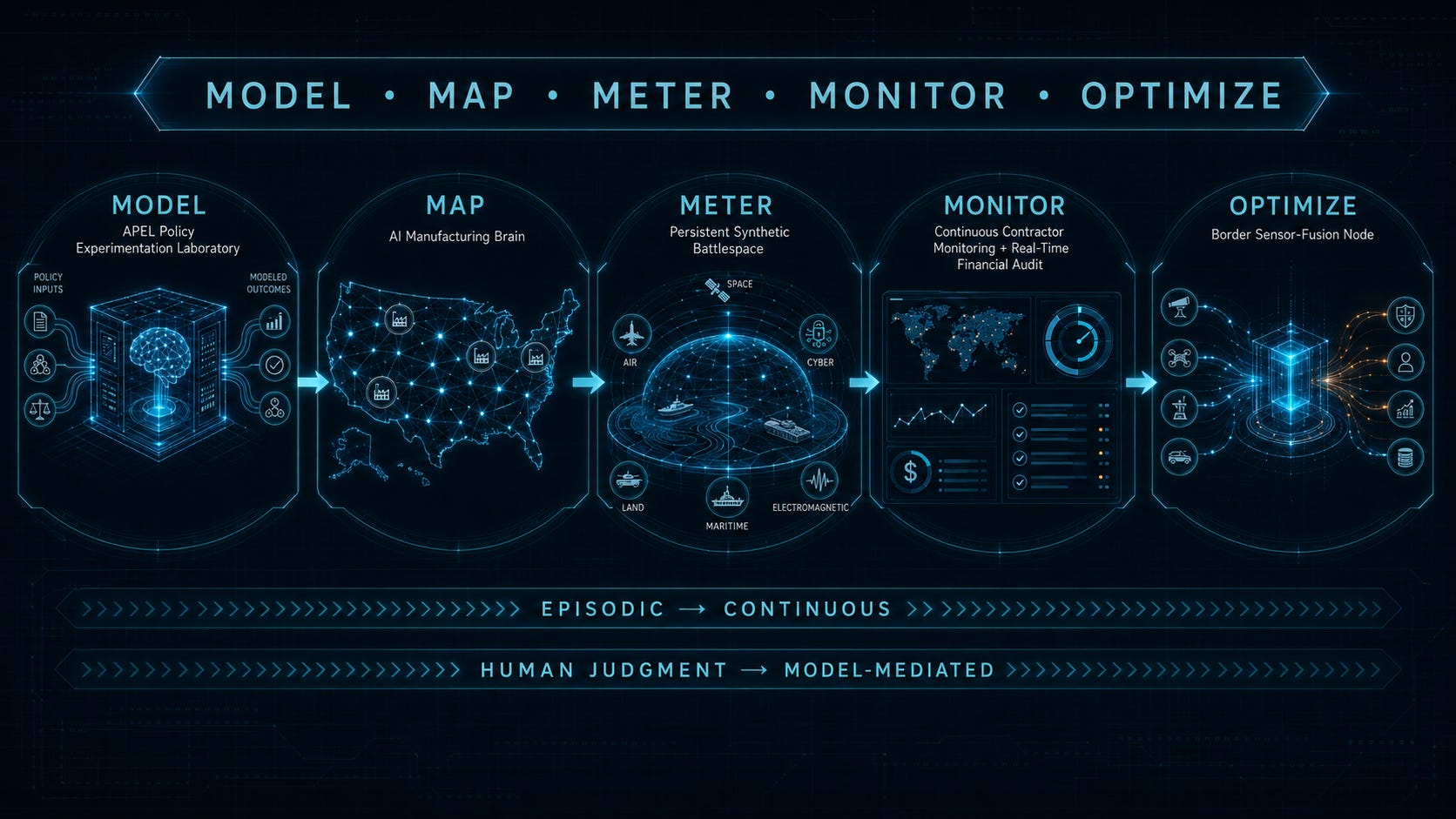
This is the cognitive layer of an architecture I have been tracing across this body of work — the layer that sits atop the minerals, compute, capital, and procurement floors of the architecture the State Department calls Pax Silica — the framework I traced in May.
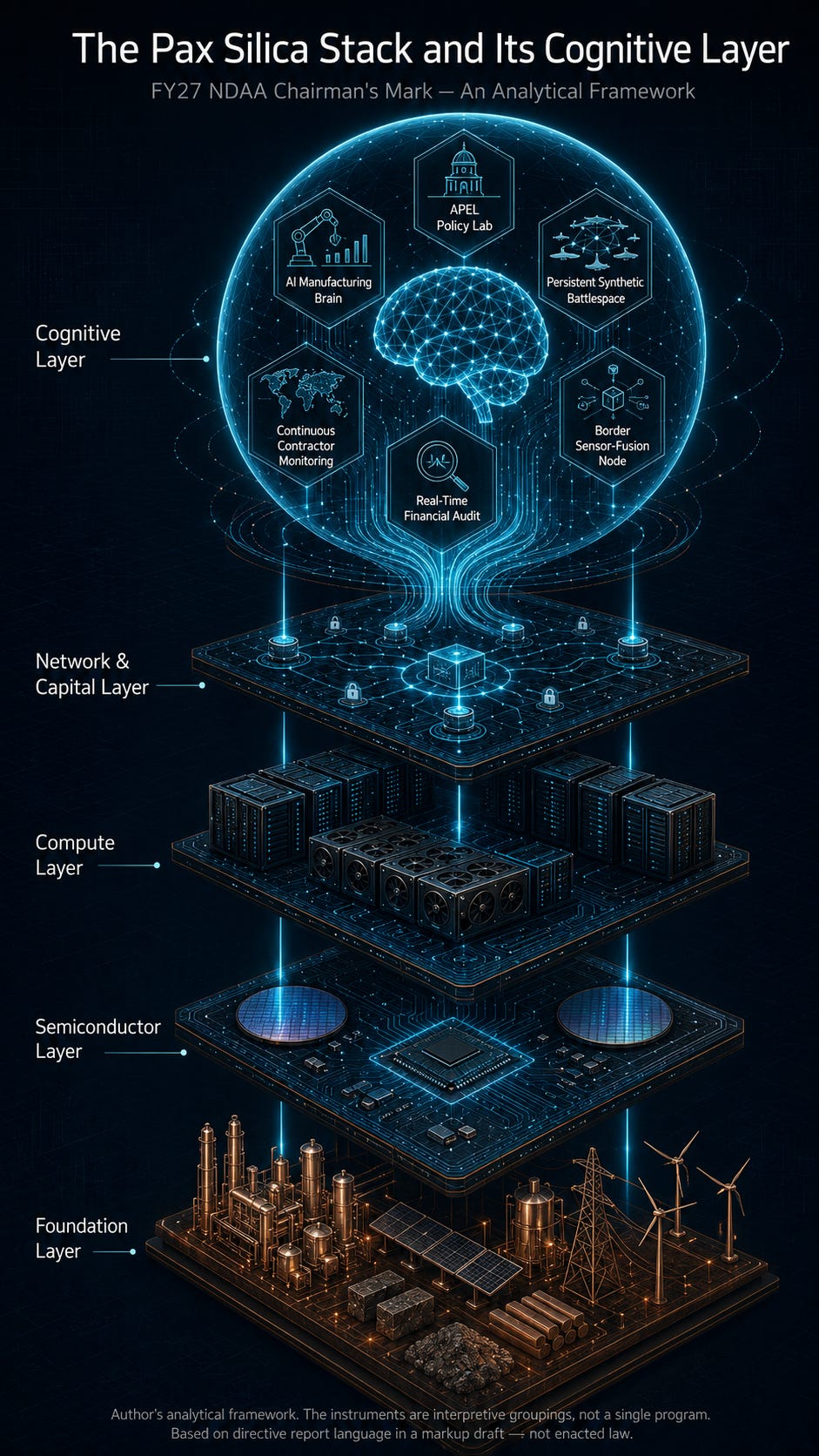
A word on that term, for readers encountering it here for the first time. Pax Silica is the name the State Department gave to the emerging U.S.-led effort to reorganize global order around the physical and computational stack of the artificial-intelligence age: critical minerals, semiconductors, energy, data centers, logistics corridors, payment rails, and “trusted” capital and allies.2 The twentieth-century order ran on oil, steel, sea lanes, and central banks. The order now being assembled runs on compute — and because compute is physical, the contest over artificial intelligence is also a contest over minerals, factories, ports, and the institutions that govern them. Think of it as a stack: minerals and energy at the foundation, semiconductors and compute above them, networks and capital at the apex. Pax Silica named that stack. The FY27 NDAA Chairman’s Mark, read in its quietest passages, shows the stack acquiring something new — the instruments by which it intends to perceive, simulate, and continuously observe the system it governs.
Let me be precise about what this is and is not, because precision is the entire argument.
This is not a civilian surveillance system. It is not enacted law. It is not proof of a single coordinated plan. Most of what follows applies to contractors, supply chains, the defense industrial base, and the Department’s own internal operations — not to ordinary citizens. I will hold that line scrupulously throughout, because the argument does not need exaggeration to be serious. The significance here is not any one provision. It is the logic that runs across them — a logic in which judgment is steadily routed through models, dashboards, and continuous-monitoring systems, and the result is rebranded as readiness.
That logic is worth seeing whole.
The Boring Place Where the Future Is Built
First, why this document, and why this layer of it.
The annual NDAA is the one bill Congress reliably passes. It is must-pass, omnibus, and enormous — which makes it the natural carrier for provisions that would never survive standalone scrutiny. But even within the NDAA, there is a hierarchy of attention. The statutory text gets read. The funding tables get mined by defense reporters for procurement winners and losers. The directive report language — hundreds of pages of “the committee notes,” “the committee believes,” “the committee directs the Secretary to provide a briefing” — is read by almost no one outside the contractors and program offices it concerns.3
This is not law. A directive item cannot, by itself, establish a program or obligate a dollar. What it does is signal — it records what the Armed Services Committee wants the Department to pursue, study, and report back on, and it sets the agenda for the programs that follow. In the grammar of the administrative state, report language is where the committee works policy out before anyone votes on it. By the time something reaches statutory text, the thinking has already happened here.
So when I say the FY27 Chairman’s Mark “builds” a cognitive layer, I am using the word carefully. It does not build it in the sense of appropriating it into existence. It builds it in the sense that matters earlier and more durably: it commissions the thinking, names the instruments, designates the offices, and sets the briefing deadlines. It is the blueprint stage, written in the institution’s own hand.
And it is a Chairman’s Mark — one chamber’s opening draft. Provisions will change. Some will vanish. I will write in the conditional throughout, because that is what the evidence supports.
With that established, walk the layers.
The Policy Lab That Models the Industrial Base Before Acting On It
Begin with the item that most repays a close reading — and the one almost certain to go uncovered in the press.
Buried in Title XVIII — “Revitalization of the Defense Industrial Base” — is a directive titled, in full: “An Enduring Acquisition Policy Experimentation Laboratory to Model, Simulate, and Analyze the Impact of Acquisition and Industrial Base Policies.”4
The committee directs the Under Secretary of Defense for Acquisition and Sustainment, working through the Acquisition Innovation Research Center, to develop “an initial but enduring Acquisition Policy Experimentation Laboratory (APEL)” by January 15, 2027.5 APEL’s purpose is to “model, simulate, and analyze proposed acquisition policy options” — to test policy in a synthetic environment before applying it to the real industrial base.
Read the committee’s own description of what this laboratory would weigh. Policy test labs, it writes, “can model, simulate, and analyze proposed acquisition and sustainment policies in a multi-domain environment to include consideration of financial implications, market reactions, supply chain availability, technological capabilities, and effects on national security.“6
Sit with that phrase: market reactions.
What is being described — in the committee’s own words, not my interpretation — is a digital-twin-like policy simulation lab for the defense industrial base. A standing computational environment in which a contemplated policy can be run against a model of how the industrial base, its contractors, its supply chains, and the relevant markets will respond, and the projected national-security consequences read off before the policy is ever enacted. The committee notes that such “policy test labs have been developed over the past decade” in “medical care infrastructure, transportation, higher education, and the defense budget.”7 In other words, this is not a novel method invented for defense. It is a general-purpose technique of governance — modeling a domain and the responses of the actors within it — migrating into the industrial-base context, and being made, in the committee’s chosen word, enduring.
I want to be exact about the boundary here, because this is precisely the kind of provision that invites overreach. APEL does not model the U.S. economy. It does not model citizens. It models the defense industrial base — its contractors, supply chains, and the market behavior of those firms — and the effects of acquisition policy upon them. Anyone who stretches it further is describing something the text does not support, and weakening the real point in the process.
Because the careful version is the more unsettling one. What APEL represents is the institutionalization of a particular epistemology of power — the premise, visible in the committee’s own description, that the right way to govern a complex domain is to build a model of it, simulate interventions inside the model, and let the simulation guide the decision. This is the logic of the digital twin, which I have traced before in the context of smart cities — the virtual replica that lets planners “simulate, analyze, and test different scenarios” before acting on the physical world.8 There, the twin was a city. Here, the twin is the productive sinew of the defense state. The method is identical. Only the referent has changed.
This is the technocratic premise in its purest form — the premise the original Technocracy movement stated outright in 1937, that society could be run “as a scientific, technical engineering problem,” with “no place for Politics or Politicians.”9 A policy laboratory that models market reactions to acquisition rules is that premise rendered in software: it relocates the act of political judgment — should we do this? — into an optimization run inside a simulation. The model does not decide. But it frames what is decidable, and it does so before any accountable person enters the room.
That is the first instrument of the simulation state: a machine for governing a domain by modeling it.
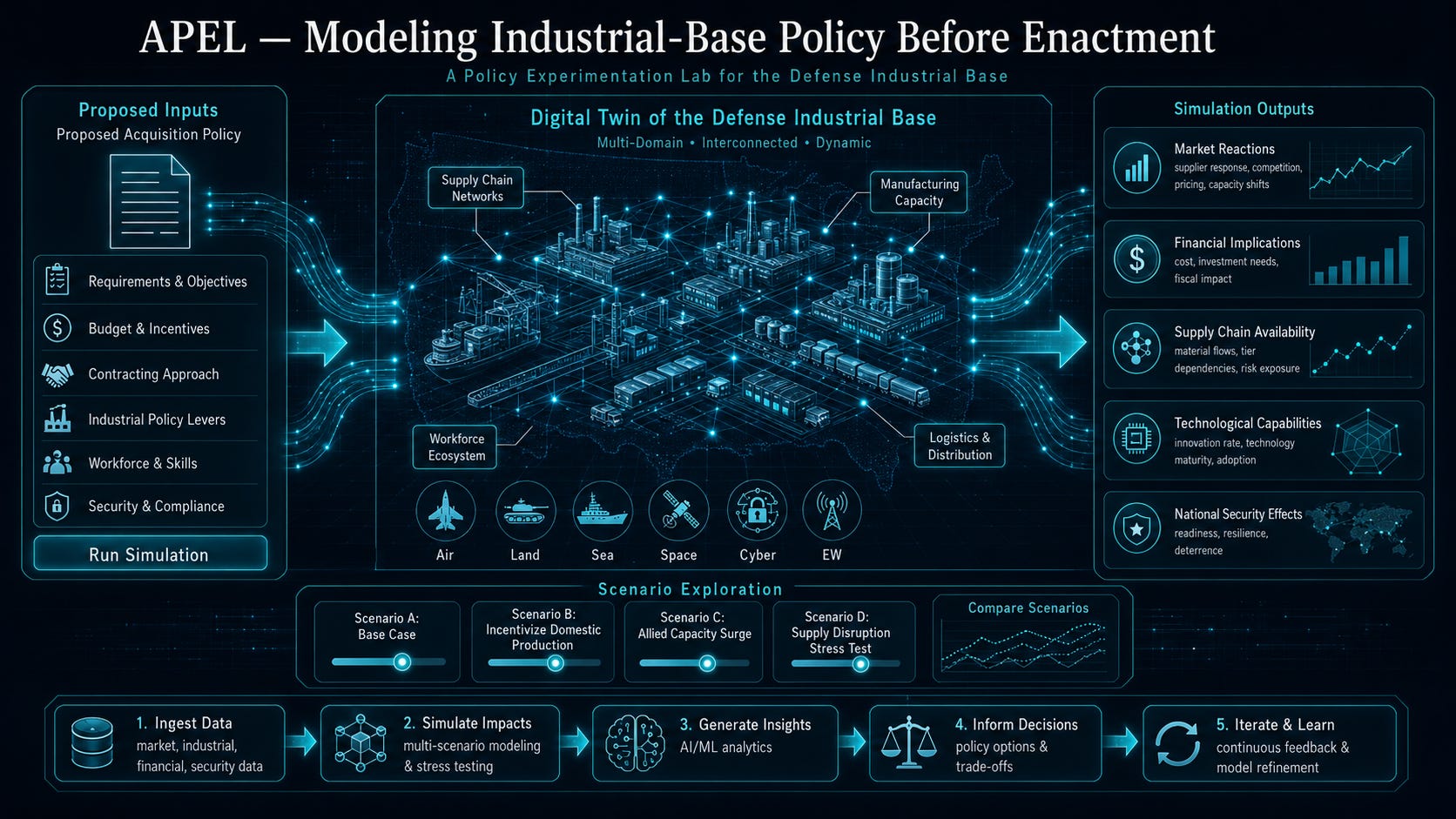
A policy laboratory that models market reactions before a rule is enacted does not abolish judgment. It preprocesses it. The deliberation happens inside the model, before any accountable human enters the room.
The AI Manufacturing Brain
If APEL is the instrument for simulating policy, the next provision is the instrument for perceiving the industrial base itself — for turning the sprawling, opaque universe of American defense manufacturers into something legible to an algorithm.
A few pages later in the same title, the committee addresses what it calls “Defense Industrial Base AI-Enabled Risk Response and Manufacturing Readiness.”10 Building on a provision of the FY26 NDAA, it directs the Under Secretary of Defense for Acquisition and Sustainment — explicitly “in coordination with the Chief Digital and Artificial Intelligence Officer“ — to brief Congress on the Department’s efforts to “establish and execute an AI-enabled manufacturing risk response capability.”11
The operative language is the fourth item the committee wants assessed. It asks for an evaluation of “existing AI-enabled platforms capable of assisting the Department’s manufacturing risk response capability by mapping domestic manufacturing capacity, interpreting technical data packages and part schematics, and matching identified capability and capacity with Department needs.“12 It pairs this with a request to assess “commercially available digital marketplace platforms” that improve “discoverability of and access to U.S.-manufactured products.”13
Read it slowly and the ambition is plain. This is an AI system that would map the domestic manufacturing base, read and interpret the engineering data and part schematics that describe what each facility can produce, and algorithmically match that mapped capacity against the Department’s needs. It is a cognitive layer over the physical economy of production — over the manufacturing base the defense state depends upon — routed through the office, the CDAO, that sits at the center of the Pentagon’s entire artificial-intelligence enterprise.
I have written before about AI.gov and the “AI-first government” — the migration of administrative function toward algorithmic determination, the stated aim of replacing “human judgment with algorithmic determination” by removing “the messy unpredictability of human decision-making.”14 That was the administrative state’s interior. This is its industrial exterior: the same approach, turned from federal employees to the manufacturing base, mapped and matched by machine.
Again, the careful version. The committee directs a briefing — an assessment of existing platforms — not the immediate construction of a finished system. This is the inquiry stage. But notice what the inquiry treats as desirable: that the right way to manage the industrial base is to render it machine-legible, interpret its technical substance algorithmically, and match supply to demand through a “digital marketplace platform.” The assumption is the destination. The briefing is the committee asking how far down that road the Department already is.
And here the connection to APEL becomes structural rather than thematic. One instrument simulates policy against a model of the industrial base; the other perceives the actual industrial base and renders it legible to AI. A simulation is only as good as the data it runs on. A mapping capability is exactly the kind of apparatus that would, over time, feed a simulation lab the live picture it needs to be more than a sketch. The committee doesn't wire these two together, and I won't pretend it does. But they are complementary halves of a single epistemology — model the system, and make the system legible to the model — set down in the same title of the same document.
That is the second instrument: a means of seeing the productive base as data.
The Synthetic Battlespace
The third instrument is the one with a price tag, and it is the largest.
In the research-and-development title, Section 217 directs the Secretary of Defense to establish, within 180 days, “a persistent, secure, all-domain, live-virtual-constructive synthetic training environment“ to support operations in the Indo-Pacific.15 The requirements are expansive: it must “provide integrated synthetic training and mission rehearsal capabilities across all warfighting domains, including land, maritime, air, space, cyberspace, and the electromagnetic spectrum,” be “scalable to support additional combatant command requirements,” and be “accessible to allies and partners.”16
Unlike the directive items, this one is funded and named. In the research-and-development tables, the line element “Synthetic Training Environment Refinement & Prototyping” is authorized at $219.137 million — an authorization, not yet an appropriation, but a figure that tells you this is a program at scale, not a study.17
Now, the essential caveat, stated without hedging: this is a military training and mission-rehearsal environment. It does not surveil civilians. It is a simulation in which forces train and rehearse operations. To suggest otherwise would be false, and I am not suggesting it.
What is worth seeing is the word the committee chose and the architecture it implies. “Persistent.” Not a scenario you load, run, and shut down. A synthetic environment that runs continuously, integrates “live, virtual, and constructive” elements — meaning real forces, simulated forces, and computer-generated forces sharing one continuous model — across every domain of operation at once, built to scale beyond its initial command and to be opened to allied militaries.
This is the digital-twin logic again, now in its native habitat. A persistent, all-domain synthetic environment is a continuously running model of the operating world. It is the document’s most literal version of the premise that runs through this article: that the appropriate substrate for action is a model that is always on. The military builds the always-on synthetic environment first, because that is where the operational case is strongest and the institutional resistance is lowest. But once institutions grow used to operating through a persistent simulation, that habit rarely stays quarantined in the domain where it began. It becomes the default mental model of how serious people perceive and act. You build the twin for the battlespace because you can. You inherit the assumption that the twin is how reality should be apprehended.
Three instruments now, and a pattern: a lab that simulates policy, an AI that maps production, and a synthetic environment that runs the operational world as a persistent model. Simulation is not a feature of this document. It is the connective tissue.
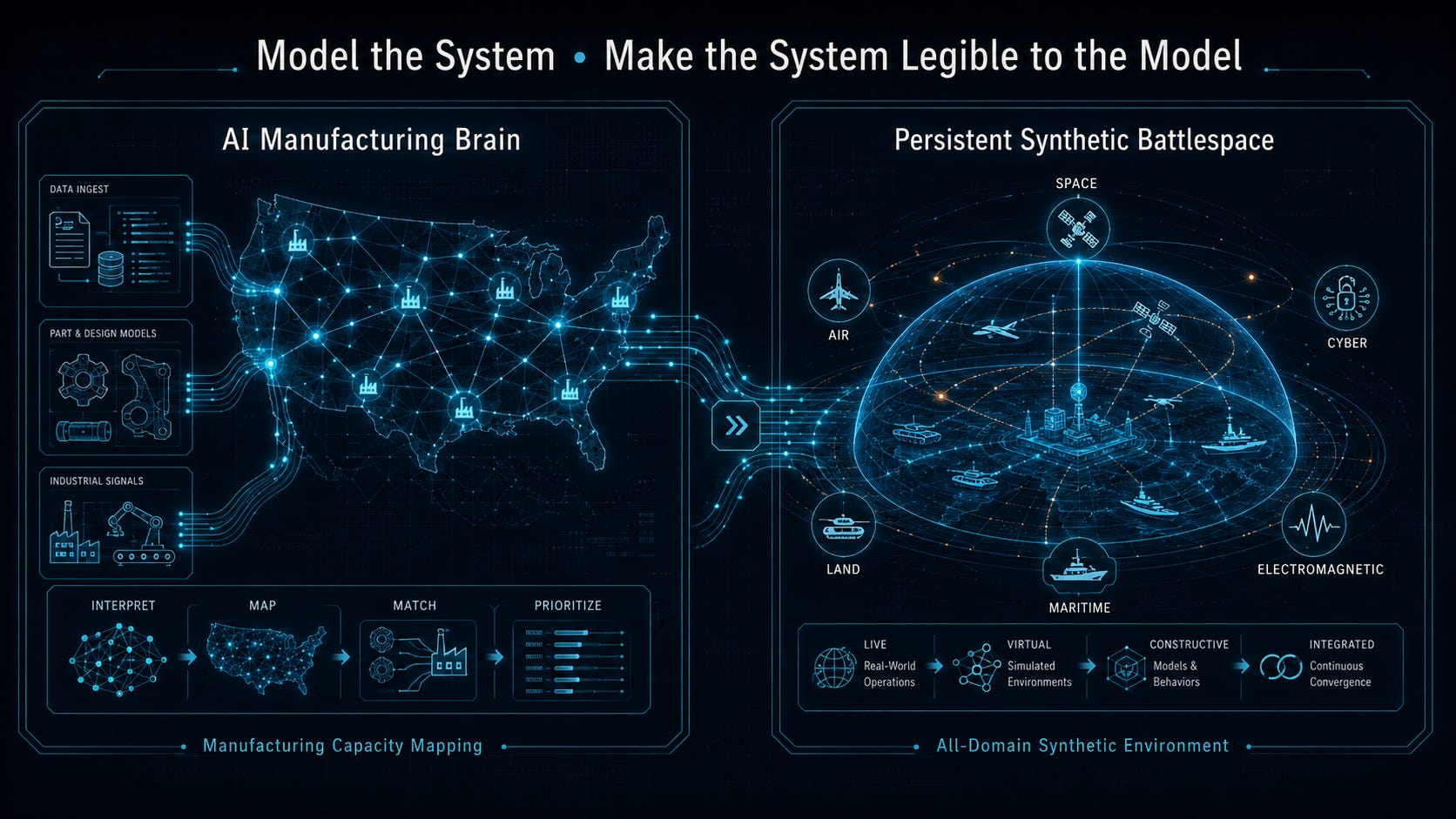
Simulation is not a feature of this document. It is the connective tissue. A lab that models policy, an AI that maps production, a synthetic environment always running — the same epistemology, three times.
From Point-in-Time to Always-On
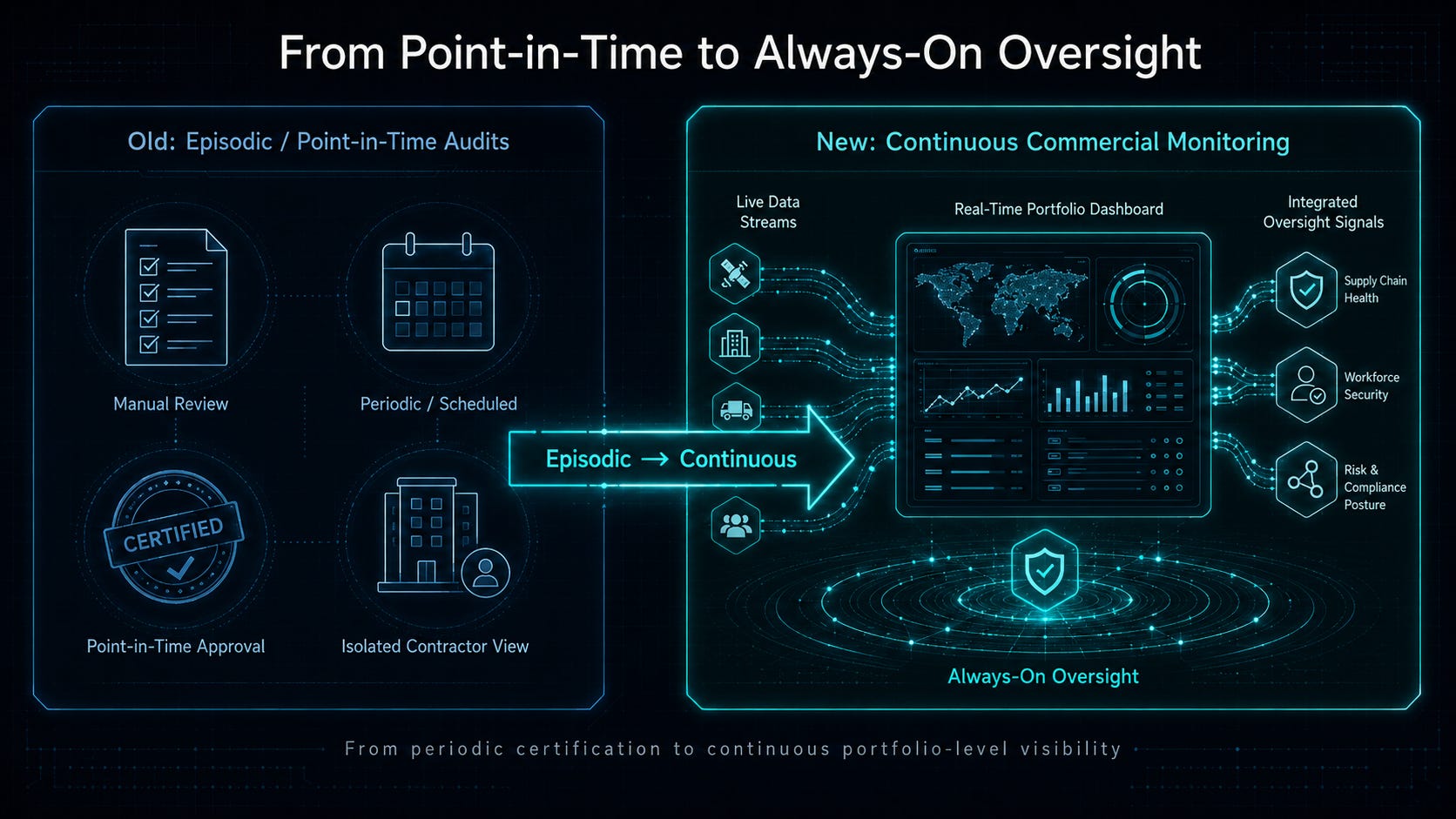
If the first three instruments are about modeling and perceiving, the next two are about observation over time — and here the architecture shifts from simulation to monitoring, in a precise and limited sense: the continuous observation of a defined population. That population is contractors and the defense industrial base. Hold that boundary firmly. It is what keeps the analysis honest, and it is what makes the analysis durable.
Return to Title XVIII, to a directive titled “Expanding the Defense Industrial Base through Balanced Compliance.”18 On its face it is a deregulatory item — the committee worries that “compliance burdens are a significant barrier to entry” that push small contractors out of the defense base. A reasonable concern. But read how the committee proposes to resolve the tension between lighter burden and continued oversight.
The committee “notes that many compliance frameworks rely on episodic audits and point-in-time certifications that do not provide continuous insight into contractor readiness or supply chain risk.“ It then “encourages the Department to evaluate the use of qualified and trusted third-party commercial solutions to support continuous assessment and monitoring of contractor compliance, improve portfolio-level visibility into supply chain health, and enable more efficient attainment and maintenance of cybersecurity, workforce security, and cloud accreditation requirements.“19
This sentence carries real weight, and almost no one will read it.
What it describes is a structural transition in the nature of oversight itself: from the discrete to the continuous. The old model is the audit — a check performed at a point in time, after which the contractor is certified and left alone until the next cycle. The proposed model is continuous assessment and monitoring — an always-on stream of insight into contractor readiness, supply-chain health, cybersecurity posture, “workforce security,” and cloud compliance, delivered through “portfolio-level visibility.” And the committee specifies who would run it: “qualified and trusted third-party commercial solutions.”
I have spent a great deal of this body of work on what I call compliance-as-surveillance — the moment when a system stops checking you at a gate and starts watching you continuously, so that participation becomes contingent on an unbroken stream of acceptable signals rather than a discrete pass or fail.20 In “The Tokenization Chokepoint,” I described the financial version: an institutional architecture rebuilt around “programmable compliance,” “near-real-time surveillance,” and “compliance-aware protocols,” where control surfaces concentrate in institutions the public neither elected nor effectively oversees.21 The mechanism here is the same control-surface logic, transposed from the financial account to the contractor: continuous monitoring, portfolio-level visibility, commercial intermediaries running the watch.
Let me state the claim at exactly the strength the evidence supports, and no further. The committee is encouraging a shift, for defense contractors and supply chains, from point-in-time certification to continuous commercial monitoring. This does not extend to ordinary citizens. On the text, it reaches only the firms and supply chains that choose to do business with the Department. What I am identifying is narrower and sturdier than any claim about the general public: that the architecture of continuous, commercially-operated monitoring is being advanced as the superior form of oversight within the defense base — and that an architecture, once it becomes the default for one population, tends to be reached for again. The phrase “workforce security” is worth noting precisely because it sits adjacent to the existing apparatus of continuous personnel vetting; I am not asserting that it expands that apparatus, only that it lives beside it, and that the documented direction of travel is from the periodic to the perpetual.
That is the fourth instrument: the conversion of oversight from a gate you pass into a stream you emit.
Real-Time Audit as Continuous Financial Visibility
The fifth instrument is the financial counterpart to the fourth, and it follows the identical pattern: discrete becomes continuous, periodic becomes real-time, human review becomes algorithmic.
In Title X — General Provisions — the committee offers a directive titled “Technological Capabilities to Improve Financial Management and Auditability.”22 It “recognizes the Department of Defense’s growing adoption of advanced software and artificial intelligence (AI) capabilities” and asserts that “modern software platforms with AI-enabled analytics can process vast quantities of transactional data, identify anomalies, track assets in real-time, and provide continuous financial visibility.“ Its conclusion is stated as fact: “A real-time audit capability represents a fundamental improvement over current periodic audit methodologies.”23
The committee then directs the Secretary to brief Congress on “plans to implement real-time audit capabilities using software and artificial intelligence,” including platforms that could “provide continuous financial monitoring,” a roadmap “that would enable continuous transaction validation, asset tracking, and financial reconciliation rather than relying solely on annual audit cycles,” and the integration of “disparate financial systems across the Department of Defense into unified platforms capable of providing enterprise-wide financial visibility.”24
Strip the bureaucratic register and the design is a continuous, AI-driven, anomaly-detecting monitoring of the transactions flowing through the Department of Defense — consolidated onto “unified platforms” that provide a single enterprise-wide field of financial visibility.
The necessary caveat is absolute: this is the Department’s own money. It audits DoD’s transactions, tracks DoD’s assets, reconciles DoD’s books. It is not a central bank digital currency. It is not civilian financial surveillance. It is, in plain terms, the Pentagon attempting at last to pass an audit it has never passed — a goal with broad bipartisan support.
And yet the architecture is the thing. What is being normalized — again — is the continuous over the periodic, the real-time over the annual, the anomaly-detecting algorithm over the human auditor, and the unified platform over the disparate systems it replaces. This is the same shape as the contractor-monitoring provision, and the same shape as the financial-rails architecture I documented in the tokenization work, where transactions become continuously legible, traceable, and — within that regulated system — controllable.25 The defense department is building, for its own books, the continuous-transaction-visibility model that the broader financial system is building elsewhere for other purposes. I am not collapsing the two into one program; they are distinct, and the distinction matters. I am observing that they rhyme — that the same epistemology of continuous, unified, algorithmic visibility is being instantiated in parallel, in the place where it is easiest to justify.
That is the fifth instrument: the replacement of the periodic audit with the permanent financial dashboard.
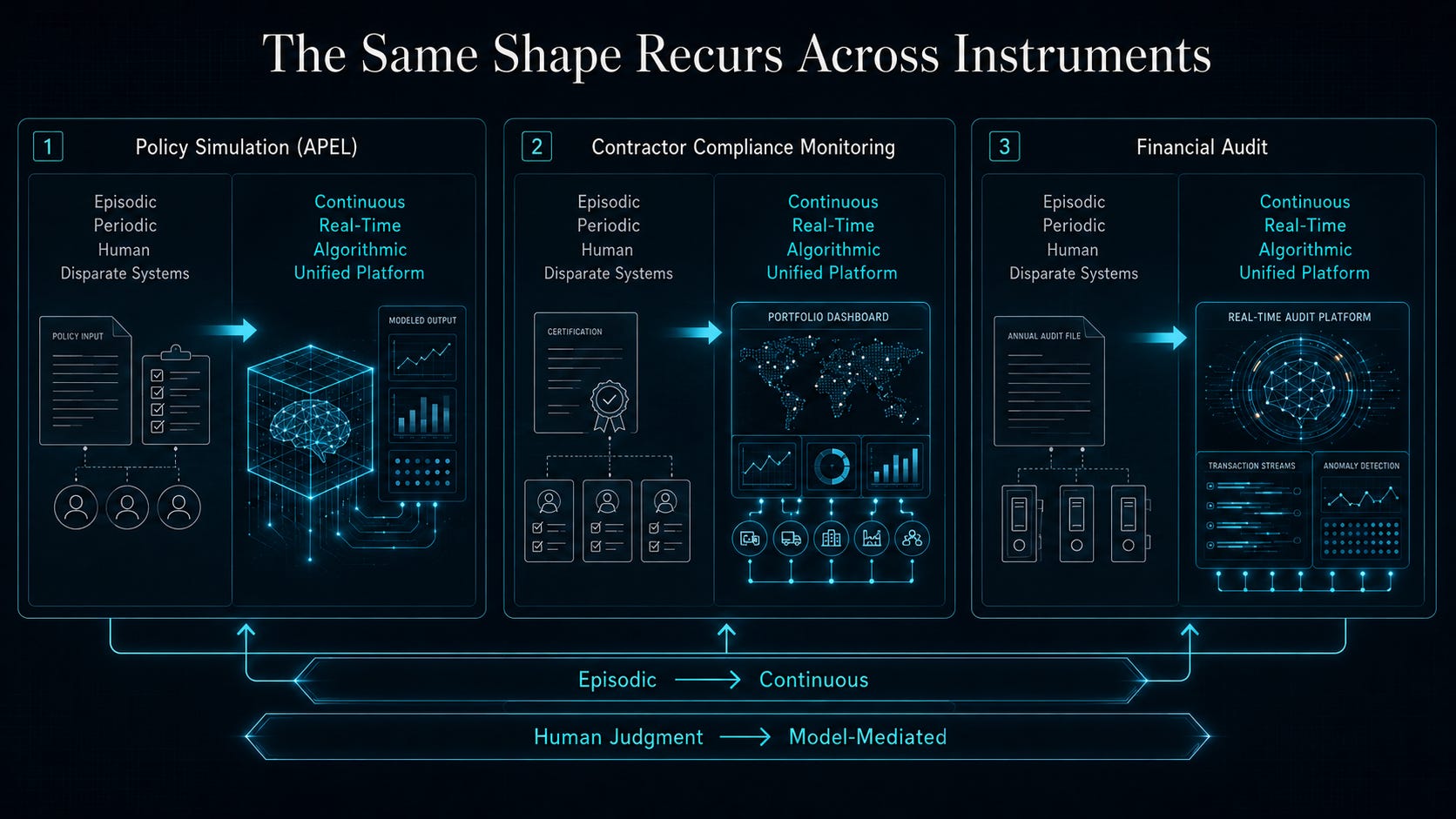
Continuous over periodic. Real-time over annual. Algorithm over auditor. Unified platform over the systems it replaces. The same shape recurs in compliance, in finance, in manufacturing — until the shape itself is the policy.
The Sensor-Fusion Frontier
The sixth instrument I will handle with the most restraint, because its setting is sensitive and the temptation to overread is greatest. I will keep it strictly to what the text establishes: an architecture of data fusion.
In Title X, two adjacent directives concern commercial remote sensing. The first encourages rapid fielding of drones and counter-drone systems against transnational criminal organizations near the southern border.26 The second — “Enhancing American Commercial Remote Sensing Support to U.S. Border Operations” — is the architecturally significant one.27
The committee directs U.S. Northern Command to report on how it incorporates commercial remote-sensing data into “analysis, force protection, and mission planning.” The report is to include information on “existing use of commercial remote sensing capabilities at U.S. military bases and Department-led fusion centers along the northern and southern borders,” gaps in “information sharing” and “interoperability with the Department of Homeland Security,” and “mechanisms to leverage Department of Homeland Security data holdings and analytic activities.“28
What this language establishes, factually, is a data-fusion architecture: Department-led fusion centers, positioned along the borders, drawing on commercially-sourced remote-sensing data and built to interoperate with DHS data holdings and analytic activities. Three streams — commercial sensing, military analysis, and civil-agency data — converge in one interoperable node.
I will state plainly what the text does not establish. It does not describe surveillance of American citizens; the stated objects are illicit trafficking routes, migration flows, and topographical change. I am drawing no inference beyond the page. My observation is purely structural, and it is the recurring concern of this body of work: fusion itself. Each component may be individually warranted. The architectural fact is the integration of them — commercial, military, and civil data merged into a single analytic picture — and infrastructure, once built, tends to outlast and exceed the rationale that justified it. That is an observation about how durable systems behave, not a claim about anyone’s intent.
That is the sixth instrument: the node where commercial sensing, military analysis, and civil data are fused.
The Physical Floor: Minerals, Microelectronics, and Strategic Capital
The simulation-and-monitoring layer does not float in air. It rests on a physical foundation — and the FY27 Chairman’s Mark funds and restructures that foundation in ways that map directly onto the Pax Silica stack.
Section 1801 comprehensively restructures the sourcing rules for critical materials, establishing a “tiered framework” of sourcing restrictions, creating “preferred status for contractors that manufacture covered materials in the United States,” providing for “expedited qualification of new domestic and allied-nation sources,” and adding “niobium oxides, metals, and alloys” to the list of covered materials.29 The structure is the trusted-bloc logic of Pax Silica written into procurement law: domestic and allied-nation sources favored, adversary sources tiered out.
The directive language makes the geopolitical frame explicit. In an item on “Practical Application of Authorities Related to Certain Critical Minerals,” the committee — citing “China’s current ban and restrictions on exports of critical minerals” — urges the Secretary to secure heavy rare earth elements, “particularly samarium,” noting pointedly that “availability of the material from an allied nation“ would justify a sourcing waiver.30 This is the minerals floor of the stack, named at the level of the individual element, with the trusted-country sourcing principle stated outright.
Above the minerals sit microelectronics and capital. The funding tables carry earmarks for “Harsh Environment Microelectronics Innovation” and “Secure Microelectronics for Anti-Tamper and Resilient Technology.”31 And the procurement tables fund the Office of Strategic Capital Loan Program at $216 million — a vehicle through which the Department functions as a capital allocator into the technology and industrial base, the “trusted capital” layer of Pax Silica rendered as a line item.32
Minerals at the foundation. Microelectronics above them. Strategic capital directing the flow. This is precisely the layered architecture I diagrammed in “Pax Silica” — the physical and financial floors on which the compute and cognitive layers stand.33 The NDAA does not merely gesture at that architecture. It funds and codifies its base.
Allied Tech Fusion
One provision ties the physical floor to the cognitive layer and to the allied-bloc logic all at once — and it does so in language that reads almost like a table of contents for the entire stack.
Section 224 establishes a “United States–Israel Defense Technology Cooperation Initiative,” directing the Secretary to designate an executive agent to “synchronize” bilateral defense-technology cooperation.34 I will keep this strictly to its governance architecture, which is where its significance for this analysis lies; the geopolitics are beside the present point. The bilateral relationship is what draws the eye — but it is the governance form, not the partner, that matters here.
What matters here is the list of domains the initiative is built to fuse, and the kinds of institutions it is built to fuse them across. The cooperative domains include “Artificial intelligence, quantum, machine learning, and autonomous systems”; “Cyber defense, electronic warfare, and digital resilience”; “Biotechnology, biomanufacturing, and medical defense”; and “Network integration, data fusion, and contested logistics.“35 The initiative is to operate, in the text’s own words, through “collaborative research initiatives involving government, private sector, and academic institutions.“36 And the Department is directed to maintain a “publicly accessible website” reporting how these efforts “contribute to United States technological and military supremacy.“37
Set aside the bilateral specifics and look at the structure. The domain list — AI, quantum, autonomy, cyber, biotech, data fusion — is a near-complete enumeration of the technology layers of the stack. The institutional form — a permanent executive agent fusing government, private industry, and academia — is the public-private-academic merger that recurs throughout this body of work, the governance form in which the boundary between state, corporation, and university softens into a single coordinated apparatus.38 And the stated telos is “supremacy.”
This is what allied tech fusion looks like at the level of institutional design: a standing mechanism for integrating the technology stack across the state-corporate-academic boundary, with an allied partner, oriented toward dominance. It is the connective principle of the whole architecture — fusion across boundaries — expressed as a named initiative.
The Stack Has a Geography
Everything described so far is, in a sense, language — committee findings, directive paragraphs, program elements, briefing deadlines. It is easy to read an argument about policy architecture and file it under theory: interesting, perhaps overinterpreted, safely abstract.
But the stack is not abstract. The minerals, compute, energy, simulation, and capital layers the committee enumerates do not stay on the page. They become land, power, cooling, rare earths, factories, laboratories, supercomputers, and permitting fights. And several of those layers are being poured in concrete right now, in and around the region where I live.
Let me be exact about the claim, because it is narrow. The FY27 Chairman’s Mark does not create the projects below, and none of them is an NDAA program. What I am pointing to is something quieter and, I think, more telling: the same layers the committee names — minerals, compute, energy, simulation, capital, allied and public-private fusion — are simultaneously taking physical form in places like Clarksville, Oak Ridge, and Huntsville. The policy language and the geography are not identical. But they rhyme.
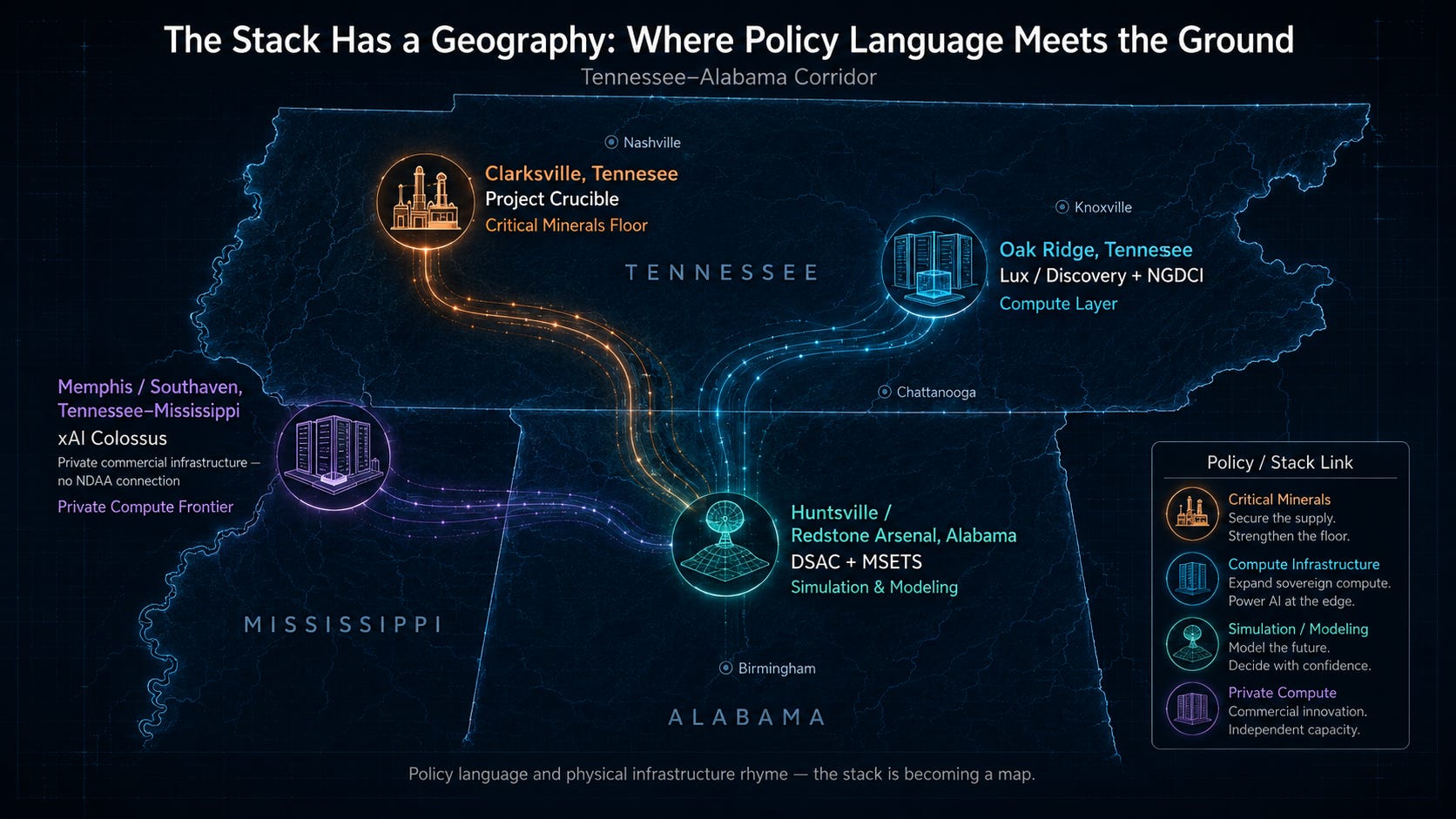
Start with the minerals floor. In April 2026, the federal Permitting Council granted FAST-41 covered-project status to Project Crucible, a proposed multibillion-dollar smelting and refinery complex in Clarksville, Tennessee — what would be the first large-scale U.S. zinc refinery built since the 1970s.39 Sponsored by a subsidiary of Korea Zinc, it is designed to produce twelve non-ferrous metals, including eleven of the sixty minerals the U.S. government designates as critical — zinc, antimony, gallium, germanium, and more — alongside semiconductor-grade sulfuric acid.40 One detail is worth pausing on: the federal press release identifies the lead federal permitting agency as the U.S. Department of War.41 This is the minerals-and-microelectronics-input floor of the stack — the exact layer Section 1801 of the Chairman’s Mark restructures, and whose directive language presses for sourcing heavy rare earths “from an allied nation” — appearing as a physical refinery, fast-tracked through a state-federal permitting agreement, with a defense department holding the pen.
Move up a layer, to compute. At Oak Ridge National Laboratory, the Department of Energy is deploying two new AI supercomputers — Lux in early 2026 and Discovery in 2028 — through a public-private partnership with AMD, HPE, and Oracle worth more than a billion dollars.42 ORNL describes the systems as designed to expand America’s leadership in artificial intelligence and high-performance computing, strengthen national security, and advance work in energy, advanced manufacturing, medicine, and cybersecurity.43 AMD, an industry partner, goes further, calling Lux “the first dedicated U.S. AI Factory for science” and casting both machines as “sovereign AI infrastructure” — language worth noting precisely because it comes from the vendor, not the government. In February 2026, ORNL launched a Next-Generation Data Centers Institute whose own description cites “digital twin infrastructure” used “to validate new technologies before industry adoption.”44 The compute layer, the public-private governance form, and the digital-twin method named throughout this article — all on one campus, in East Tennessee.
Move to the simulation layer, and cross into Alabama. At Redstone Arsenal in Huntsville, the Army’s Space and Missile Defense Command opened a Digital Simulation and Analytics Center in August 2025 — built, in the command’s own words, to host “the analytical and computational capabilities for modeling and simulation, analysis, and integration,” supporting modernization in missile defense, hypersonics, directed energy, and tactical space.45 Redstone is also home to the Army’s emerging Military Systems Electromagnetic Test Support facility, or MSETS, which the Army describes as its largest radio-frequency anechoic chamber when completed — built to test large military vehicles and aircraft systems in GPS-denied, electronic-warfare, RF cyber, and potentially distributed live-virtual-constructive environments.46This is the persistent-synthetic-environment logic of Section 217 — model first, rehearse in the synthetic, then act — rendered as government real estate sixty miles from my desk.
And the private compute frontier is here too, though I name it with a sharp distinction: xAI’s Colossus data centers in Memphis and across the Mississippi line in Southaven are private commercial infrastructure, with no governmental or NDAA connection whatsoever. I mention them only because they make one layer of the stack viscerally physical: a gigawatt-scale GPU build powered by gas turbines, now the subject of litigation alleging unpermitted gas-turbine emissions.47 Compute does not float in the cloud. It lands somewhere, draws power from somewhere, and someone downwind breathes the consequence.
None of this proves a plan. It proves a pattern — that when the policy language says minerals, compute, energy, and simulation, there are already coordinates where those words have become ground. The stack is not only an architecture. It is becoming a map.
What This Does Not Prove — and Why It Still Matters
I have been disciplined about the boundaries of this argument, and I want to gather those disciplines into one place, because the integrity of the analysis depends on them.
This Chairman’s Mark does not create a civilian surveillance system. The monitoring provisions concern contractors, supply chains, and the Department’s own books. The synthetic environment is for military training. The fusion centers process trafficking and migration data along the borders, not the lives of citizens. The financial audit watches the Pentagon’s money, not yours. And the Tennessee and Alabama projects are not NDAA programs; they are independent efforts that happen to instantiate the same layers.
It is not enacted law. It is one chamber’s opening markup. Provisions will move, change, and disappear.
The directive language is not binding. It directs briefings and assessments. It commissions thinking, not programs.
And it is not proof of a single master plan. I have drawn architectural connections — between APEL and the manufacturing brain, between the contractor-monitoring and the financial-audit provisions, between the whole and the Pax Silica stack, between the policy language and the regional geography — and I have labeled each as my interpretation, because that is what they are. The committee did not wire these instruments together in the text. I am arguing that they rhyme, and that the rhyme is the point.
So why does it matter, if so much is hedged?
Because the danger was never going to be a single provision with “tyranny” written on it. That is not how the administrative state moves, and it is not how technocratic governance installs itself. It installs itself as method — as the accumulating, unremarkable preference for modeling over deliberating, for continuous monitoring over periodic checking, for algorithmic matching over human judgment, for the unified platform over the disparate systems it replaces. Three transitions, running in parallel through this one document: from episodic oversight to continuous observation; from human judgment to model-mediated decision; from discrete institutions to integrated platforms. Each step is individually defensible. Each is sold as efficiency, readiness, resilience, accountability. And the cumulative effect, across a dozen quiet provisions, is the steady relocation of judgment out of accountable human hands and into models, dashboards, and commercial monitoring platforms.
That is the technocratic inversion I keep returning to, because it keeps returning. The 1937 Technocrats said it without embarrassment: run society “as a scientific, technical engineering problem,” with no place for politics.48 What the FY27 Chairman’s Mark shows is that the sentiment no longer needs to be spoken. It can be built instrument by instrument, in report language no one reads, and the result can be called readiness.
The significance is not the provision. It is the logic across the stack.
Conclusion: A Civilization Governed by Model
A civilization that governs by simulation does not need to abolish human judgment in a single stroke. It does not need a coup, a mandate, or an announced program. It can do something quieter and more durable. It can route judgment.
It can route the judgment of whether a policy is wise through a laboratory that models the industrial base’s reaction first. It can route the judgment of which manufacturer should make what through an AI that maps and matches capacity. It can route the judgment of whether a contractor is trustworthy through a continuous commercial monitoring stream instead of a human’s periodic assessment. It can route the judgment of whether its books are honest through a real-time anomaly-detecting platform. It can route the judgment of what is happening at the border through a fusion center that integrates commercial, military, and civil data into one picture.
At each step, a human being who once exercised judgment becomes, instead, the operator of a system that has pre-structured the judgment — and, over time, an input to it. The institution stops being a body of accountable people and becomes a model with a dashboard. Governance stops being deliberation and becomes the management of feedback loops.
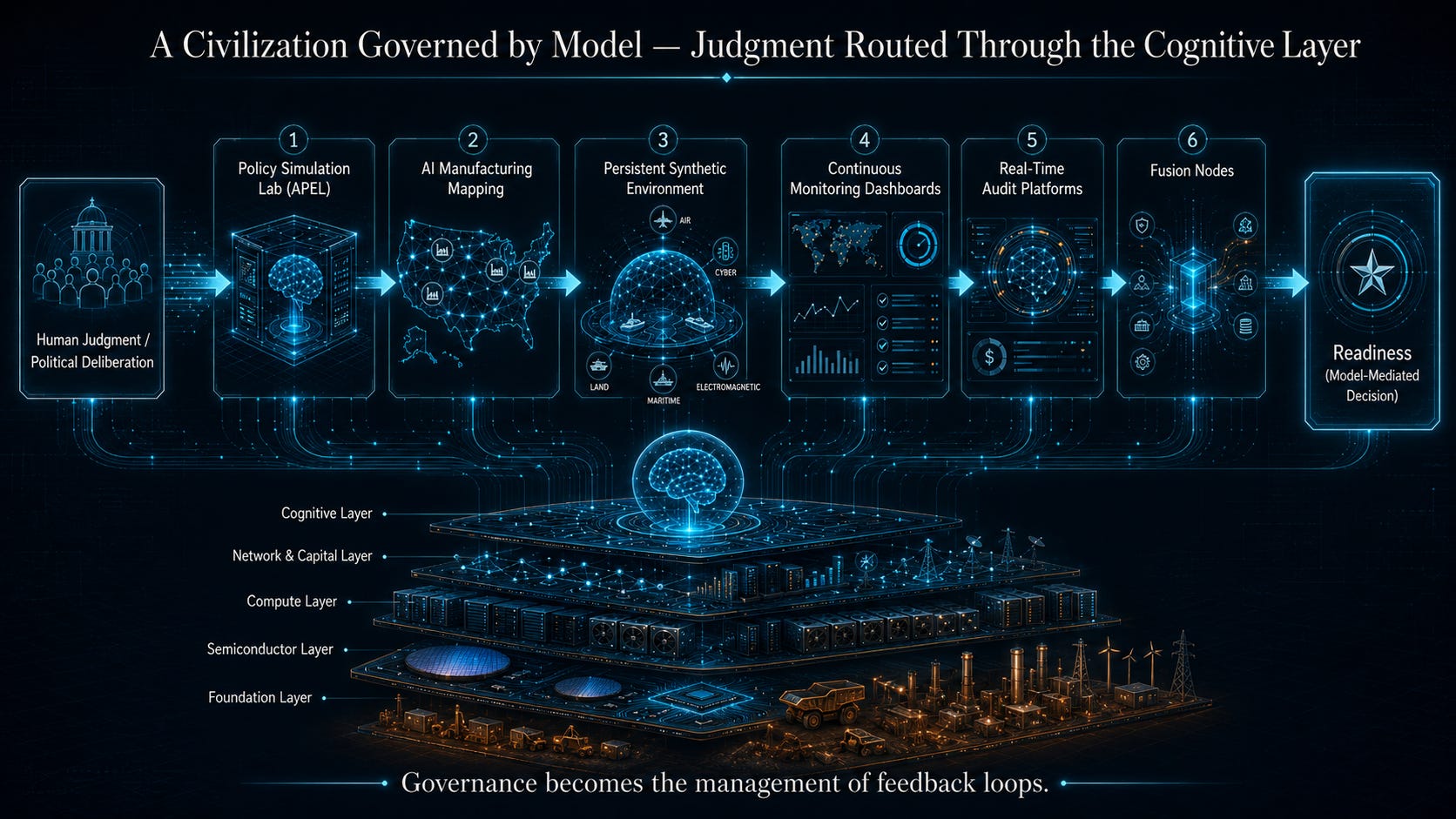
This is the cognitive layer of Pax Silica: not the minerals, not the chips, not the capital, but the means of perception — the simulation labs, the mapping AIs, the persistent synthetic environments, the continuous monitors, the real-time audits, the fusion nodes — by which the stack perceives the system, models it, and observes it without pause. And as the last section showed, that cognitive layer is not only drawn in policy language. It is acquiring an address — in Clarksville, in Oak Ridge, in Huntsville — while the blueprint that names it is still a draft.
The FY27 NDAA Chairman’s Mark does not announce this. It would not need to. It is enough to commission the instruments, designate the offices, set the briefing deadlines, and let the method accrete — model, map, meter, monitor, optimize — until one day the architecture is simply how things are done, and no one quite remembers deciding to build it.
We are not there. This is a draft, not a law; an architecture in commission, not a system in operation. Which is exactly why it is worth reading the boring pages now, while the blueprint is still legible and the instruments still have names.
Because a government does not need to announce a sweeping control system to begin governing by model.
First it models. Then it maps. Then it meters. Then it monitors.
Then it calls the result readiness.
This essay maps a single provision. The book maps the whole system.

Footnotes
FY27 National Defense Authorization Act, Chairman’s Mark, H.R. 8800 (505 pp.)(PDF). Document status: “CHAIRMAN’S MARK,” p. 1. House Armed Services Committee markup draft, not enacted law. ↩
Courtenay Turner, “Pax Silica: Who Owns the Rails of the AI Civilization?” (May 15, 2026), describing the U.S.-led AI and supply-chain framework organized around “compute, semiconductors, critical minerals, energy, data centers, logistics corridors, payment rails, and trusted capital,” and drawing on the State Department’s Pax Silica framing. ↩
FY27 NDAA Chairman’s Mark, “Directive Report Language,” p. 467 et seq.; “Items of Special Interest” subsections by title. ↩
Directive Report Language, Title XVIII, “An Enduring Acquisition Policy Experimentation Laboratory to Model, Simulate, and Analyze the Impact of Acquisition and Industrial Base Policies,” p. 492. ↩
Ibid. (”develop an initial but enduring Acquisition Policy Experimentation Laboratory (APEL) not later than January 15, 2027,” leveraging the Acquisition Innovation Research Center established under 10 U.S.C. § 4142). ↩
Ibid. (emphasis added). ↩
Ibid. (”a series of policy test labs have been developed…in medical care infrastructure, transportation, higher education, and the defense budget”). ↩
Courtenay Turner, “The Path to Mass Surveillance and Technological Singularity,” on digital twins as “virtual representations…to simulate, analyze, and test different scenarios.” ↩
Technocrat magazine (1937), quoted in Turner, “AI.gov: The Digital Leviathan”: technocracy as “the science of social engineering…done as a scientific, technical engineering problem. There will be no place for Politics or Politicians.” ↩
Directive Report Language, Title XVIII, “Defense Industrial Base AI-Enabled Risk Response and Manufacturing Readiness,” pp. 493–494. ↩
Ibid., p. 494 (”in coordination with the Chief Digital and Artificial Intelligence Officer…an AI-enabled manufacturing risk response capability”; building on § 1841 of the FY26 NDAA, Pub. L. 119-60). ↩
Ibid., p. 494, item (4) (emphasis added). ↩
Ibid., p. 494, item (3). ↩
Turner, “AI.gov: The Digital Leviathan Launching This Independence Day” (the chatbot assistant “designed to replace human judgment with algorithmic determination” by removing “the messy unpredictability of human decision-making”). ↩
FY27 NDAA Chairman’s Mark, Sec. 217, “Establishment of Synthetic Training Environment to Support Indo-Pacific Operations,” bill text pp. 38–41; summary p. 7. ↩
Ibid., Sec. 217(b) (requirements, including all-domain coverage, scalability, and allied access). ↩
Ibid., Division D funding tables, Sec. 4201 (RDT&E), line 088, “0604129A Synthetic Training Environment Refinement & Prototyping,” $219.137M (House Authorized), p. 421. An authorization, not an appropriation. ↩
Directive Report Language, Title XVIII, “Expanding the Defense Industrial Base through Balanced Compliance,” p. 495. ↩
Ibid. (emphasis added). ↩
Turner, “The Proof of Persona: Decoding Patent 060606,” and “Technocracy’s War on Free Speech,” on the shift from proof-of-work toward “proof-of-compliance” and continuous validation. ↩
Turner, “The Tokenization Chokepoint” (”programmable compliance,” “near-real-time surveillance, compliance-aware protocols,” control surfaces “concentrated in institutions that the public neither elected nor effectively oversees”). ↩
Directive Report Language, Title X, “Technological Capabilities to Improve Financial Management and Auditability,” p. 478. ↩
Ibid. (emphasis added). ↩
Ibid., items (1)–(3) (emphasis added). ↩
Turner, “The Tokenization of Everything” (digital dollars as “fully traceable tokens,” transactions that authorities can “trace, track, and freeze”). ↩
Directive Report Language, Title X, “Counter Small Uncrewed Aerial Systems at the Southern Border,” pp. 477–478. ↩
Directive Report Language, Title X, “Enhancing American Commercial Remote Sensing Support to U.S. Border Operations,” pp. 477–478. ↩
Ibid., p. 478, items (1) and (3) (emphasis added). ↩
FY27 NDAA Chairman’s Mark, Sec. 1801, “Critical Materials: Tiered Sourcing Restrictions and Requirements,” summary p. 23. ↩
Directive Report Language, Title XVIII, “Practical Application of Authorities Related to Certain Critical Minerals,” p. 497. ↩
FY27 NDAA Chairman’s Mark, Division D, Sec. 4201 (RDT&E), “Harsh Environment Microelectronics Innovation” ($15M, p. 421); “Secure Microelectronics for Anti-Tamper and Resilient Technology” ($10M, p. 423). ↩
Ibid., Sec. 4101 (Procurement), “Office of Strategic Capital Loan Program,” $216M, p. 419. ↩
Turner, “Pax Silica,” six-layer stack diagram (minerals/energy foundation; semiconductors, compute, networks, devices, capital at the apex). ↩
FY27 NDAA Chairman’s Mark, Sec. 224, “United States–Israel Defense Technology Cooperation Initiative,” bill text pp. 41–45; summary p. 7. ↩
Ibid., Sec. 224(b) (cooperative domains). ↩
Ibid., Sec. 224(a)(2). ↩
Ibid., Sec. 224(g) (public transparency provision). ↩
Turner, “The Phoenix Conspiracy,” on public-private governance networks and the dissolution of boundaries between state, corporate, and academic power. ↩
Federal Permitting Improvement Steering Council (Permitting Council), “Project Crucible Minerals Manufacturing Project Gains FAST-41 Coverage,” April 24, 2026 (permitting.gov). First project listed under the Permitting Council–State of Tennessee Memorandum of Understanding; described as the first large-scale U.S. zinc refinery built since the 1970s. Dollar figures vary by source; “multibillion-dollar” is used here to avoid privileging a single estimate. ↩
Ibid. (”12 types of non-ferrous metals, including 11 of the 60 critical minerals designated by the U.S. government, as well as semiconductor grade sulfuric acid”; products listed include zinc, lead, copper, gold, antimony, gallium, and germanium; sponsored by Crucible Metals, LLC, a wholly owned subsidiary of Korea Zinc Co., Ltd.; facility design based on Korea Zinc’s Onsan smelter in South Korea). ↩
Ibid. (”The U.S. Department of War is the lead federal permitting agency.”) The term is reproduced as it appears in the federal press release. ↩
U.S. Department of Energy / Oak Ridge National Laboratory, “ORNL, AMD and HPE to deliver DOE’s newest AI supercomputers: Discovery and Lux,” October 27, 2025 (ornl.gov); Oak Ridge Leadership Computing Facility announcement, same date; HPE corporate announcement, October 27, 2025. More than $1 billion in public-private investment; Lux to deploy in early 2026, Discovery in 2028; co-developed with AMD, HPE, and Oracle Cloud Infrastructure. ↩
Oak Ridge National Laboratory, “ORNL, AMD and HPE to deliver DOE’s newest AI supercomputers: Discovery and Lux,” October 27, 2025 (ornl.gov), stating the systems “will expand America’s leadership in artificial intelligence for scientific computing, strengthen national security,” and accelerate work in fusion, fission, materials discovery, advanced manufacturing, and grid modernization. The phrases “first dedicated U.S. AI Factory for science” and “sovereign AI infrastructure” appear in AMD’s industry-partner announcement, “AMD Powers U.S. Sovereign AI Factory Supercomputers,” October 27, 2025 (amd.com), and are attributed to AMD rather than to DOE or ORNL. ↩
Oak Ridge National Laboratory, “Oak Ridge National Laboratory launches the Next-Generation Data Centers Institute,” February 26, 2026 (ornl.gov), describing ORNL’s “campus microgrid, thermal energy networks and digital twin infrastructure [that] allow researchers to validate new technologies before industry adoption.” ↩
U.S. Army Space and Missile Defense Command, Digital Simulation and Analytics Center (DSAC) ribbon-cutting, Redstone Arsenal, August 7, 2025. Per SMDC, the DSAC is “designed to host the analytical and computational capabilities for modeling and simulation, analysis, and integration efforts for the Technical Center as well as SMDC partner organizations and customers,” supporting science, technology, and testing for “space, high altitude, missile defense, hypersonic, and directed energy systems.” ↩
U.S. Army, “Redstone Test Center Breaks Ground on Army’s Largest Electromagnetic Testing Facility,” April 14, 2026 (army.mil). The Army describes the Military Systems Electromagnetic Test Support (MSETS) facility as the Army’s largest radio-frequency anechoic chamber when completed in 2028 — a congressionally funded, 28,000-square-foot facility built to assess electromagnetic-spectrum impact on integrated equipment for large military vehicles and aircraft systems, including all Army rotary-wing aircraft. Per the Army’s Redstone Test Center, MSETS capabilities include GPS-denied / synthetic-GPS wrap-around environments, electronic-warfare and safety-of-flight testing, jammer and distributed RF cyber testing, and “potential interconnectivity for Distributed Live, Virtual and Constructive Testing.” See also U.S. Army, “U.S. Army Redstone Test Center is Ready for FLRAA,” February 20, 2026 (army.mil). ↩
xAI’s Colossus and Colossus 2 facilities (Memphis, Tennessee, and Southaven, Mississippi) are private commercial data centers with no governmental or NDAA connection. The facilities are the subject of litigation alleging unpermitted gas-turbine emissions under the Clean Air Act, brought in 2026 by the NAACP with the Southern Environmental Law Center and Earthjustice; the allegations are contested and not adjudicated as of this writing. Cited solely to document the compute-and-energy layer as physical infrastructure. ↩
Technocrat (1937), as cited supra note 9. ↩