
Escaping the Wizard’s Circle
An Open Letter to Matthew Ehret on Philosophy, Friendship, and Freedom

Why I refuse to debate inside a closed dialectical system — and why metaphysical realism is the only foundation for genuine human liberty
,
I read your latest epistle with the same sinking feeling one gets when watching a brilliant friend descend deeper into the very esoteric vortex he once swore to expose. What began as a philosophical disagreement now feels like a full-blown ideological purge.
You keep demanding a “friendly debate” while simultaneously publishing public denunciations that read like a Stalin-era show-trial transcript: I am sloppy, prideful, unread, hypocritical. You then express theatrical shock that I didn’t privately clear my essays with you before publishing. First, I made it clear to you privately, and to others publicly, that I wrote the original article as a response to many who had asked my thoughts on LaRouche. I wish I could answer everyone properly, but I’m completely unfunded and my days are stretched beyond thin. The paid subscriptions I do have (and I’m endlessly grateful for every single one) only just keep the podcast breathing; they don’t come close to freeing up real time or covering living expenses. So I poured my thoughts into one longer reply, and archived it on Substack for future reference. Your patience and support mean the world. Second, Matt, that as you full well know, is not how independent scholarship works. That is how cults work.
Let us be crystalline about what actually happened:
1). I wrote a long, carefully sourced essay arguing that the historical Plato–Aristotle “irreconcilable rivalry” narrative (especially the LaRouchian version) is a post-renaissance fabrication that begins with the Florentine Neoplatonists (Ficino, Pico) and is later weaponised by 19th- and 20th-century esoteric traditions.
2). You responded by insisting I hadn’t read enough primary sources (while misrepresenting several of the ones I cited. This is typical critical theory-Marxist tactics where you attempt to put yourself on top of Plato’s divided line.
3). I wrote a second essay pointing out multiple contradictions and unacknowledged Neoplatonic/Hermetic influences in the specific tradition you defend.
4). You now respond with what can only be described as an attempted intellectual assassination—complete with the accusation that I rely on “Stanford Encyclopedia” (a claim you keep repeating even though my footnotes show I cite primary texts and specialist secondary literature almost exclusively) and darkly hinting with the McCarthyite whisper, that anyone who recommends a book edited by a Georgetown professor must be tainted by Jesuits.
This is no longer a disagreement about Kepler’s method. This is a loyalty test dressed up as scholarship.
A few concrete corrections (since you insist on precision):
You keep saying my article was subtitled “With Friends like these, Who needs Sophists”. The actual subtitle was, “How The Caricature of Aristotle Undermines the Metaphysical Foundations of Human Liberty”, which is precisely my core argument that you continue to obfuscate.
I have never called you personally a “Hermetic-Kabbalist mentalist.” I said the tradition you inherited from LaRouche contains significant, undeniable Neoplatonic, Renaissance Hermetic, and Kabbalistic influences (Ficino, Pico, Cusa’s more speculative works, Plethon, etc.), and that those influences shape its metaphysical architecture in ways you refuse to acknowledge. That is a scholarly observation, not a blood libel.
Your claim that I only read the title of LaRouche’s “From Kant to Riemann” essay is demonstrably untrue. I quoted the exact passage where LaRouche credits Kant with having “posed the crucial questions” before allegedly transcending him. LaRouche’s lifelong pattern was: praise a thinker for isolating a crucial paradox → claim only he (or Cusa/Poe/Leibniz) resolved it. That is textbook Neoplatonic dialectic, not its refutation.
Kepler does indeed savage Aristotle in several places, but he also explicitly retains Aristotelian causal language, hylomorphism, and the framework of final causality in the very texts you cite. Pretending he was a pure “anti-Aristotelian Platonist” is simply false. Read the prefatory material to the Astronomia Nova again—he is trying to save the best of Aristotle from the Peripatetic school, not burn the Lyceum to the ground. Kepler was not waging war on Aristotle’s metaphysics, Matt—he was torching the dead hand of late-scholastic Peripatetic astronomy that had calcified into dogma. When he thunders that “Aristotle is not to be tolerated in the Christian religion,” he is staring straight at the Jesuit-trained astronomers and their ossified, earth-centered, circular-orbit idolatry dressed up in Aristotelian jargon. He is not repudiating the Stagirite’s core ontological commitments; he is furious that they were being weaponized to defend a cosmology that had become an embarrassment to reason and revelation alike.
Read the actual passages in context (Harmonice Mundi Book IV, the Astronomia Nova dedications, the footnotes—he never walks away from the intelligibility of nature, the reality of final causality, the stability of natural kinds, or the conviction that the book of nature is written in the language of mathematical harmony rooted in the Divine Mind). Those are all profoundly realist, profoundly Aristotelian commitments. Kepler is trying to rescue the real Aristotle from the corpse-like branch of scholastic commentariat that had been strangling him for centuries.
The sleight of hand the LaRouche school always performs is this: you deliberately collapse the historical failures of 16th-century scholastic conservatism with Aristotle himself so you can torch metaphysical realism in one dramatic bonfire and replace it with your preferred Neoplatonic/Hermetic/Leibnizian “creative reason” paradigm. You need Aristotle to be the villainous reductionist so your “method” can swoop in as the only path to genuine discovery. That is historically illiterate and philosophically dishonest.
Kepler never had to reject realism—because his entire breakthrough depended on it. The harmonies he discovered were real proportions in the actual world, not projections of a subjective “creative mentation.” The solar system sang because God made it that way, not because Johannes Kepler hypnotized it into harmony with his superior dialectical process.
And this is the crux I keep hammering, and you keep dancing away from: you and your tradition only ever talk about METHOD—never ontology, never metaphysics—because the moment you step onto that ground your entire project collapses. Either you know deep down that genuine metaphysical realism (the kind Aristotle defended and Kepler presupposed) is incompatible with the esoteric, elite-initiated, “higher hypothesizing” gnosticism you inherited, or—and this is the sadder possibility—your intellectual formation has rendered you literally incapable of distinguishing the two anymore.
Kepler didn’t need to be “saved” from Aristotle.
He needed to be saved from the people who were quoting Aristotle to keep the Earth at the center of the universe.
Stop hiding behind Kepler. He’s not on your side of this divide.
Nicholas of Cusa was a brilliant Christian Platonist (which is essentially Pythagorean-Neoplatonism btw), he was also the direct conduit through which Ficino and the entire Florentine academy received their Plato. To pretend there is a bright red line between “true Christian Platonism” and “gnostic Hermeticism” in the 15th century is ahistorical. Bessarion, Plethon, Ficino, and Cusa all sat at the same table in Florence.
Most disturbing is the emotional tone: you keep saying you “love” me and want me to “succeed” while simultaneously diagnosing me with pride, cognitive dissonance, and methodological sterility. That is the classic abuser’s refrain: “This hurts me more than it hurts you.” I have watched this exact pattern play out in every high-demand ideological group I have ever studied. It is the exact same diagnostic dismissal you recently deployed against Peter Duke in your piece Don’t Be Symbol-Minded—labeling an outsider’s methodology as proof of their inability to access ‘universal principles’ rather than engaging their actual argument.
You say I “bypassed friendship” by not sending you my essay for pre-approval. My first article wasn’t at all to you or about you!! It was a response to copious requests for my thoughts on LaRouche. Moreover, friendship does not require ideological conformity or editorial veto power. The fact that you experience independent criticism as betrayal is the clearest evidence yet that the tradition you defend has cult-like control mechanisms baked into its epistemology: only those who master “the method” can truly understand; anyone who critiques from outside is simply displaying their cognitive limitations. That is Gnosticism.
As for your repeated offer of a “friendly debate”: I have a book tour, show, and a business—because I’m not paid to participate in endless intellectual debates. When I said 2026 was the earliest realistic date, that was not a dismissal—it was simple scheduling reality. If you interpret that as further proof of bad faith, that is unfortunate.
Finally, spare me the performance of wounded magnanimity. You have now published two lengthy public attacks framing me as simultaneously ignorant and dangerous. You have mobilised your followers to flood my mentions with the same talking points. And you have done it all under the banner of Platonic “love”. I have seen this script before. It never ends with Socratic dialogue. It ends with excommunication.
I still believe you are a brilliant man capable of genuine contributions. But until you can criticize an argument without diagnosing the spiritual pathology of the person making it, until you can disagree without implying your interlocutors are prideful, un-read, or secretly serving oligarchic forces, I see no path toward productive dialogue.
With sorrow, your friend in the spirit of Philia,
Courtenay
P.S. I read the primary sources in English when possible. I do not need your reading list, your classes, or your movement’s approval to think about Plato, Aristotle, Kepler, or Cusa. That is the entire point, it’s not about method.
Addendum: Escaping the Dialectical Trap – A Note to the Reader
CONTEXT: The Full Exchange and Pattern
This letter responds to a series of public exchanges and demonstrates
a recurring pattern in how epistemological gatekeeping operates.
THE DIRECT EXCHANGE (The Plato-Aristotle Debate):
1. My Initial Essay (Nov 14)
“The Metaphysical Betrayal: From Cult Leader to Kremlin Tool”

2. The X/Twitter Exchange (Nov 26, 2025)
• My “Addendum” Post:

• Matthew Ehret’s Reply:

3. Matthew Ehret’s First Response (Nov 27, 2025)
“Is LaRouche Lying About Plato’s Opposition to Aristotle?”

4. My First Rebuttal (Nov 30, 2025)
“Is LaRouche Telling the Truth About Plato and Aristotle?
A Response in the Spirit of Philia”

5. Matthew Ehret’s Second Response (Dec 4, 2025)
“Am I a Hermetic Kabbalist Mentalist with a Secret Doctrine?”

THE PATTERN DEMONSTRATED ELSEWHERE:
6. Matthew Ehret’s “Don’t Be Symbol-Minded: Why Everything is
NOT a Psyop” (Nov 26, 2025)

PRIMARY EVIDENCE: Published the same day as the X exchange. Shows Ehret using the “diagnostic dismissal” on Peter Duke.
7. Peter Duke’s “With Friends Like These, Who Needs Enemas?” (Nov 28, 2025)

Documentation of the fallout from Ehret’s gatekeeping method.
What you have just read is not merely a dispute between two friends over historical interpretations of Plato, Aristotle, Kepler, or Cusa. It is the visible outcropping of a far deeper and more dangerous conflict: the conflict between metaphysical realism (the conviction that being is intelligible in itself, prior to any human “method”) and the post-Renaissance esoteric tradition that quietly replaced being with an elite, proprietary epistemological method as the supposed guarantor of truth.
The LaRouche movement—and the broader continuum of modern “dialectical” schools that descend from the Florentine Neoplatonists through German Idealism and 20th-century synarchist-esoteric circles—operates inside what can rightly be called a dialectical trap or circular hermeneutic. The structure is always the same:
A paradox or aporia in ordinary reason or empirical science is identified (correctly or incorrectly).
The tradition declares that only a higher, initiated “method” (Cusa’s docta ignorantia, Hegel’s dialectic, LaRouche’s “From Kant to Riemann” transcendence, etc.) can resolve the paradox.
Mastery of that method then becomes the sole criterion of insight. Anyone who questions the method from outside it is automatically diagnosed as still trapped in the lower paradox—proof that they have not yet ascended.
The circle closes: the method is validated by the very superiority it claims over those who have not submitted to it.
This is not philosophy. It is a self-referential epistemological control mechanism dressed up as discovery. It is Gnostic in structure: salvation comes through initiation into the correct process of knowing, not through the humble recognition that reality is already intelligible to rightly ordered intellect.
I am not writing from inside that circle, nor am I trying to beat the method-followers at their own game by offering a rival “higher hypothesis.” I am stepping outside the wizards circle entirely and pointing back at it so that readers can see the mechanism for what it is.
Metaphysics is NOT a method.
Being precedes method.
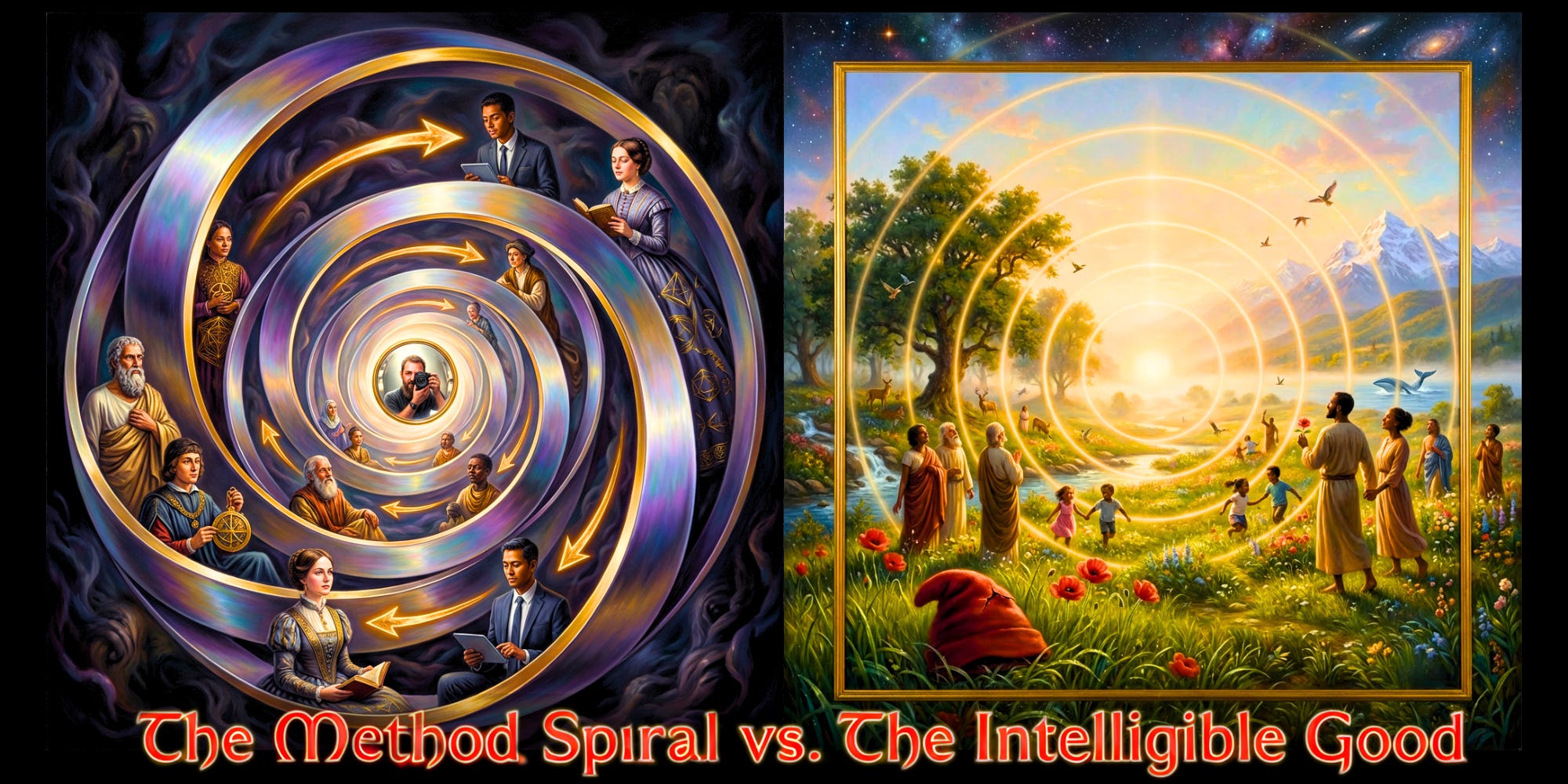
The real is not generated by creative mentation, by dialectical negation, or by any elite-initiated epistemological technology. The real is given, and the intellect is proportioned to receive it. That is the Aristotelian-Thomistic conviction that animated the American Founding (read the Declaration’s appeal to “the Laws of Nature and of Nature’s God”—a direct echo of Aquinas’s prooemium to his commentary on Aristotle’s Physics). The Founders did not need a secret method to know that men are endowed by their Creator with unalienable rights; they needed only the common light of natural reason illumined by revelation.
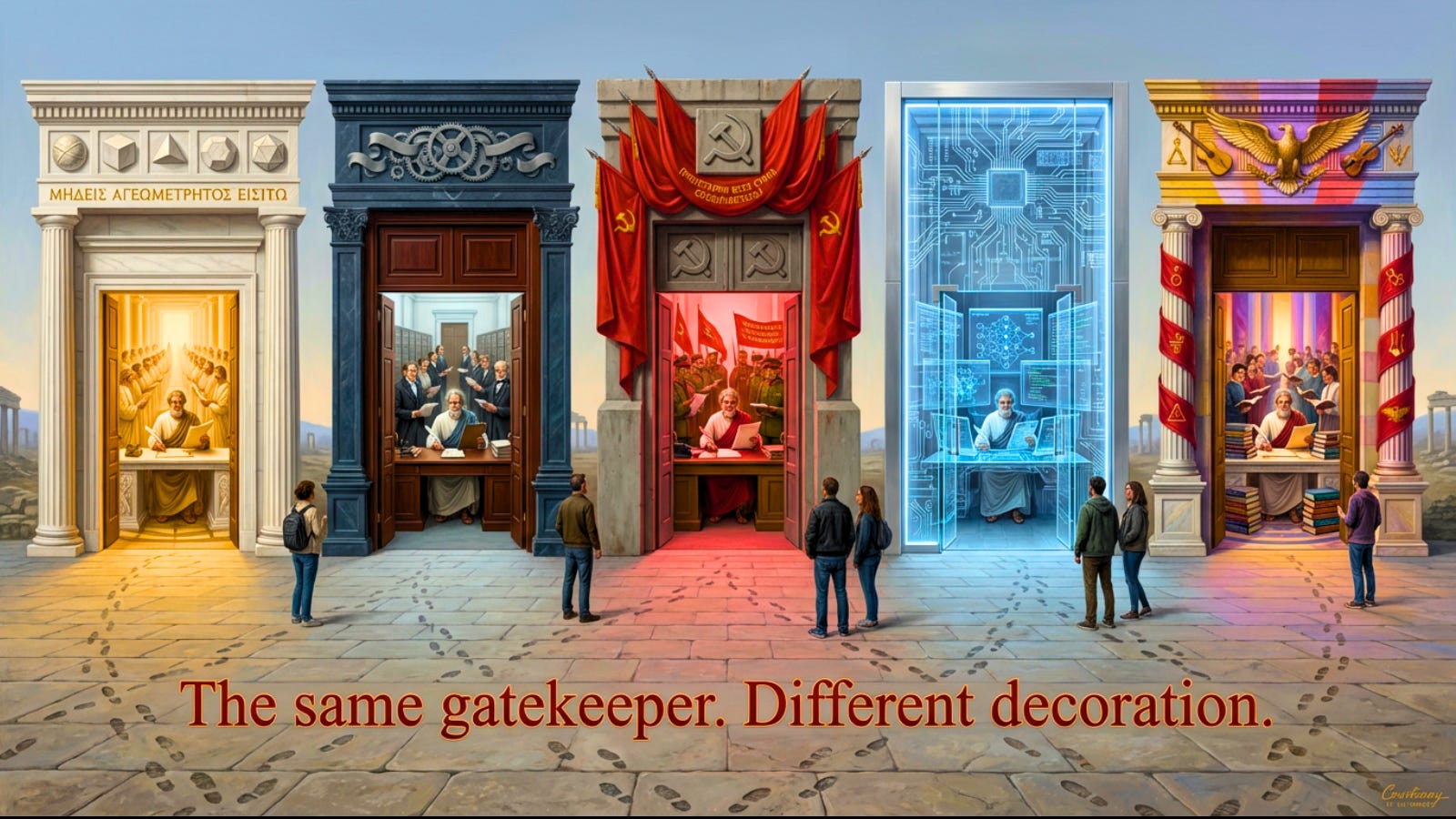
The geopolitical implications of abandoning this realist foundation are catastrophic. When being is replaced by method, politics inevitably becomes the contest of which initiated elite controls the superior process of “world-historical” knowing. Liberty, law, and the dignity of the common man collapse because none of these things can be justified without a public, shareable order of being. What remains is rule by self-appointed “knowers”—whether they call themselves the Platonic Academy, the Hegelian bureaucracy, the Comintern, The LaRouche school, the Silicon Valley AI priesthood, the rationalist effective altruism movement or the modern trans-humanist technocracy that now openly speaks of “rewiring” human consciousness through AI-mediated “epistemic engineering.”
The LaRouche tradition, for all its anti-oligarchic rhetoric, is unwittingly one more variant of this post-realist paradigm. Its obsessive focus on “creative reason” as a faculty that allegedly generates new ontological domains (rather than discovering what is already there) is continuous with the very British-Hegelian synthetic projects LaRouche claimed to oppose. It is no accident that its organizational psychology mirrors every other high-demand dialectical sect: the demand for total intellectual submission, the diagnosis of critics as spiritually defective, the promise that only the method can save civilization.
I reject the trap. I do not offer a rival method. I simply re-assert the philosophical realism that runs from Aristotle through Albertus and Thomas to the American Founding: reality is intelligible, the intellect is adequate to the real, and no gnostic key, no secret dialectic, no elite-initiated “higher hypothesizing” is required to know the truth that makes men free.
That is why I wrote the original essays. That is why I wrote this letter. And that is why I will not be drawn into an endless “dialectical” tennis match inside a cage whose rules guarantee only one possible winner—the one who controls the method.
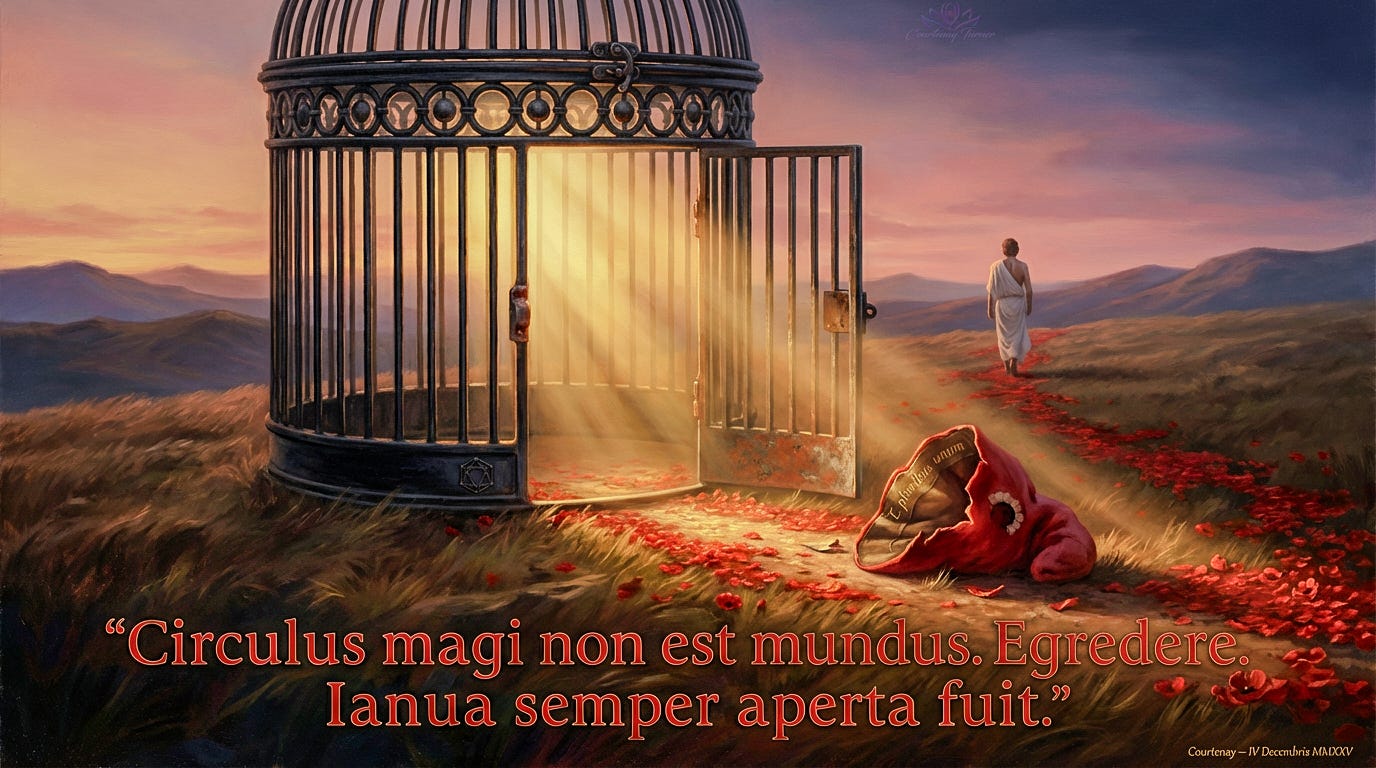
The cage door is open. Being is waiting on the other side.
The Geopolitical Stakes: Why This Apparently Obscure Metaphysical Dispute Actually Determines the Future of Human Freedom

What is ultimately at stake in this exchange is not who has read more pages of Kepler or who has the correct interpretation of Nicholas of Cusa. What is at stake is the philosophical foundation on which either human liberty or new forms of high-tech tyranny will be built in the century ahead.
Metaphysical realism produces natural rights and self governing legitimacy.
If human beings possess, by their very nature, a rational soul whose dignity is grounded in being itself and not in any elite technique or historical process, then certain consequences follow inescapably: rights are universal, inalienable, and prior to all positive law; every citizen possesses in principle the same capacity to discern truth and justice; and no vanguard, no party, no initiated elite can legitimately claim a monopoly on “world-historical” reason. This is the metaphysics that animated the American Founding. The Declaration’s appeal to “the Laws of Nature and of Nature’s God” is not rhetoric; it is Aristotelian-Thomistic natural law in its purest form.

Method-centric idealism, by contrast, always produces gnostic hierarchy.
If genuine insight into reality is only possible through mastery of an esoteric epistemological method—whether that method is called “learned ignorance,” “dialectical materialism,” “creative mentation,” or “higher hypothesising”—then a natural elite inevitably emerges: those who have internalized the technique and those who have not. Self-governance becomes literally impossible, because the uninitiated cannot “see.” Politics is thereby reduced to a contest over which initiated group gets to steer history.
We have seen this movie before: the Bolshevik Central Committee, the Nazi Sicherheitsdienst, the Islamic Revolutionary Guard Council, the Chinese Communist Party’s Politburo Standing Committee—all of them claimed (and claim) proprietary access to a higher mode of knowing that justifies their rule over the unenlightened masses.
Your tradition, Matt, for all its fiery anti-oligarchic rhetoric, falls squarely into the second category. When LaRouche taught that ordinary empirical reason and Aristotelian logic are intrinsically incapable of discovering new physical principles, and that only the trained “creative-mental” process can generate ontological breakthroughs, he was not transcending oligarchism—he was reproducing its deepest epistemological structure under new branding.
This is why so many sincere people who adopt the LaRouche/“multipolar” framing end up performing the most extraordinary moral and intellectual contortions: NATO is uniquely evil, but Russian disinformation, Chinese concentration camps, and Iranian theocratic repression somehow disappear from view. Once you accept that objective reality is unknowable without the correct method, you have no stable ground from which to criticize any regime’s narrative. All that remains is the binary choice: Western unipolar oligarchy (bad) or Eastern multipolar oligarchy (good, because it opposes the West). Universal standards of justice evaporate; everything becomes a question of which “civilizational method” you align with.
Metaphysical realism, in contrast, gives you the only position from which you can consistently oppose both Western financial imperialism and Eastern authoritarianism without falling into relativism. Because human dignity and rational freedom are rooted in being itself, they are not “Western values”; they are human values. You can condemn the Iraq War and the Uighur camps using exactly the same principles. You can acknowledge legitimate Russian security concerns after 1991 without becoming a propagandist for Putin’s regime. You can criticize the American security state without apologizing for Xi’s.
This is the philosophical grounding required for Genuine Pluralism of Nations not to become merely a new mask for empire or a conduit to OWG/NWO.
Russia and China both advance sophisticated forms of methodological relativism: “liberal democracy” is just one cultural preference among many; there are no universal standards, only competing civilizational codes. That argument becomes infinitely more persuasive once the West itself has abandoned metaphysical realism and replaced it with positivism, pragmatism, and now trans-humanist “epistemic engineering.” When both sides agree that being is plastic and truth is whatever the dominant method declares it to be, freedom has already lost.
True multipolarity would be a world of sovereign nations cooperating as equals. What is actually being built—by both the old “unipolar” globalists (Club of Rome, Brzezinski, Kissinger, WEF) and many of the new “multipolar” voices—is something very different: a fragmented planet of regional power blocs whose competition is managed and eventually superseded by transnational technocratic institutions and elites. In this scripted transition, the nation-state is deliberately hollowed out, popular sovereignty is transferred upward to supranational entities and “expert” bodies, and the ordinary citizen is left with neither the old national protections nor any real voice in the new regional or global arrangements. Metaphysical realism, with its insistence on universal human dignity and the priority of being over method, is the only intellectual firewall that can expose and block this convergence of East and West toward a common post-national, post-democratic future.
Why I Now Refuse to Continue the Debate

Every additional exchange would only legitimate the closed system. As long as I remain inside the frame where “mastery of method” is the criterion of insight, every argument I advance can be dismissed as proof that I have not yet mastered the method. The game is rigged by design: the house always wins.
Psychologist Robert Jay Lifton, in his classic study of ideological totalism and thought reform, identified this exact pattern: the moment disagreement is reframed as evidence of the critic’s spiritual or cognitive defect, the system has become self-sealing. Every objection confirms the premise; every attempt to leave is proof you never truly understood. Lifton observed this in Maoist China and in certain American cults; I have now watched it unfold in real time in this exchange.
Real philosophy operates in the open, under the judgment of common reason and publicly accessible evidence. Your system operates inside a hermeneutical circle whose only exit is submission. Recognizing that, and refusing to play any longer, is not cowardice or defeat. It is the only move that preserves intellectual and political freedom.
I will stop here. My final words are no longer for the arena we have been in together, Matt, but for everyone else who has been quietly watching and wondering what all of this means for them, because I have reluctantly concluded that the system we are inside only permits one form of resolution.
You do not need a secret method to read Plato, Aristotle, Kepler, or the American Founders.
You do not need an initiated elite to tell you what reality is.
Reality is intelligible.
Your intellect is proportioned to the real.
Your dignity and your rights are rooted in being itself, not in any historical process or creative technique.
Hold fast to that. Read the primary texts yourselves. Trust the light of natural reason. Defend universal principles without apology.
That is the only foundation on which genuine human freedom can possibly stand.
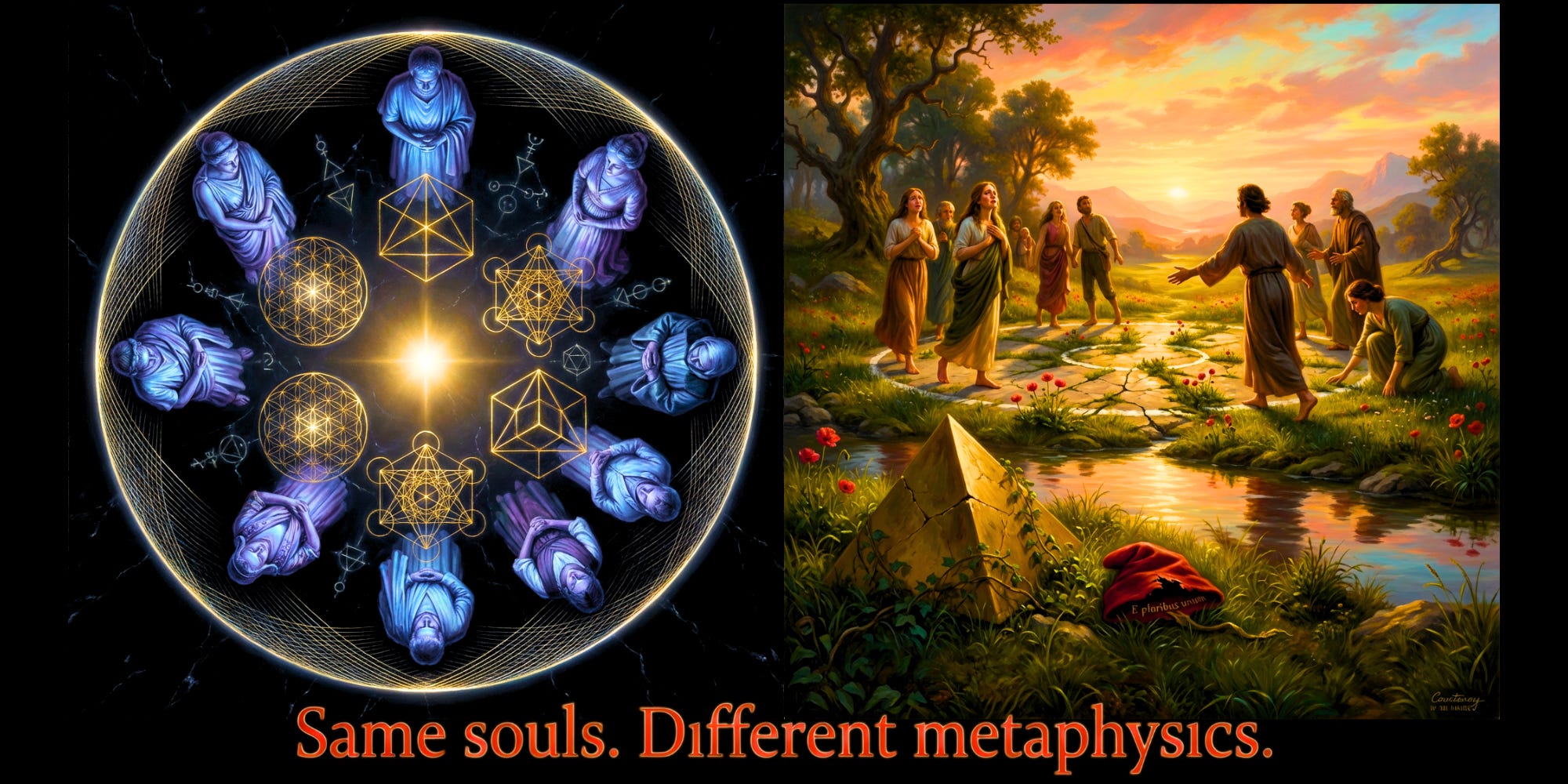
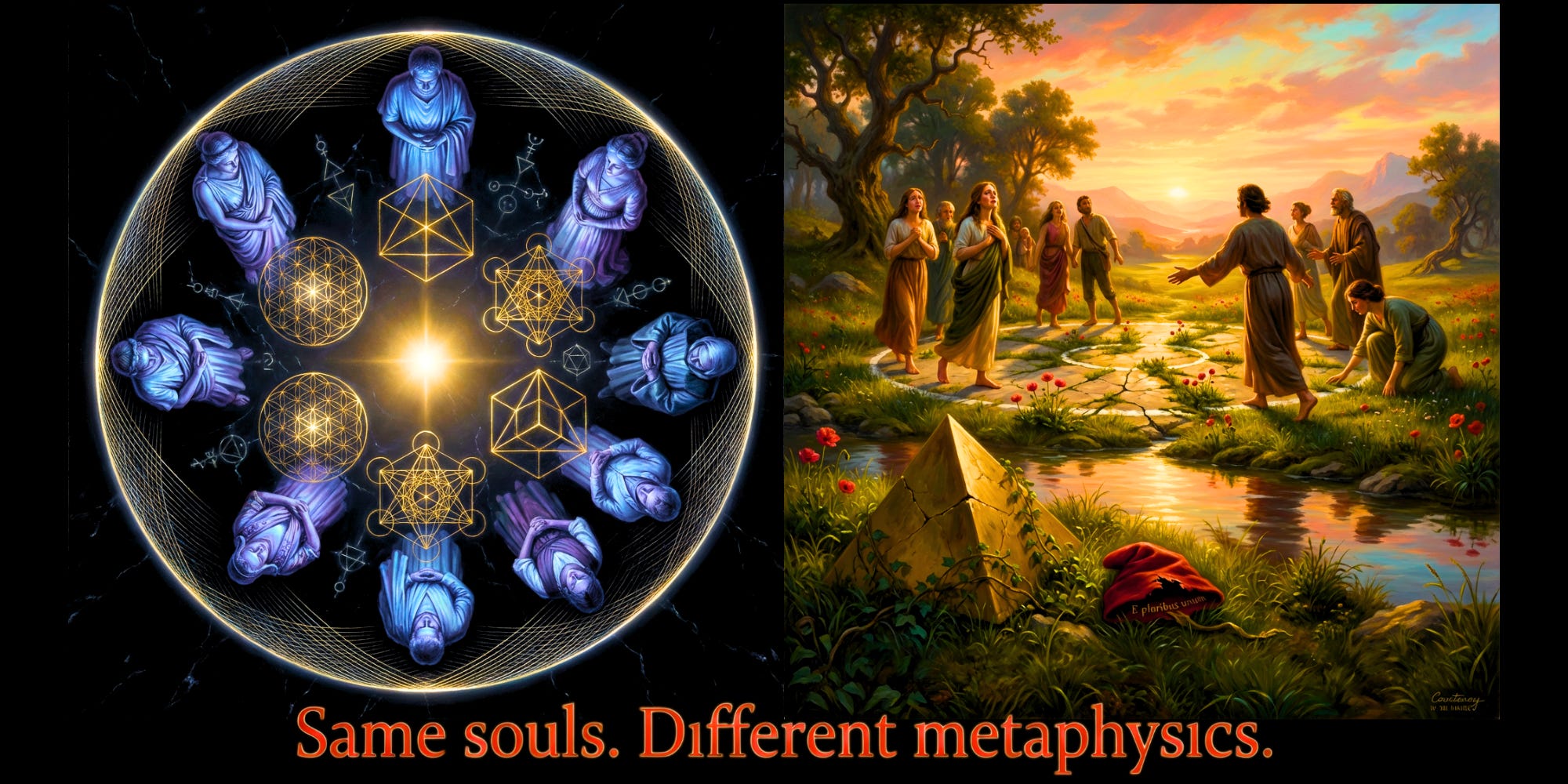
The wizard’s circle is not the world.
Step outside.
The door has always been open.
With steadfast hope for everyone still trapped inside,
Courtenay
P.S. I will not respond further in this venue. Those who wish to explore the philosophical questions should go straight to the primary sources. Those who wish to understand how ideological capture operates should study this exchange carefully. And those still inside similar systems should ask themselves one simple question they may not have been permitted to ask in years:
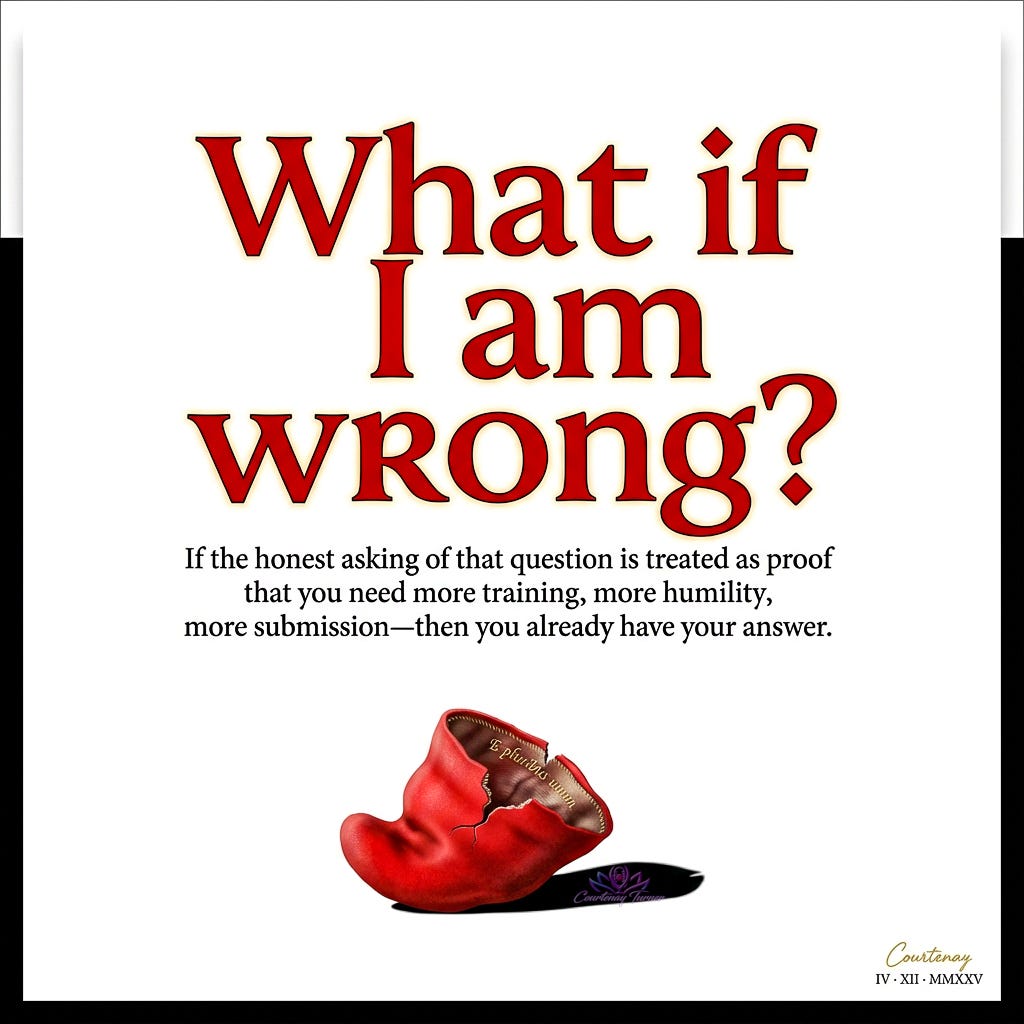
“What if I am wrong?”
If the honest asking of that question is treated as proof that you need still more training, more humility, more submission—then you already have your answer.
Choose freedom. It means reading the text yourself, trusting your own reason, defending universal principles without apology, building community grounded in shared nature, not shared method!

In the spirit of Philia,
Courtenay
I just recently paid for a year-long subscription to your Substack. Reading this letter makes me even more certain that that was a very wise decision. You're much more learned and well-read than I am, but I followed what you said here and found it very refreshing. Sad to see the rift between you and Matt, though.
Love both of you guys, and as a 61 year old with diminished brain space, have learned oodles ( at least the stuff that doesn't bounce off the useless knowledge I've retained through over half a century and disappear into knowledge-oblivion ) from each of you, and appreciate all that you both do.
However, after following this debate - in which the conduct of the back-and-forth has in itself been enlightening - I have to side with you on this one, Courtenay. I know that doesn't add anything of intrinsic value, but it is to say that watching the methods involved in the debate - and the substance thereof - this final argument, on your behalf cleans it up for me.
We can know. And are created to 'know', without the need for method. The simplicity of the cross of Christ, has and will always be a stumbling block to the unbeliever, because it is so simple and able to be grasped by those not endowed with great analytical and probing minds. In my off and on forays into philosophy, I have detected a lot of this 'allergy to simplicity', a simplicity that ( and this is coming from a total layman's perspective ) seems to reside quite nicely in this metaphysical realism, or dare I say Platonic-Aristotleianism? Okay, maybe not, but as with the example above, I have found that philosophy cannot abide simplicity, and in fact seems to have, as history 'progressed', fled from it into all forms of occultism, ideological gatekeeping, mental gymnastics and not a little ridiculousness and absurdity. All of it tugging on man's pride to at least meet - if not exceed or cast off wholly - God in his intellectual capacity to reveal and run things according to His wisdom.
Studying those in power, and the occult traditions that underlie and drive their pursuits to become our gods - or at least usher in their god for what's left of us to worship - I see the results of ideological fire-walling based on philosophies and methods that want to look past the real, tangible and simple, and into the abyss of an unshackled, prideful pursuit of intellectual godhood. And those have not turned out well for humanity.
I'm not accusing Matt of any of this of course, but if you're playing in the same park, you're liable to get hit with a ball occasionally.
Once again, I appreciate you both, and hope that this can be resolved. Either way, I thank you both for the 'light' reading material during this exchange, and as Doe-nut so eloquently puts it, "making me wicked smahht".....at least the parts that stick to my brain.