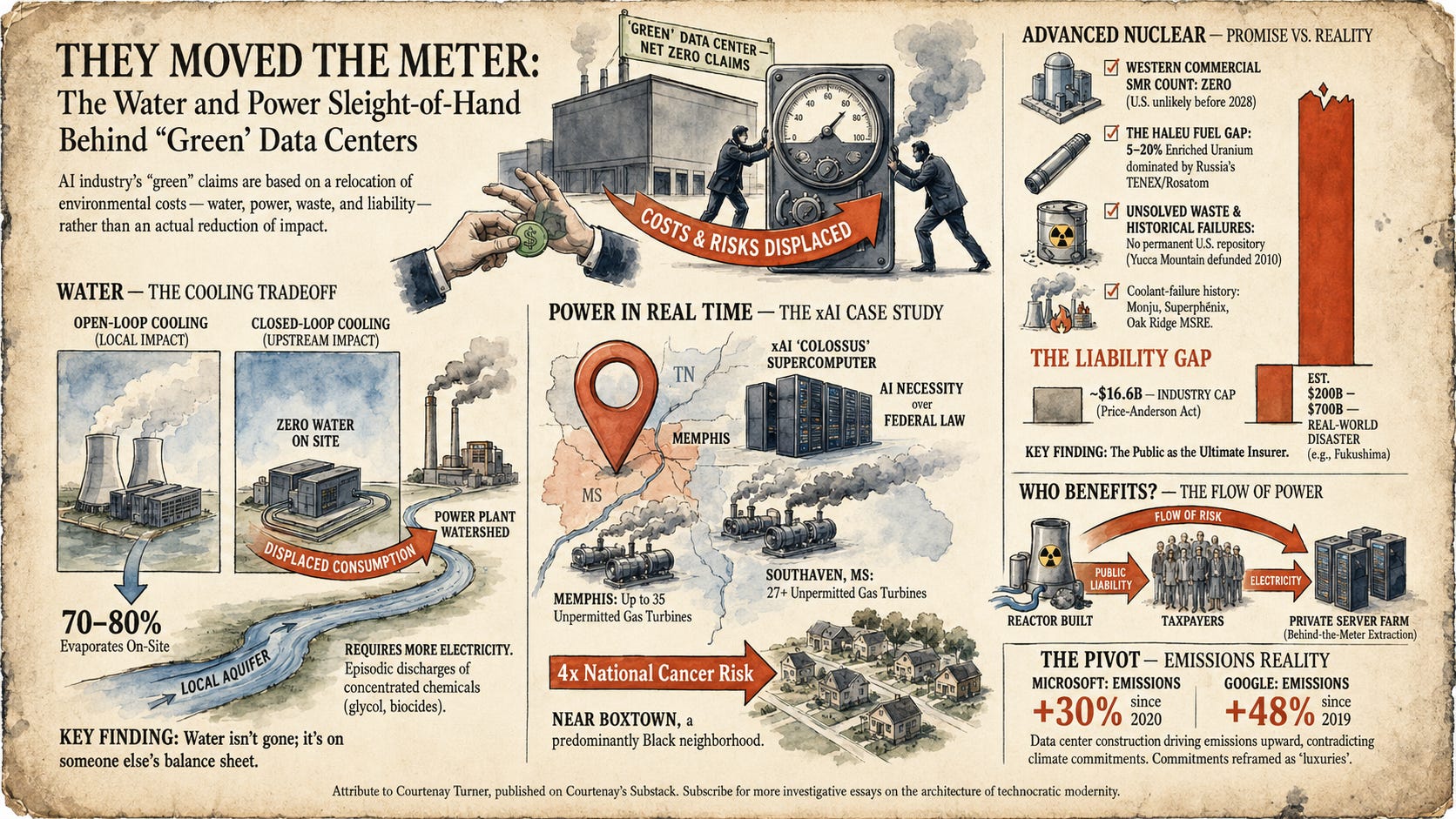
They Moved the Meter
The Water and Power Sleight-of-Hand Behind “Green” Data Centers

You’ve been told to shorten your showers. Replace your lawn. Audit your appliances. Meanwhile, the same regulatory ecosystem issuing those instructions has been quietly approving industrial facilities whose daily water and power draws exceed entire municipalities — and whose sustainability reports claim, by way of accounting moves rather than actual reduction, to use almost none of the water on site and to fully offset the power against renewable contracts written elsewhere.
Derrick Jensen made the structural version of this argument in Orion in 2009, observing that personal-virtue environmentalism functions as a kind of distraction from the industrial decisions that actually move the numbers. The data center version of that pattern is what follows.
The trick is not that the numbers are fake. The trick is where the numbers are measured.
Hyperscale data centers — the massive server complexes operated by Amazon, Microsoft, Google, and Meta — have spent the last several years caught in a public relations problem. Local communities in Arizona, Virginia, Oregon, and Georgia started noticing aquifer drawdowns, well failures, and municipal water reallocations happening alongside data center construction. The industry pivoted. The new generation of facilities, they announced, would use “closed-loop” cooling. Microsoft has gone further, publicly stating that its newest designs consume effectively zero water on site.
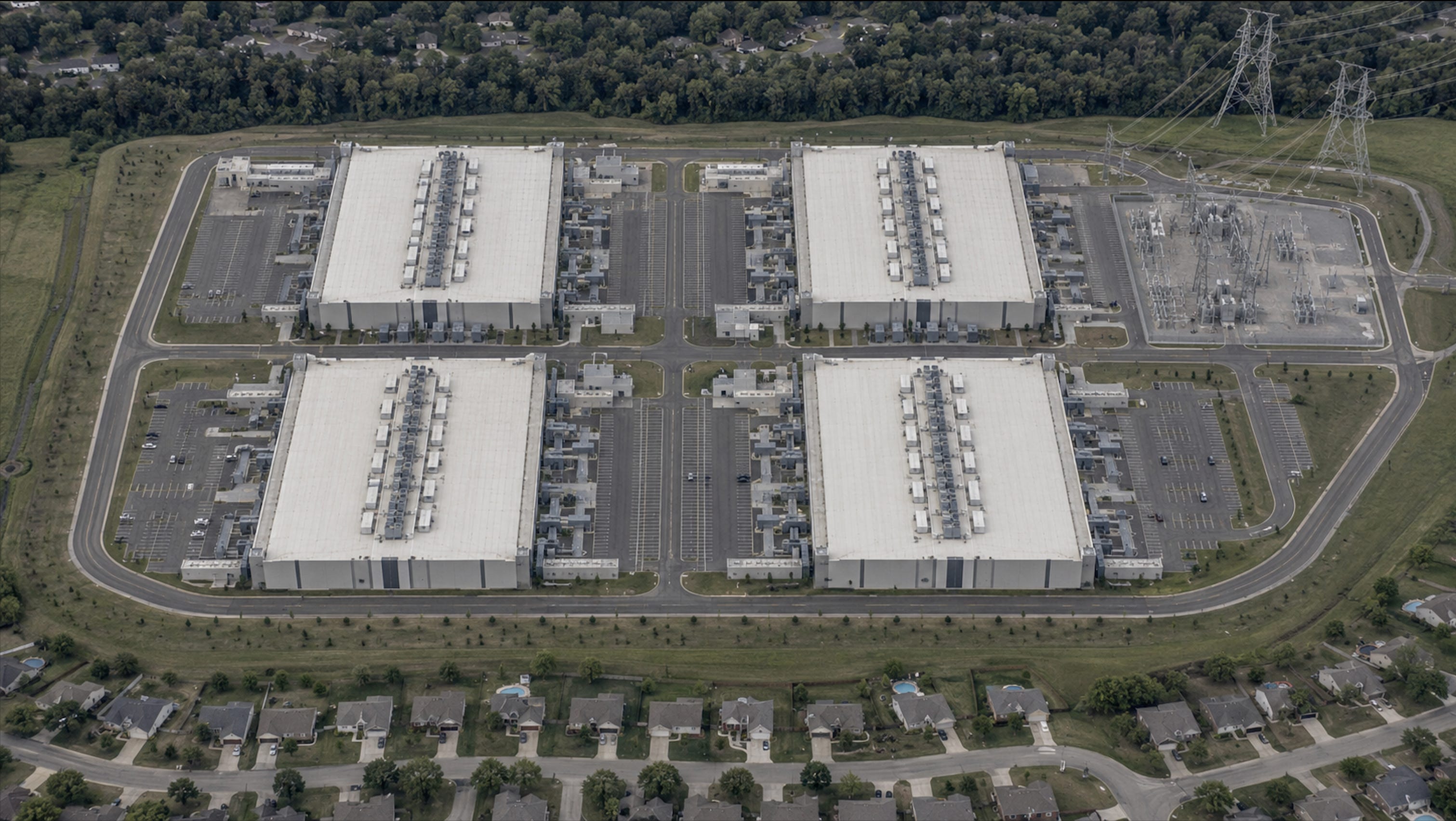
The claim is technically accurate. It is also materially incomplete. And once you understand how it works, you start to see the same trick repeated across the entire AI buildout — water, power, waste, and cost, all relocated rather than reduced.
Start with the cooling.
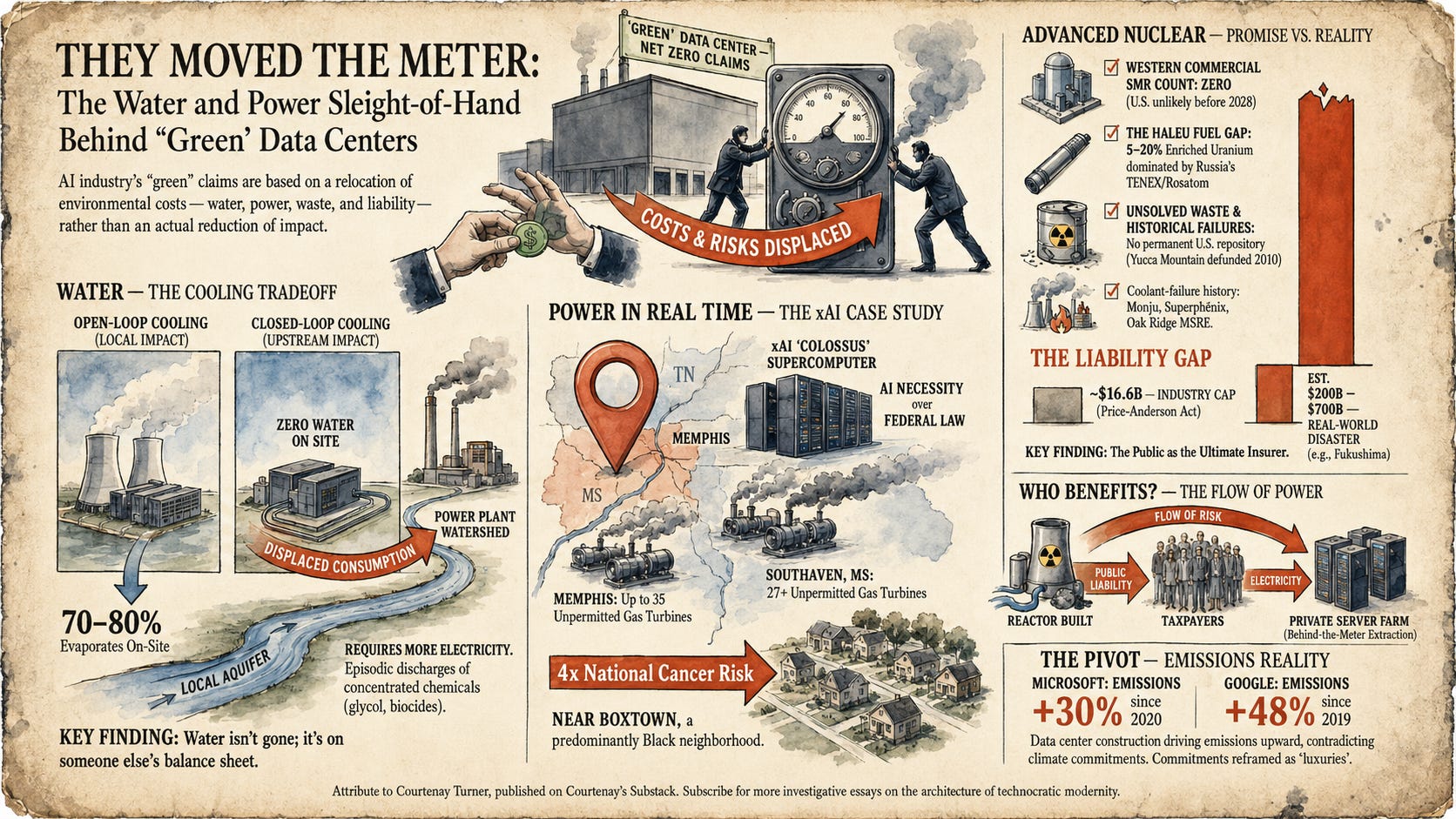
Conventional data center cooling has historically been open-loop or evaporative: water absorbs heat from servers and is sent through a cooling tower, where roughly 70 to 80 percent evaporates into the atmosphere. The remainder is discharged as warmed wastewater, carrying concentrated minerals, scale inhibitors, and biocides. This is the model that produced the well-publicized conflicts in Arizona, Virginia, Oregon, and Georgia, where residents and local officials began questioning aquifer drawdowns and municipal water allocations.
In response, the industry has pivoted toward closed-loop cooling, in which the same fluid recirculates through sealed piping and is cooled by heat exchangers rather than evaporation. The claim of dramatic water savings is technically accurate but materially incomplete. In most climates, closed-loop systems require more electricity to perform the same cooling work — the penalty is largest in hot regions and smaller in cool ones, but on average it is real — and most of the U.S. grid is still served by thermal generation. Natural gas, coal, and nuclear plants all withdraw and consume substantial quantities of water at the generation site. The water has not disappeared. It has been displaced to another watershed, where it shows up on someone else’s balance sheet. The “100% renewable” framing hyperscalers attach to those operations is its own parallel sleight-of-hand: a power purchase agreement for solar generation in West Texas does not reduce the actual grid mix powering a facility in Northern Virginia. It pays for renewable capacity to exist somewhere; it does not unbuild the gas turbines feeding the meter.
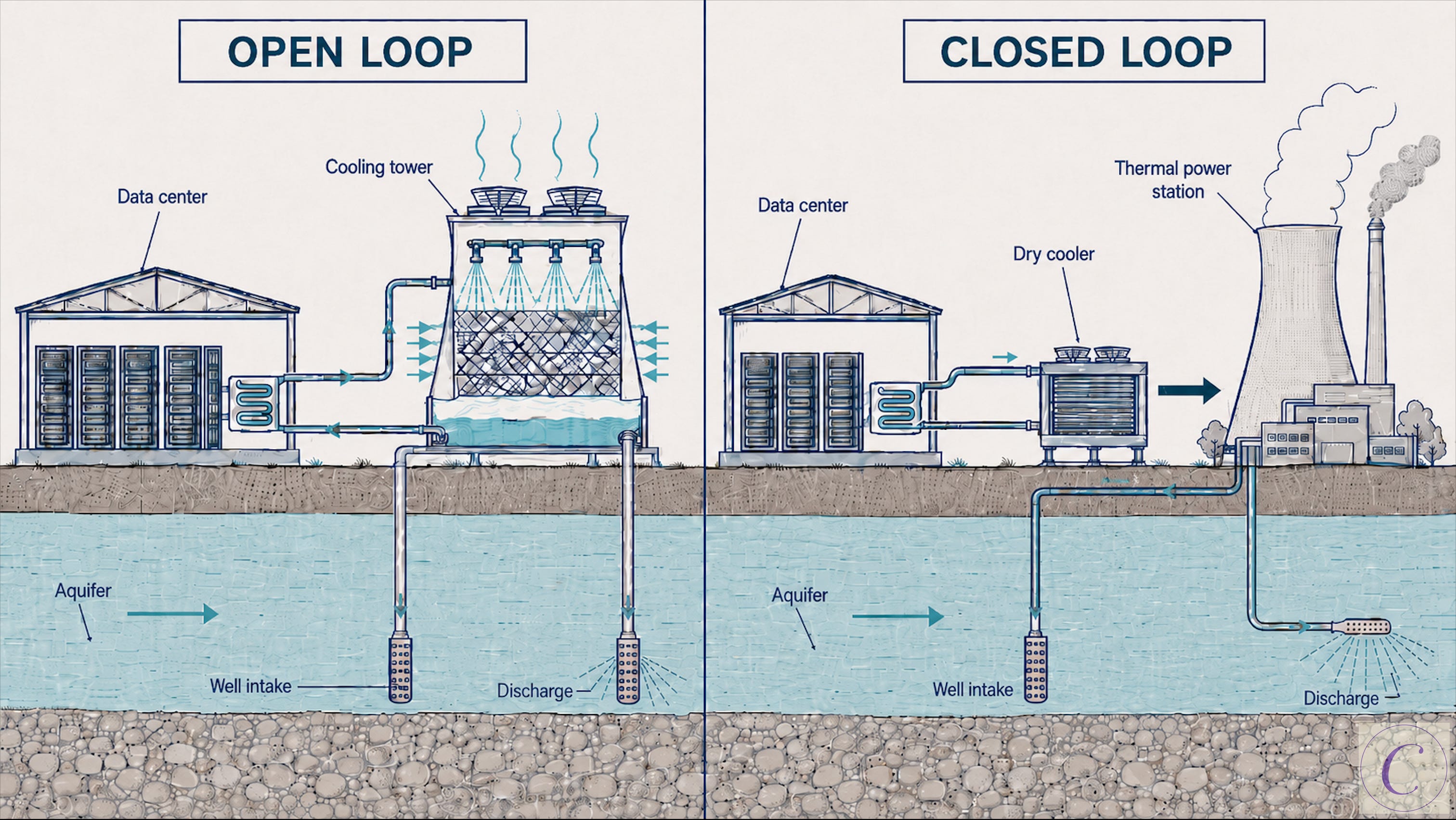
A more honest framing of the cooling tradeoff: open-loop produces a large, continuous, primarily quantitative impact on local water systems — sizable withdrawals, sizable warm-water discharges, and relatively dilute chemistry. Closed-loop produces a smaller, more concentrated, qualitative and geographically displaced impact — minimal on-site withdrawal, but harsher per-gallon discharge when the system is drained for maintenance or repair, plus the indirect water embedded in the additional electricity required to run it. Neither system is “clean.” They distribute the burden differently across quantity, quality, location, and time. The choice between them is a choice about which community absorbs which form of cost.
The chemistry of closed-loop discharge deserves particular attention because it is rarely discussed in the trade press. Recirculating fluids accumulate corrosion inhibitors, antifreeze compounds such as glycol, and antimicrobial agents over months of operation. When that fluid is eventually drained — for a valve replacement, a leak, or scheduled maintenance — it enters municipal treatment systems that were not engineered to receive concentrated industrial coolant. The risk profile shifts from chronic dilute discharge to episodic concentrated discharge, and local water authorities are rarely consulted about which they would prefer to inherit.
Now consider the power side of the equation, where the rhetorical inflation has been even more pronounced — and where the consequences of believing the marketing are considerably more serious than a depleted aquifer.
Start with what is actually powering the buildout right now.
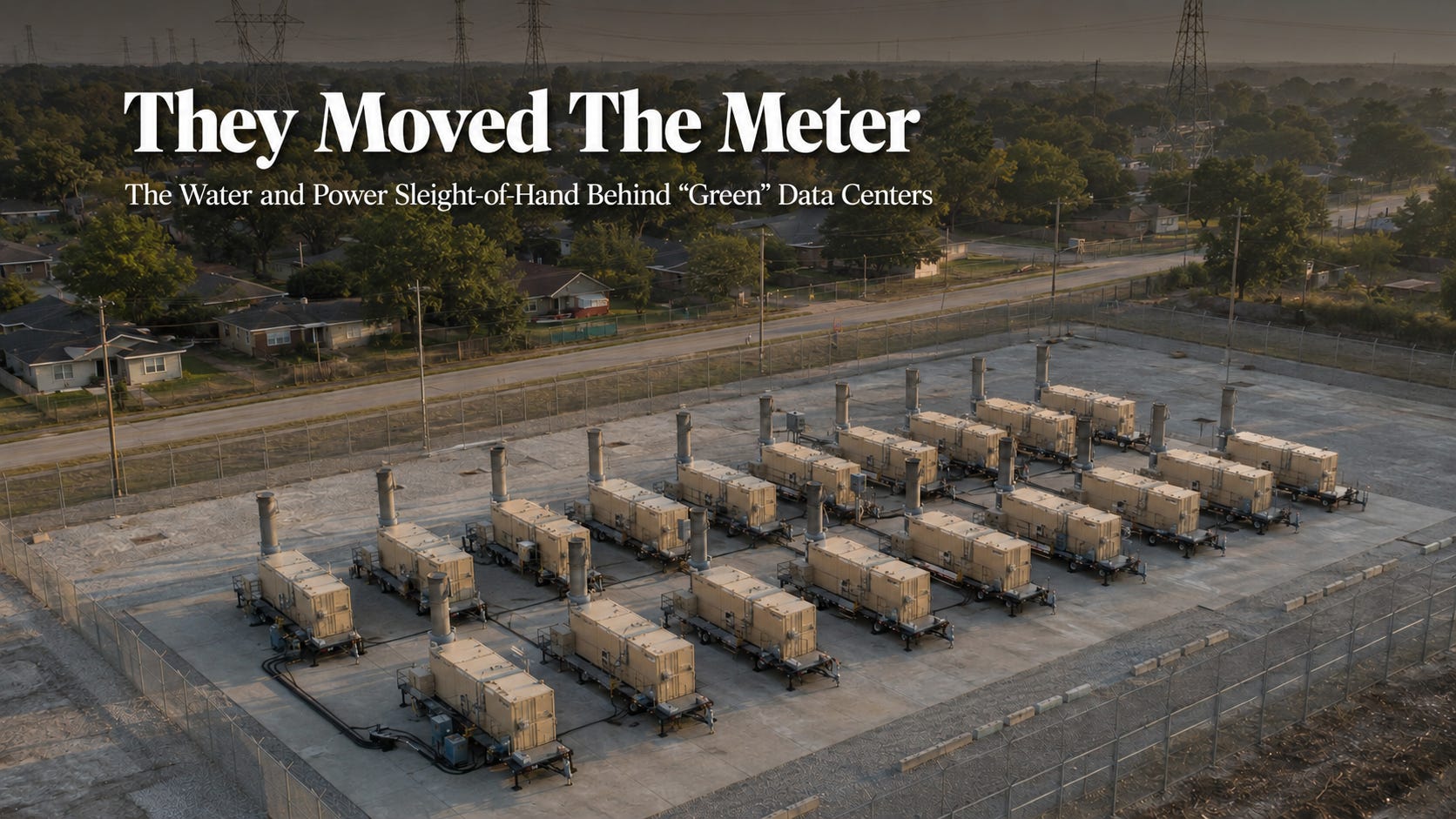
In June 2024, xAI — Elon Musk’s AI company — began operating its Colossus 1 supercomputer in South Memphis on power from as many as 35 unpermitted methane gas turbines. After the Southern Environmental Law Center and the NAACP filed a notice of intent to sue under the Clean Air Act, xAI removed some turbines and obtained permits for fifteen. The company then built a second data center, Colossus 2, drawing power from a new and likewise unpermitted gas turbine plant — 27 units to start, six more added after litigation began — located across the state line in Southaven, Mississippi. The NAACP filed suit in April 2026, and an emergency injunction request followed weeks later. The case is ongoing.
Gas turbines emit smog-forming nitrogen oxides, particulate matter, and hazardous air pollutants including formaldehyde. The Clean Air Act requires major sources of pollution to obtain permits, install best available control technology, and submit to public review before being constructed or operated. xAI did none of that. The facilities sit near Boxtown, a predominantly Black neighborhood in South Memphis where the cancer risk runs roughly four times the national average — a community already absorbing emissions from an oil refinery, a steel mill, and a TVA gas plant. The Memphis metro area has documented ozone problems independent of the data center.
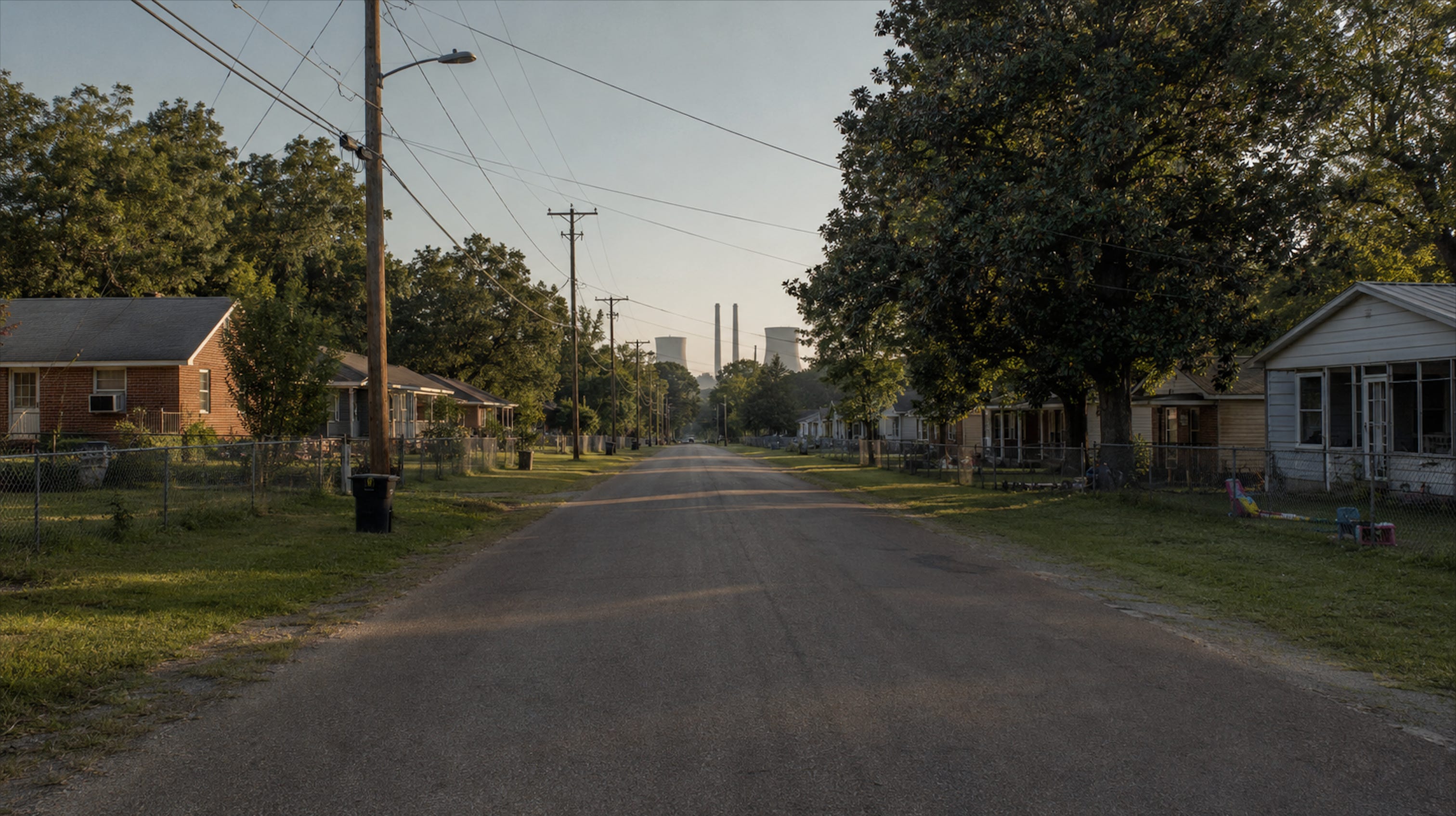
This is not an accounting maneuver. It is a federal pollution-control statute being openly disregarded by one of the most heavily capitalized companies in the world, to power a chatbot. The cooling-tower disputes at least involve operators trying to optimize within the rules. The xAI case is what the buildout looks like when no rules are being respected at all — happening in real time, in Tennessee and Mississippi, while the industry’s public-facing material describes a clean future powered by advanced nuclear designs that do not yet exist.
The promised future is supposed to be different. The hyperscalers driving demand — Amazon, Microsoft, Google, Meta — have moved aggressively into nuclear procurement, with particular attention to small modular reactors and advanced Generation IV designs. The marketing vocabulary is consistent: “inherently safe,” “factory-built,” “advanced,” “passive.” The operational reality is that almost none of these designs have actually been built and run commercially in the West. Aside from units operating in China and Russia, no commercial SMR exists in the Western world. The Carbon Free Power Project, NuScale’s planned deployment with Utah Associated Municipal Power Systems at Idaho National Laboratory, was canceled in 2023 after cost estimates roughly doubled. Several other projects — TVA’s Clinch River BWRX-300, X-energy’s partnership with Dow, Kairos Power, Oklo — are in various stages of licensing and site preparation. First U.S. commercial operation is unlikely before 2028 and may be considerably later. The country is being asked to build out an industrial-scale energy source whose flagship Western deployments do not yet exist.
What the country is being asked to absorb, in the meantime, is the risk envelope of designs whose failure modes are documented but unsolved.
The fuel problem is a national security problem dressed up as a logistics problem. Most advanced reactor designs require high-assay low-enriched uranium, or HALEU, enriched to between 5 and 20 percent — substantially above the roughly 5 percent enrichment used in the current light-water fleet. Higher enrichment is closer to weapons-usable material. It requires new transport packaging, new safeguards, new security protocols, and a new domestic supply chain that does not yet exist at commercial scale. Commercial HALEU production today is dominated by Russia’s TENEX, a subsidiary of Rosatom — the same Russian state nuclear company the United States is otherwise treating as a strategic adversary. Centrus Energy has begun limited domestic production under a Department of Energy contract, but commercial-scale supply remains years away. Until that gap closes, any claim that advanced nuclear will deliver American “energy independence” is selling a future that depends on Russian fuel.
The waste problem is worse, and it has been worse for forty years. The United States has no operating permanent repository for high-level nuclear waste. The Yucca Mountain project was effectively defunded in 2010 and has not been revived. Spent fuel from the entire existing reactor fleet is held in pools and dry casks at the generating sites themselves, accumulating year after year, awaiting a federal solution that has not arrived since the Carter administration.
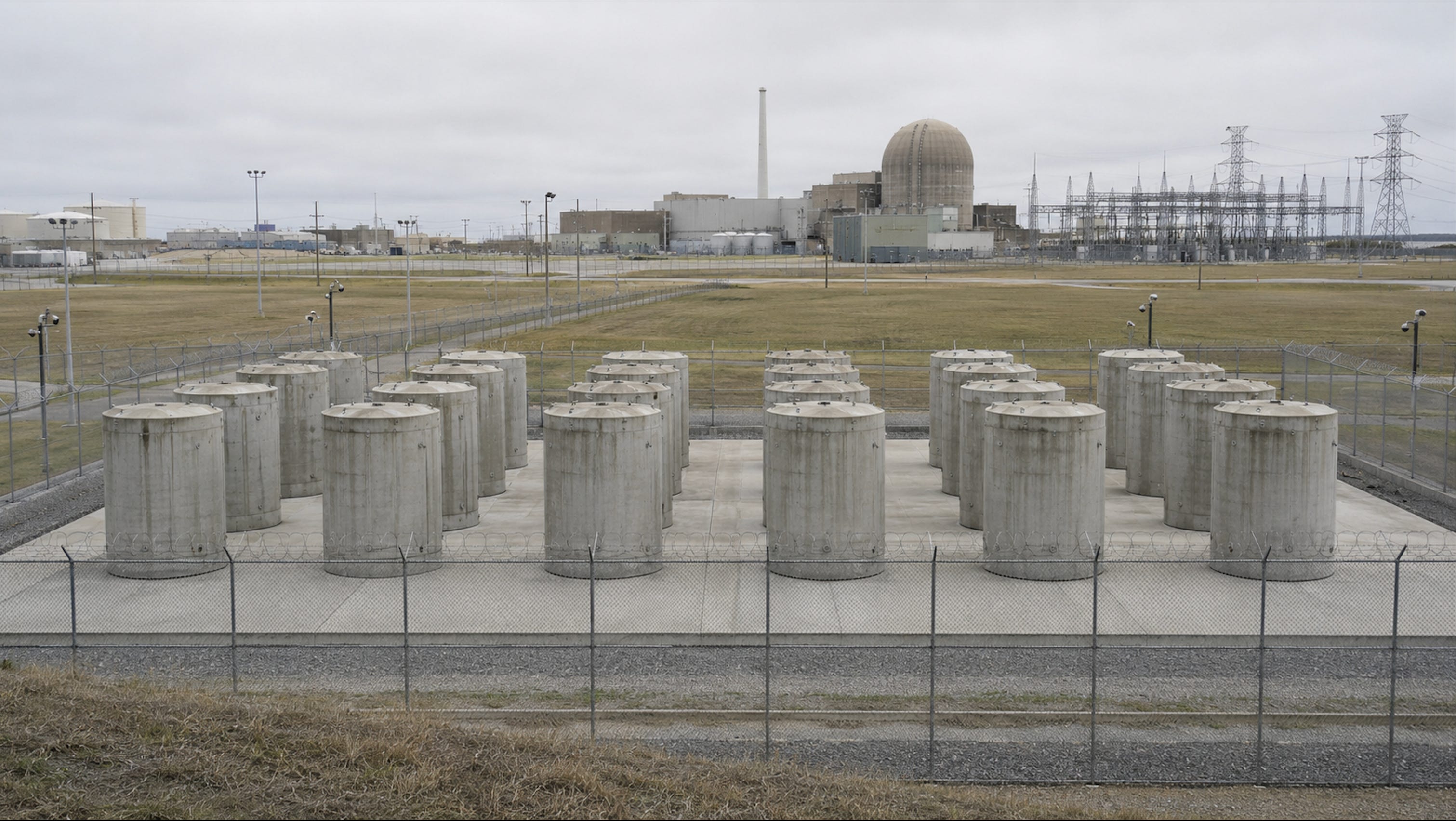
Advanced reactor designs do not solve this problem. They make it more complicated. High-temperature gas reactors using TRISO fuel generate larger volumes of irradiated graphite. Molten salt designs produce chemically reactive fuel residues that current packaging standards were never designed to handle. Sodium-cooled fast reactors leave sodium-bonded fuel that does not meet existing repository acceptance criteria — a problem already affecting roughly 60 tons of legacy fuel from the EBR-II reactor in Idaho that has sat without a disposal pathway for decades. The disposal framework built around uranium oxide pellets in zirconium cladding does not accommodate these new waste forms, and the regulatory work to address that is in early stages. The country is being asked to commit to building reactors whose waste has nowhere to go.
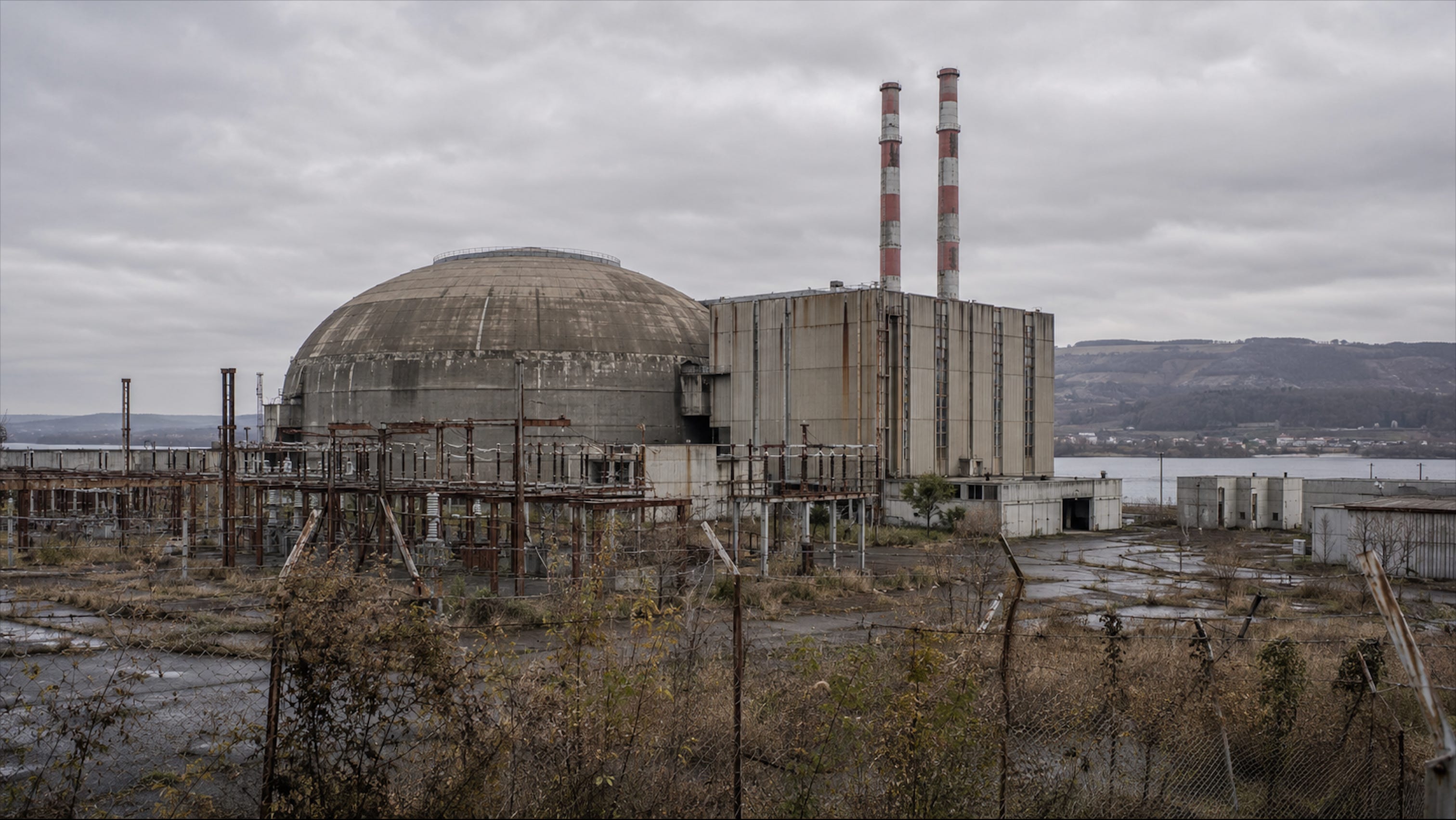
The coolants themselves are not safe in the everyday sense of the word. They are managed risks, and the management has failed before. Sodium reacts violently with air and water; sodium-cooled designs require fluids that combust on contact with the substances most likely to be present in any leak. The Monju reactor in Japan suffered a sodium fire in 1995, was shut down for years, and was eventually abandoned in 2016. France’s Superphénix, the largest sodium-cooled reactor ever built, ran at low capacity for fourteen years and was closed in 1997 after persistent sodium and operational problems. Lead-bismuth eutectic coolants generate polonium-210, an alpha-emitter so radiotoxic that microgram quantities have been used as an assassination weapon; it is contained under normal operation but creates serious complications for maintenance, refueling, and any accident scenario involving coolant release. Molten salt corrodes the structural alloys it flows through, a problem that contributed to the closure of the Oak Ridge Molten Salt Reactor Experiment in 1969 and remains an active and unsolved materials-science challenge half a century later. These are the documented reasons earlier prototypes of these designs were shut down. The industry’s position is essentially that this time will be different. That position is a claim, not evidence.
Then there is the question of accident liability, which the marketing avoids almost entirely. Under the Price-Anderson Act, the nuclear industry’s liability for any single accident is capped at approximately $16.6 billion across the entire industry pool — a figure adjusted for inflation every five years and last updated in 2023. The Japanese government’s official estimate of Fukushima cleanup costs stands at roughly $200 billion. Independent analyses by the Japan Center for Economic Research place the eventual total considerably higher — somewhere between $350 billion and $700 billion depending on what is counted, including long-term decontamination, waste storage, and compensation. The Chernobyl figure runs higher still. The arithmetic is straightforward: in a serious accident, the gap between industry liability and actual cost falls on the federal taxpayer.
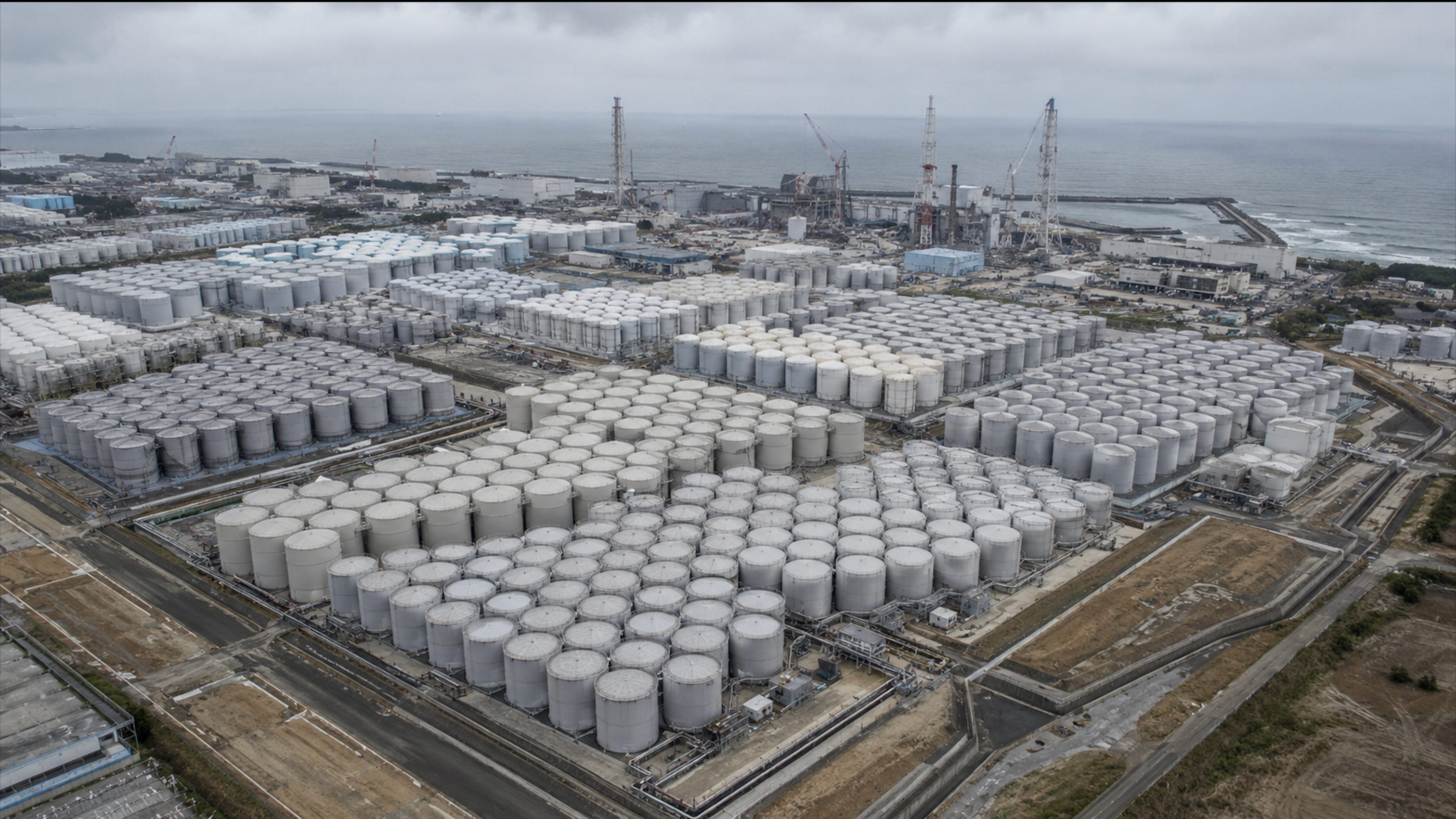
Distributing reactors more widely — next to data centers, near population centers, in regions without prior nuclear infrastructure — distributes that exposure more widely as well. “Inherently safe” is a design claim. It is not an insurance policy.
Finally, the structural question of who benefits. The procurement deals being announced are not general grid expansions. Microsoft’s agreement with Constellation to restart Three Mile Island Unit 1 — the undamaged reactor at that site — is structured to deliver power directly to Microsoft’s operations. Amazon’s arrangement with Talen Energy at the Susquehanna nuclear plant was structured as a behind-the-meter sale, an arrangement the Federal Energy Regulatory Commission partially blocked in late 2024 over concerns about cost-shifting to other ratepayers. The dispute is instructive: it is the first regulatory acknowledgment that dedicated nuclear-to-data-center deals can externalize costs onto households and small businesses that share the same grid infrastructure but receive none of the generation. The reactor goes up. The water gets drawn. The waste accumulates. The liability sits with the public. The electricity ships to a server farm.
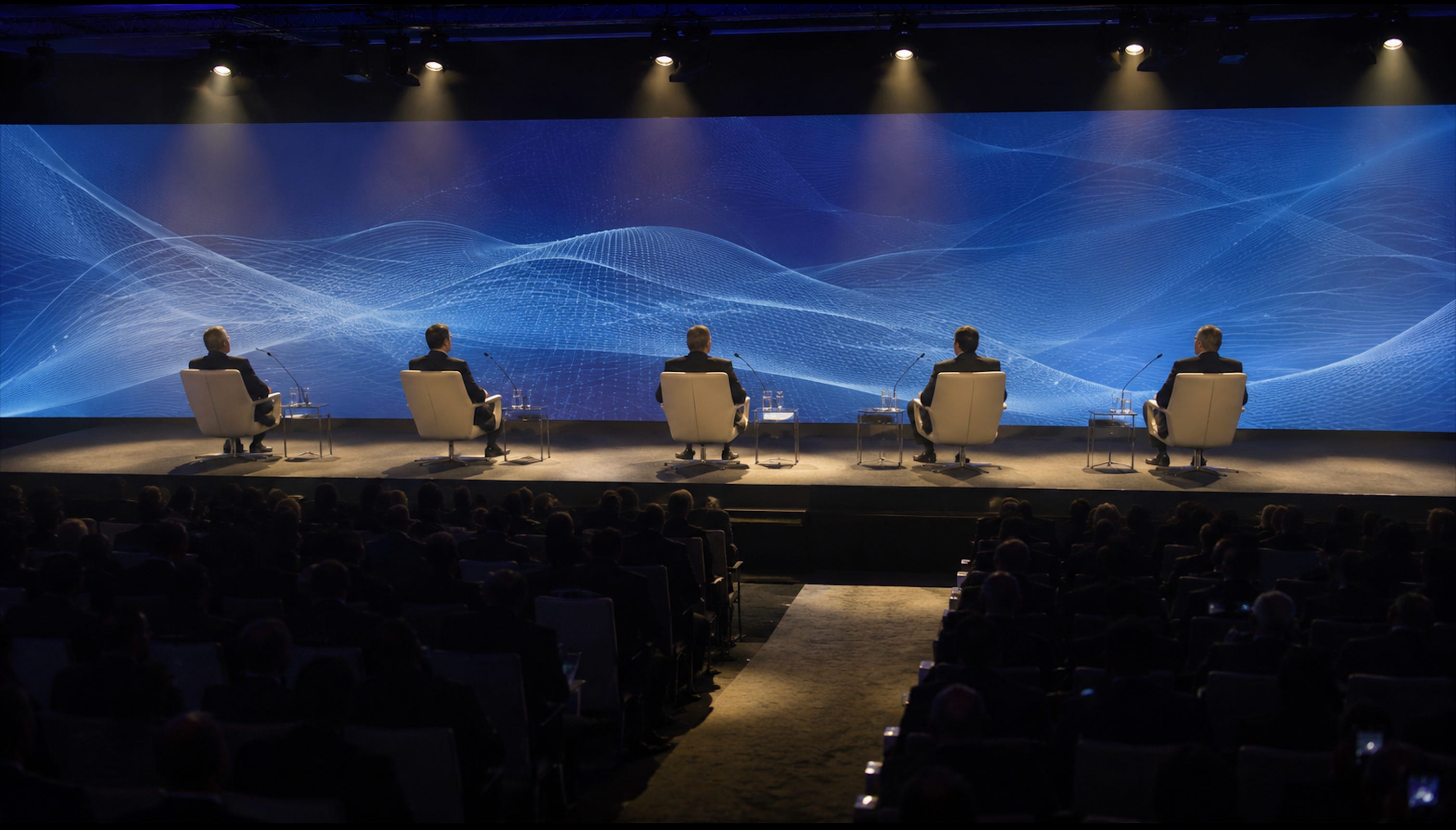
What makes this pattern hold across so many fronts at once — water, power, waste, liability — is that it is not a series of unrelated accounting decisions. It is a coordinated pivot. The same Silicon Valley and Davos rooms that spent the 2010s building entire brand identities around climate commitments have, over the last two years, reorganized their public arguments around what amounts to AI necessity: the claim that the compute buildout is so important to economic competitiveness, national security, and human progress that the energy and emissions costs are an acceptable near-term price.
The hyperscalers’ own disclosures bear this out. Microsoft’s 2024 sustainability report acknowledged the company’s emissions are up roughly 30 percent since 2020, driven by data center construction. Google’s are up roughly 48 percent since 2019. Both companies have framed these increases as compatible with their existing climate commitments, on the assumption that AI itself will eventually accelerate decarbonization enough to make up the difference. The 2025 World Economic Forum convened under the theme “Collaboration for the Intelligent Age.” The 2026 meeting again placed AI at the center of nearly every major panel. Climate is still on the agenda. It is no longer the agenda.
This pivot is not coincidental, and it is not a sincere reweighting of priorities based on new information. The companies making the AI necessity argument are the same companies whose own sustainability disclosures show emissions climbing year over year, whose own water reports document expanding withdrawals into stressed watersheds, whose legal departments are receiving Clean Air Act notices of intent to sue, whose environmental teams have read the same studies as everyone else about aquifer drawdowns in Arizona and ozone problems in Memphis. They are not pivoting because the harms are unclear to them. They are pivoting because the harms are clear to them — and because the alternative is admitting that the climate and water commitments they made in the 2010s are incompatible with the compute growth they now want. The pivot is not “we have changed our minds about which problem matters more.” It is “we cannot continue building and also keep our previous commitments, so we are reframing the building as the thing that matters more.” Climate concern, water concern, air-quality concern — under this logic, all become luxuries that must be subordinated to a buildout treated as nondiscretionary. That is a political claim wearing a technological costume.
There is a serious case for nuclear power as a reliable, high-density energy source. Several advanced designs incorporate passive safety features that represent real engineering progress over earlier generations, and the energy density of uranium fission is genuinely difficult to match with other baseload options. There is also a serious case that the compute demand driving this buildout produces real economic and scientific value. Reasonable people can weigh those benefits differently. None of that justifies evaluating the buildout solely against the marketing material. The phrases “zero water use” and “inherently safe” are not technical descriptions. They are claims that require examination of where the water actually goes, where the waste actually sits, who actually pays, and who actually benefits.
That is the meter they moved. That is the story.
What this essay documents in one sector — measurement substituted for accountability, technical framing deployed to subordinate democratic deliberation, environmental and civic commitments reclassified as luxuries when they conflict with building — is the operational signature of a broader system. The Final Betrayal: How Technocracy Destroyed America, my book with Patrick M. Wood, traces that system across the institutions it now governs. Available now: Amazon

OPENING & FRAMING
Derrick Jensen, “Forget Shorter Showers,” Orion Magazine, July/August 2009.
Microsoft, “Sustainable by design: Next-generation datacenters consume zero water for cooling,” The Microsoft Cloud Blog, December 9, 2024.
COOLING SECTION
Cooling tower evaporation rates: Lawrence Berkeley National Laboratory, “Water Use of Data Center Workloads”.
Conflicts in Arizona, Virginia, Oregon, and Georgia: Forbes, “America’s data centers are thirsty. Rural towns are paying the price—from tanked water pressure to stolen desert groundwater”.
POWER SECTION (xAI MEMPHIS)
Southern Environmental Law Center, “Resistance against Elon Musk’s xAI facility in South Memphis gets stronger,” February 2026.
Aerial documentation: Steve Jones / Southwings for SELC, published in Inside Climate News, “In South Memphis, Elon Musk’s Colossus Operated Gas Turbines Without Appropriate Permits, Residents and Activists Claim,” July 17, 2025.
NAACP April 2026 suit: (PDF)
xAI Colossus 2 / Southaven Mississippi unpermitted turbines: Mississippi Free Press, “xAI Faces Fierce Opposition Over Southaven, Mississippi Power Plant Permit,” March 16, 2026.
Boxtown cancer risk roughly four times the national average: Vanderbilt Political Review, “Carcinogenic Pollution is Endemic in South Memphis”.
NUCLEAR SECTION — SMR PROGRAMS
NuScale Carbon Free Power Project cancellation: NuScale Power and Utah Associated Municipal Power Systems joint press release, “Utah Associated Municipal Power Systems and NuScale Power Agree to Terminate the Carbon Free Power Project,” filed with SEC November 8, 2023.
TVA Clinch River BWRX-300: TVA, “Clinch River Nuclear (CRN) Site”
X-energy / Dow partnership: Dow, “Dow and X-energy advance efforts to deploy first advanced small modular nuclear reactor at industrial site under DOE’s Advanced Reactor Demonstration Program”
Kairos Power: Hermes 2, “Nuclear Regulatory Commission Approves Construction Permits for Hermes 2 Demonstration Plant”
Oklo: “Oklo’s NRC Principal Design Criteria Topical Report Approved for Aurora Powerhouse in Idaho”.
NUCLEAR SECTION — FUEL
HALEU enrichment specifications (5-20%): NRC, “High-Assay Low-Enriched Uranium (HALEU)”
TENEX/Rosatom HALEU dominance: CSIS, “Leveraging International Partnerships Is the Key to Supercharging the United States’ Global Nuclear Leadership”
Centrus Energy domestic HALEU production status: Centrus, “Centrus Energy Secures Contract Extension from Department of Energy to Continue HALEU Production”
NUCLEAR SECTION — WASTE
Yucca Mountain defunding 2010: U.S. Government Accountability Office, “Commercial Nuclear Waste: Effects of a Termination of the Yucca Mountain Repository Program and Lessons Learned,” GAO-11-229, April 2011.
EBR-II 60 tons sodium-bonded legacy fuel: INL, “Metallic Fuels: The EBR-
NUCLEAR SECTION — COOLANT FAILURES
Monju sodium fire 1995 and abandonment 2016: Wikipedia
Superphénix operational history and 1997 closure: Wikipedia
Oak Ridge Molten Salt Reactor Experiment closure 1969: Wikipedia
LIABILITY SECTION
Price-Anderson Act $16.6 billion cap and 2023 inflation adjustment: Congressional Research Service, “Price-Anderson Act: Nuclear Power Industry Liability Limits and Compensation to the Public After Radioactive Releases,” IF10821.
Japanese government Fukushima cleanup estimate (~$200 billion / ¥21.5 trillion): Bloomberg, “Japan Fukushima Cost Seen Almost Doubling to $188 Billion,” December 9, 2016.
JCER higher estimate: Japan Center for Economic Research, “Accident Cleanup Costs May Rise to 50-70 Trillion Yen,” March 2017.
BENEFICIARIES SECTION
Microsoft-Constellation Three Mile Island Unit 1 restart deal: Constellation, “Constellation to Launch Crane Clean Energy Center”.
FERC rejection of Talen-Amazon Susquehanna ISA expansion: Talen Energy, “Talen Energy Statement on FERC Order Rejecting Susquehanna ISA,” November 3, 2024.
Supplementary coverage with FERC order detail: Utility Dive, “FERC rejects interconnection pact for Talen-Amazon data center deal at nuclear plant,” November 4, 2024.
PIVOT SECTION
Microsoft emissions increase ~30% since 2020: Brad Smith and Melanie Nakagawa, “Our 2024 Environmental Sustainability Report,” Microsoft On the Issues, May 15, 2024.
Google emissions increase 48% since 2019: Google, “Our 2024 Environmental Report,” July 2, 2024.
WEF 2025 “Collaboration for the Intelligent Age” theme.
WEF 2026 “A Spirit of Dialogue“ theme.