


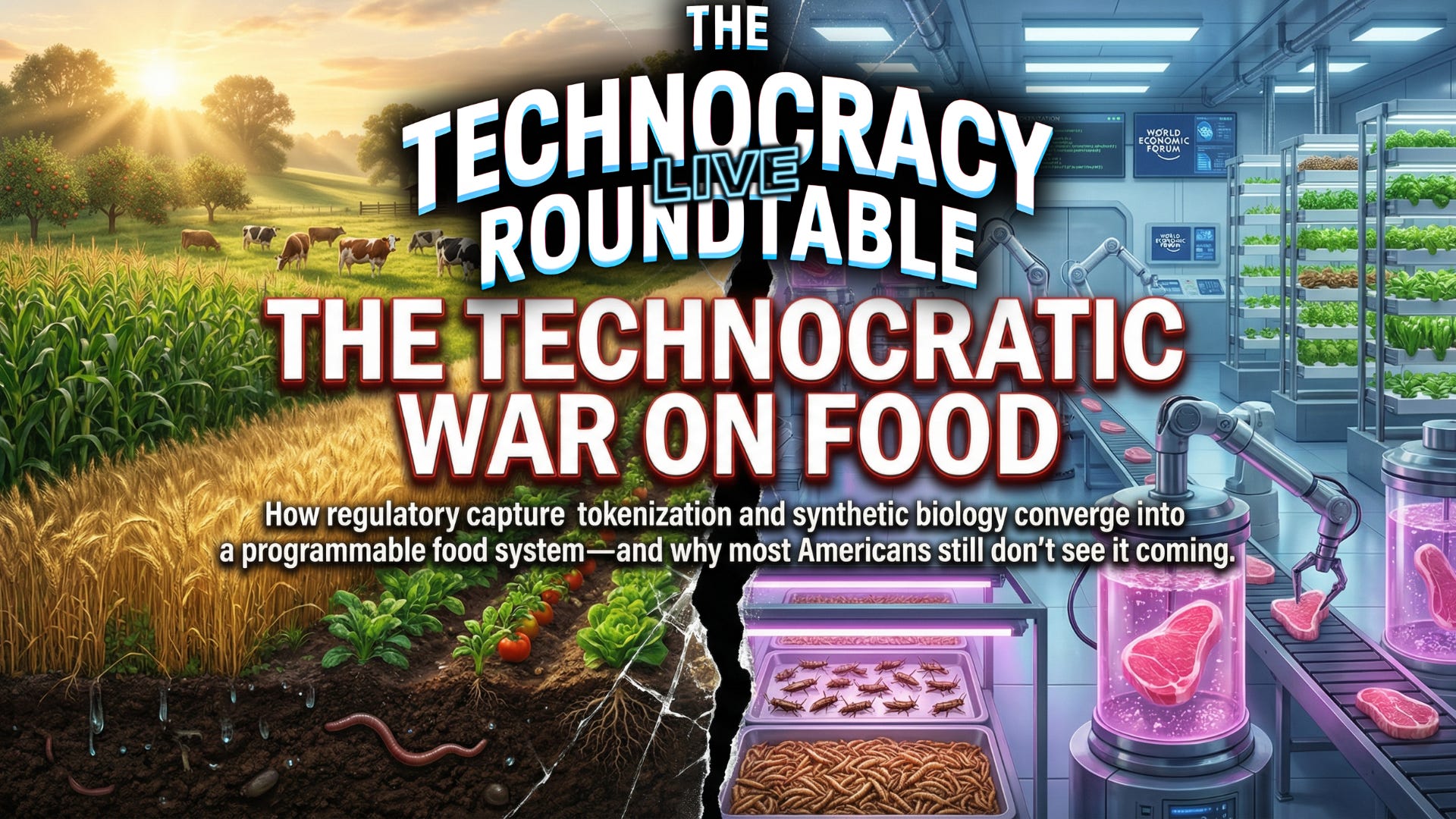
The Invisible War
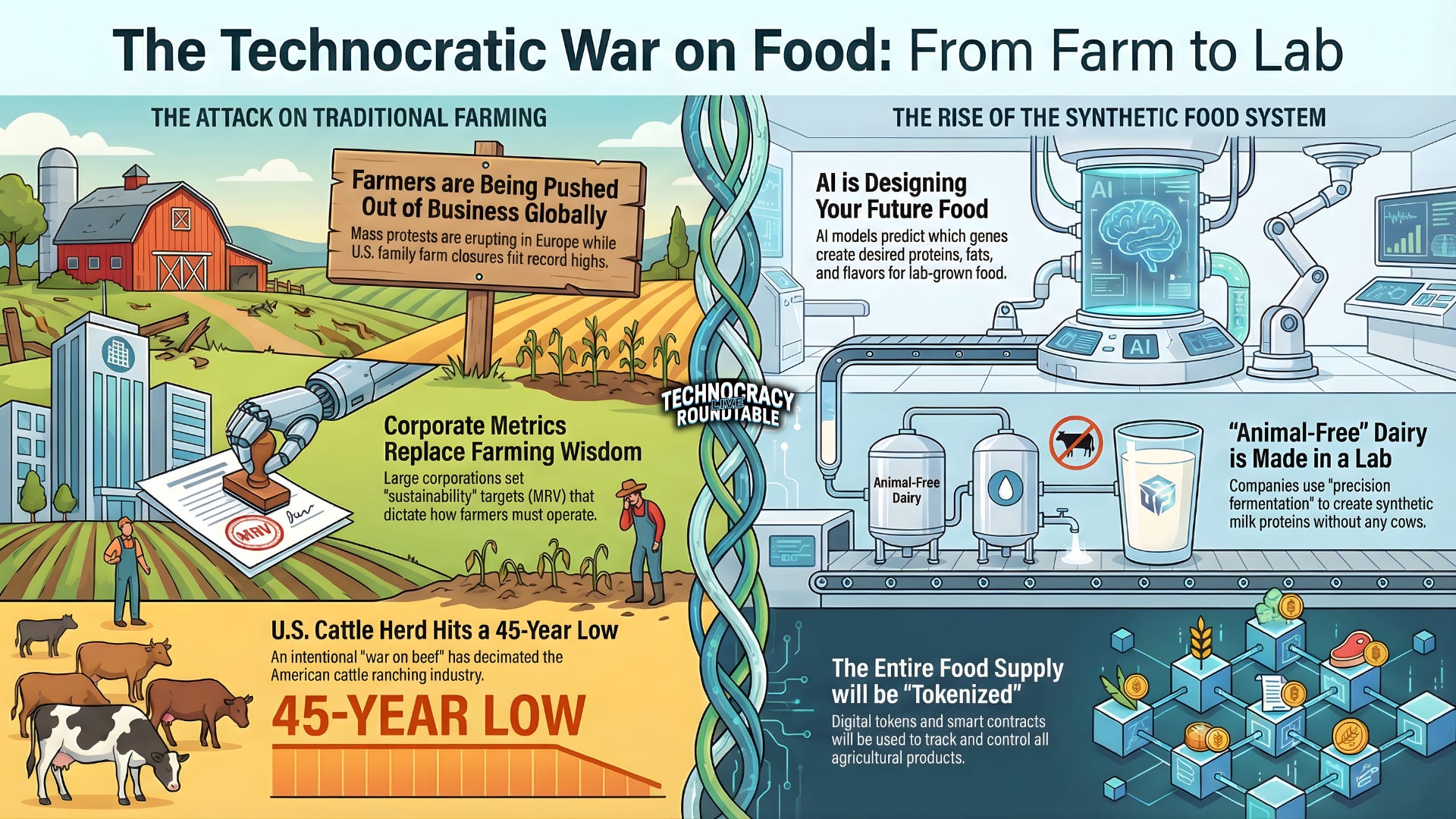
While European farmers block roads with tractors and storm government centers, American agriculture is being squeezed in near-silence—through paperwork, procurement mandates, consolidation, and the slow replacement of real food with synthetic substitutes.
Europe can’t hide what’s happening: when farmers are crushed, shelves feel it immediately.
America can hide it—because our grocery abundance is propped up by long supply chains and imports that create a false sense of permanence. Avocados from Mexico. Beef from abroad. Strawberries from everywhere. This arrangement masks the squeeze, creates the illusion of eternal choice, and buys time for the machinery doing the squeezing to finish its work.
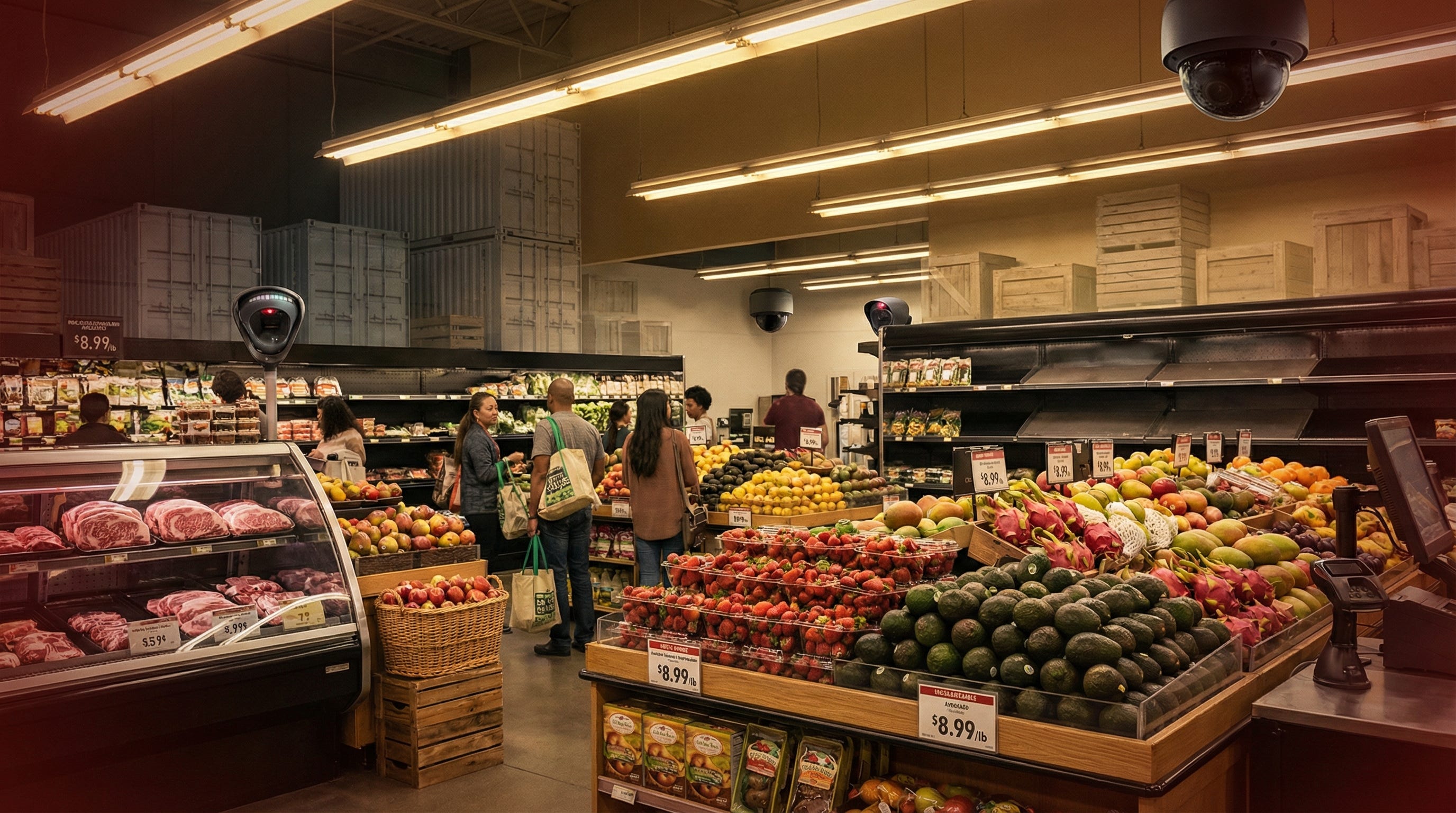
This isn’t a conspiracy theory. It’s regulatory infrastructure and supply-chain governance—mostly invisible, openly implemented, and comprehensive.
Here’s the system in one line:
Control the metrics → control market access → replace real inputs → replace real food → tokenize enforcement → make it programmable.
On January 21, 2026, I hosted a roundtable with three people who understand the machinery from different angles:
Patrick Wood (Technocracy.news; 15+ years tracking technocratic governance)
Craig Wenclewicz (35 years in commodity markets; deep ag + financial plumbing)
Aaron Day (CBDC/tokenization researcher; Daylight Freedom Foundation)
What follows is the cleanest “control-stack” map I have ever seen, for how food becomes a compliance system.
The Control Stack
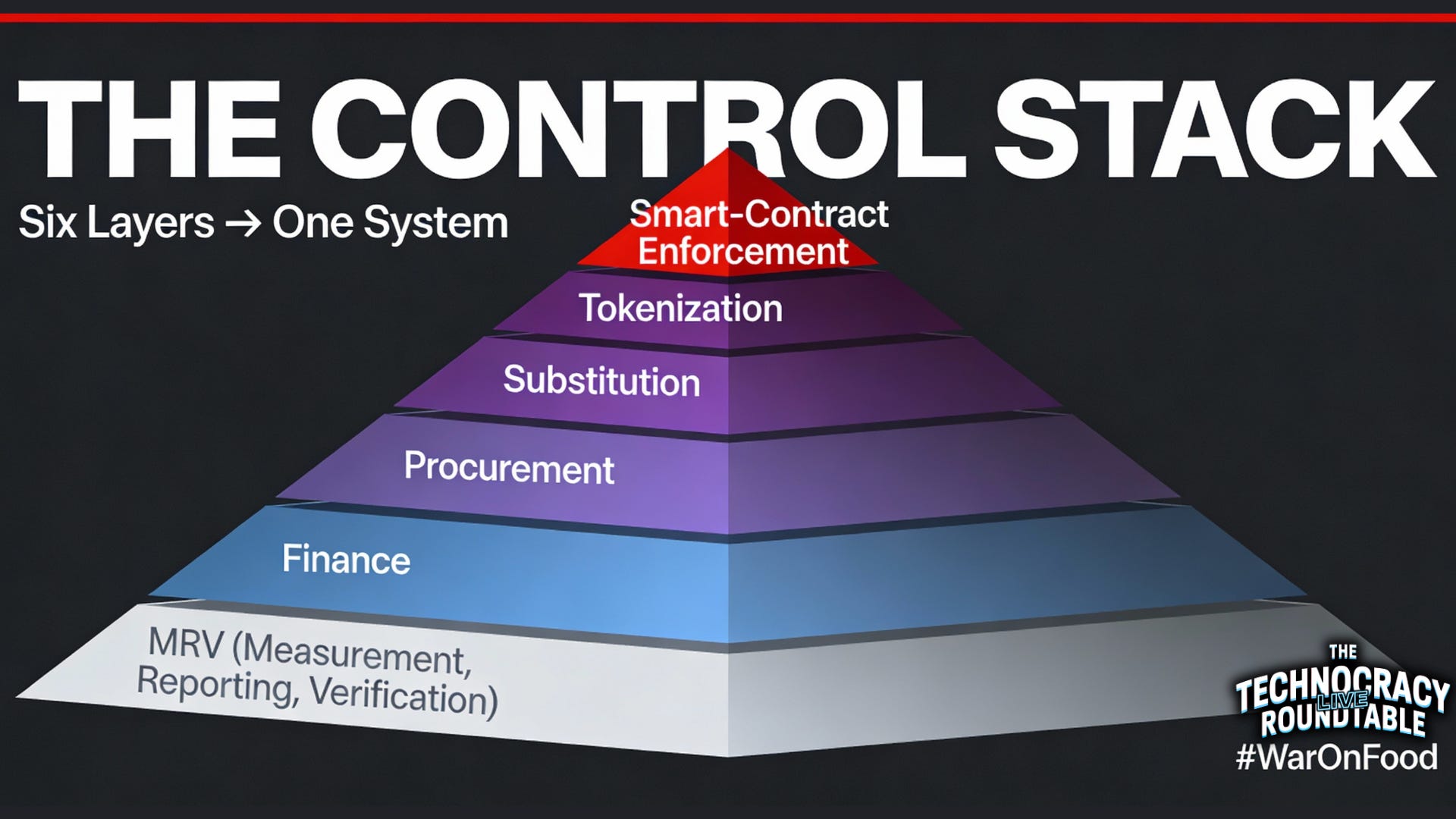
MRV (Measurement, Reporting, Verification)
↓
Finance (incentives, insurance, credit)
↓
Procurement (retailer mandates)
↓
Substitution (synthetic inputs/foods)
↓
Tokenization (digital commodities/credits)
↓
Smart-Contract Enforcement (automatic compliance)
Each layer sounds boring. Each layer looks optional. Together, they become a system where human decision-making is replaced by rules enforced at the point of transaction.
1. Europe Is the Visible Flashpoint—America Is the Quiet Rollout
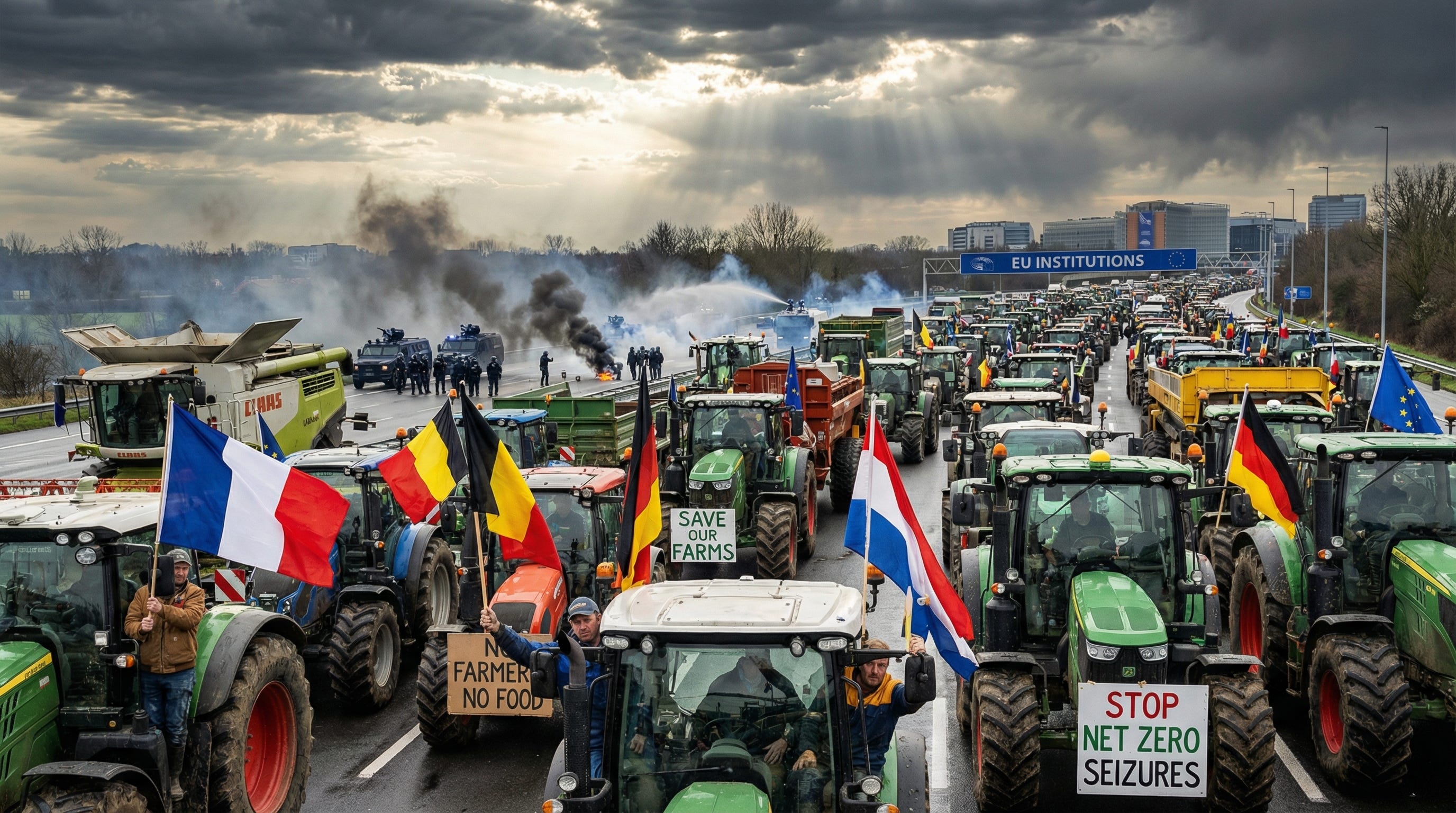
In January 2026, farmers descended on Brussels—tractors, disruptions, open revolt—focused on the EU–Mercosur trade deal and the broader squeeze of regulation and market capture.
“Watch the scale—then ask why Americans rarely see this.”
Then came escalation—more disruptions, higher intensity, and the unmistakable signal: we are past polite petitions now.
“This was just days ago—watch the escalation.”
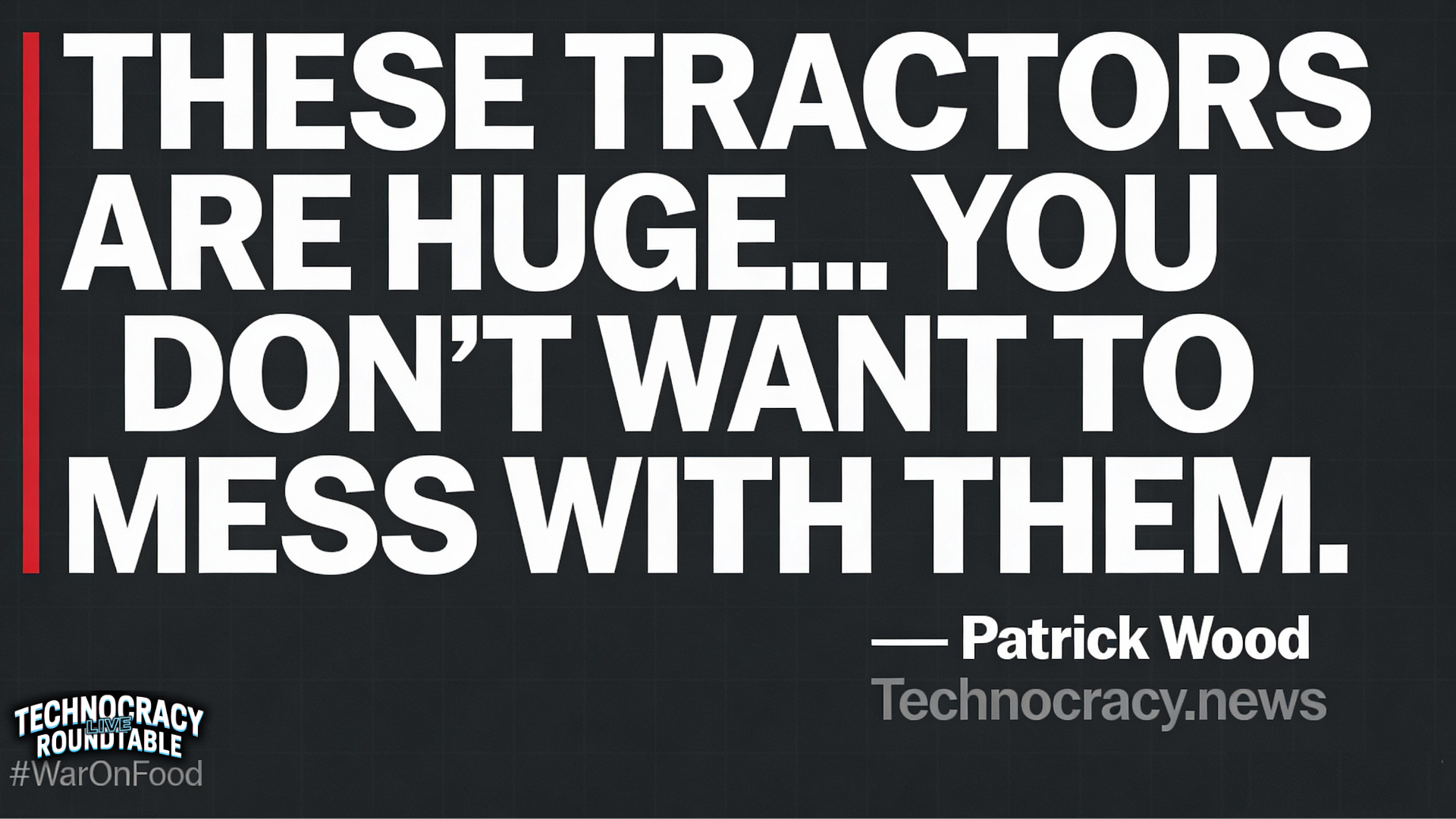
Europe has geographic reality forcing awareness. When farmers go down, shelves talk back immediately.
America has buffers that create delusion. Our shelves stay full longer because imports cushion disruption. Our media rarely frames agriculture as a civilizational choke point. And our “solutions” arrive as corporate programs, not laws—quietly installed through procurement and finance.
That’s the difference: Europe gets street-level visibility. America gets an “innovation rollout.”
2. MRV: Metrics as Governance
MRV sounds dull. That’s the point.
Once food becomes an MRV domain, agriculture becomes:
Auditable (every input measured)
Financeable (data becomes collateral)
Securitizable (metrics become tradeable assets)
Punishable (compliance becomes automatic)
Walmart’s Project Gigaton: The Supply-Chain Enforcement Model
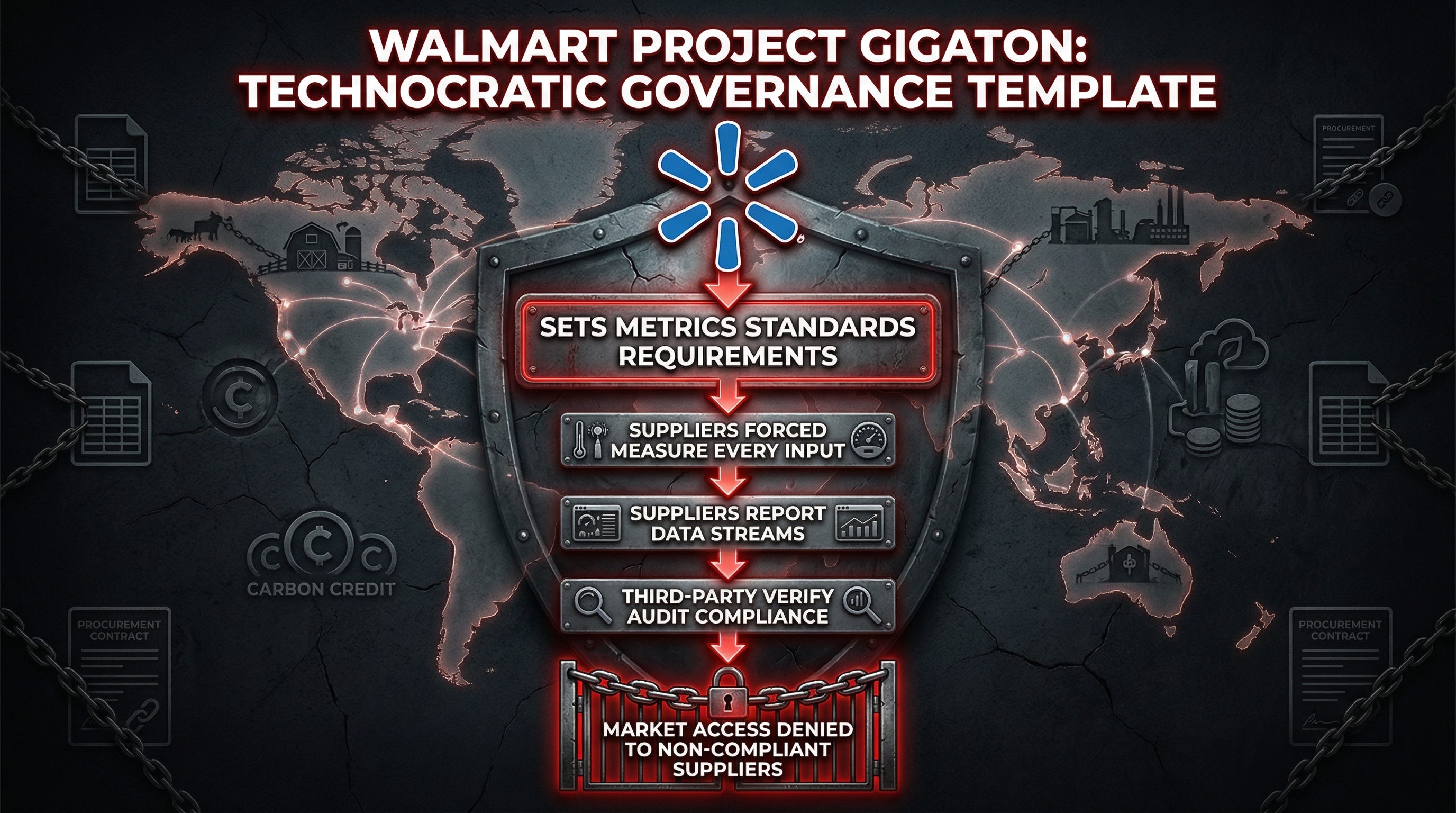
Walmart launched Project Gigaton in 2017—aiming to eliminate one billion metric tons of emissions from its supply chain by 2030, and i. 2024 announced it had reached that target early.
The mechanism matters more than the PR:
Walmart sets the metrics → suppliers measure → suppliers report → third parties verify → Walmart tracks compliance.
No ballot. No debate. Just market access.
Now apply that model to food.
Every farm. Every processor. Every distributor—wired into reporting, verified metrics, and eligibility gates.
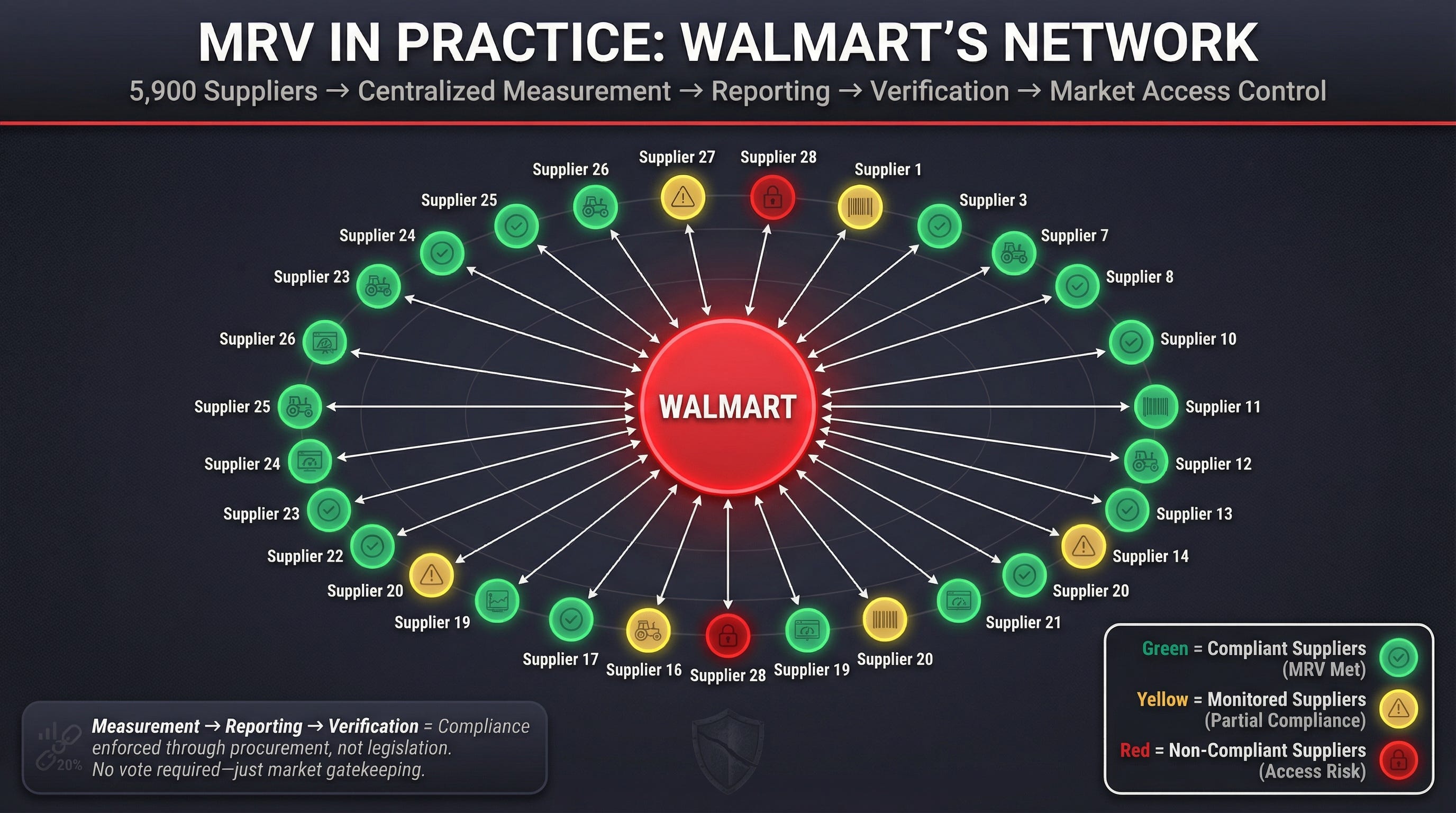
SIDEBAR: MRV in Plain English
MRV is how you convert life into spreadsheets… and spreadsheets into permission.
3. Substitution: Replacing Food with “Ingredients” Made in Bioreactors
You don’t ban food. That’s politically costly.
You replace it—quietly—ingredient by ingredient.
Perfect Day: The “Kinder, Greener” Case Study
Perfect Day produces beta-lactoglobulin (whey protein) using genetically engineered microorganisms and sells it as an ingredient—designed to behave like dairy without cows.
“Watch this ‘kinder, greener’ ad… and notice what your body tells you.”

Perfect Day has submitted GRAS (Generally Recognized As Safe) notices to FDA for its fermentation-derived whey protein. The company’s consumer brand was spun off in 2023; the real business is B2B ingredient supply.
Here’s the pattern you need to recognize:
Novelty products
Ingredient supply deals with major manufacturers
Normal shelf placement
Label confusion
“You’ve already been eating it”
SIDEBAR: Where to Find It
Perfect Day whey protein has shown up in products like: Brave Robot ice cream, Board Cow, Nick’s, Strive protein powder, and more.
How to spot it: read ingredient lists like a hostile contract. Watch for language like “precision fermented,” “animal-free,” and “sustainable” used as a halo—while the sourcing gets murkier.
SIDEBAR: Precision Fermentation ≠ Grandma’s Sauerkraut
Traditional fermentation transforms food.
Precision fermentation manufactures specific molecules at industrial scale—then inserts them back into “food” like interchangeable parts.
Parallels Between Ira Levin’s This Perfect Day and Perfect Day’s “Kinder, Greener” Narrative
Ira Levin’s 1970 dystopian novel This Perfect Day depicts a technocratic utopia where a supercomputer (UniComp) enforces total uniformity and “perfection” through genetic engineering, mandatory drug treatments, centralized control, and standardized daily life. Everyone eats identical “totalcakes” and drinks “cokes,” wears the same clothing, and lives in engineered harmony—free from war, hunger, and conflict, but stripped of individuality, free will, and authentic human experience. The slogan “Christ, Marx, Wood, and Wei led us to this perfect day” reinforces the illusion of benevolence.
Perfect Day’s 2022 advertisement (the provided transcription and video) echoes this language in an eerily similar way. It portrays an ordinary day transforming into something revolutionary through simple choices—like a glass of milk or scoop of ice cream—reimagined via “precision fermentation” to become a “promise to the planet” and a “portal to a new way of thinking.” The company promises a “sea change” by “rethinking our routines and redesigning our favorite foods” in partnership with nature, creating products that make humankind “more human and more kind,” leading to a “perfect” day that’s “kinder [and] greener.”
Parallels to Ira Levin’s Novel “This Perfect Day”.
The Illusion of Perfection Through Engineered Uniformity
In the novel, UniComp creates a “perfect” world by eliminating natural variations (e.g., no daytime rain, no facial hair, genetically merged humanity). Perfect Day’s messaging similarly sells “perfection” by engineering dairy proteins (beta-lactoglobulin) identical to cow-derived whey but produced in labs via genetically modified microbes—eliminating animals while promising identical taste, function, and nutrition. The ad frames this as a utopian upgrade: everyday foods become portals to sustainability and kindness, much like the novel’s controlled harmony hides deeper control.
Centralized, Tech-Driven Control Over Food and Daily Routines
Levin’s society dictates what people eat (standardized, processed “totalcakes” and “cokes”) via UniComp’s algorithms. Perfect Day’s precision fermentation manufactures specific molecules at industrial scale, inserting them into familiar products (ice cream, protein powders) as interchangeable parts. The ad romanticizes this as “partnering with nature” to redesign routines, but critics argue it’s synthetic biology replacing traditional farming—mirroring the novel’s centralized system that eliminates choice under the guise of efficiency and benevolence.
Label Confusion and the “You’ve Already Been Eating It” Narrative
In This Perfect Day, the system normalizes conformity so people accept it without question. Perfect Day’s B2B model supplies “animal-free” whey to brands like Brave Robot ice cream, Nick’s, or Strive protein powders, often placed on shelves alongside traditional dairy. Marketing emphasizes “sustainable” and “identical” without always highlighting the microbial origins, leading to claims of label confusion. The pattern—“novelty products → ingredient deals → normal shelf placement → you’ve already been eating it”—parallels how the novel’s dystopia normalizes engineered uniformity until rebellion reveals the truth.
Precision Fermentation vs. Traditional Processes
The novel’s engineered foods are far from “Grandma’s sauerkraut” (natural fermentation). Similarly, precision fermentation differs from traditional methods: it genetically engineers microbes to produce exact molecules at scale, then blends them into “food” like interchangeable parts. The ad’s poetic language (“a scoop of ice cream becomes a portal”) contrasts with this industrial reality, evoking the novel’s critique of technology that promises kindness but delivers control.
The Dark Side of “Benevolent” Innovation
Levin warns that “perfect” systems often mask elite control (programmers living in luxury while enforcing conformity). Perfect Day’s “kinder, greener” halo raises questions about transparency, long-term safety (e.g., ongoing lawsuits over residual fungal proteins and misleading claims), and whether it truly benefits humanity or concentrates power in biotech firms. The ad’s optimistic tone—ordinary days becoming “perfect”—mirrors the novel’s deceptive utopia, where freedom is sacrificed for engineered satisfaction.
4. The Microbiome Angle: Personalization as a Control Layer
Microbiome testing is sold as wellness. But at scale it normalizes a new social operating system:
Your body becomes a profile → food becomes a prescription → compliance becomes “health.”
This is where substitution grows teeth:
Your biology is “read”
An AI model outputs “optimal nutrition”
Synthetic inputs are customized
Noncompliance becomes “risk behavior”
Once food becomes “optimized,” dissent becomes “irresponsible.”
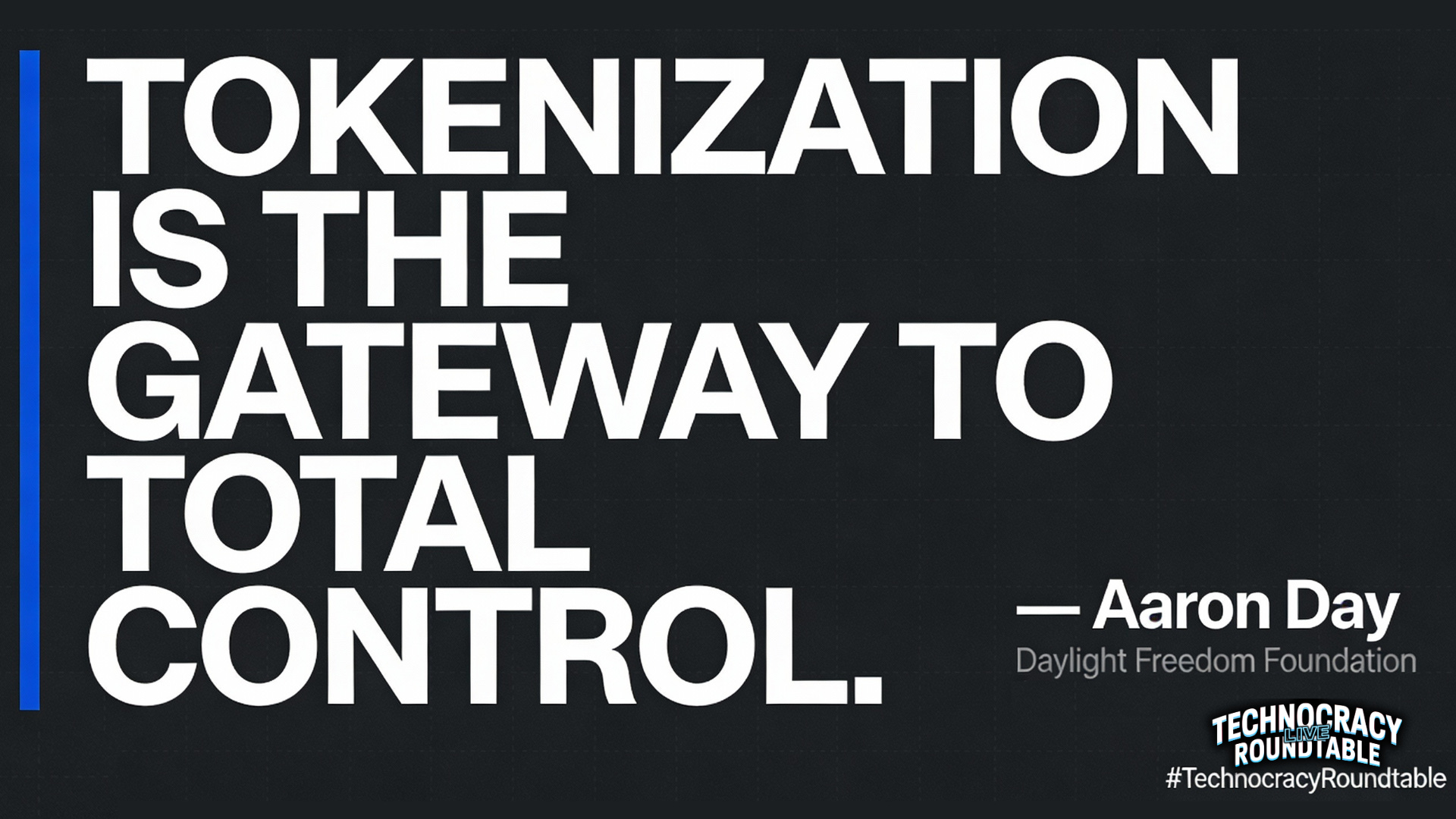
5. Tokenization: When Compliance Moves Into the Transaction
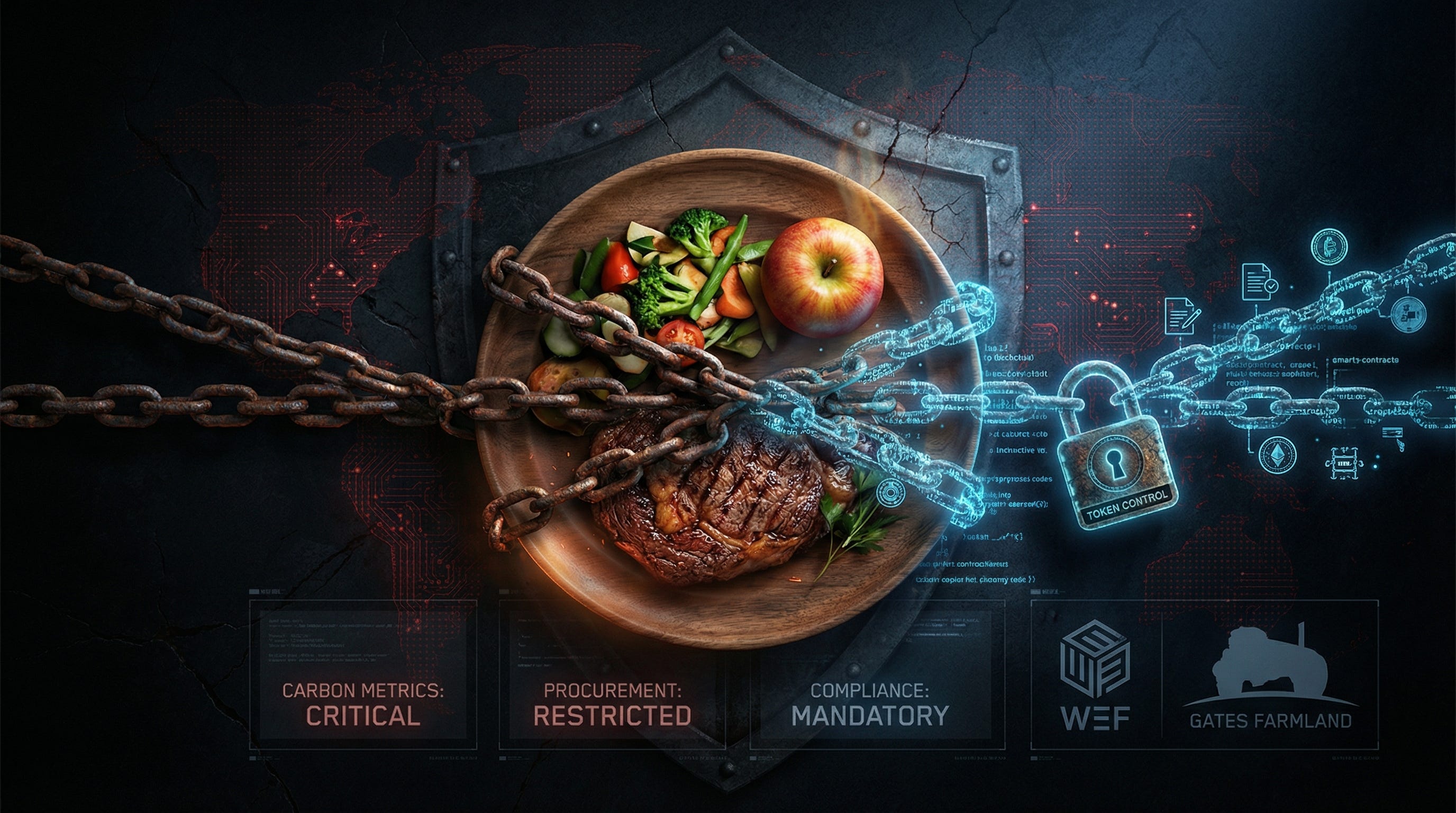
This is the missing piece in most food conversations.
Tokenization turns assets into digitally represented instruments that can carry embedded rules. Smart contracts can enforce those rules automatically.
The micro-scenario
If compliance rules ride inside the token—and the token rides inside your payment rails—then enforcement doesn’t need police.
It needs software.
And here’s the grounding line most people avoid saying out loud:
This isn’t science fiction. This infrastructure—MRV frameworks, digital commodity exchanges, smart contract settlement—is being built right now.
You go from:
“Recommendations” (guidelines, suggestions)
to“Requirements” (you must comply)
to“Your payment won’t clear.” (compliance enforced at the point of transaction)
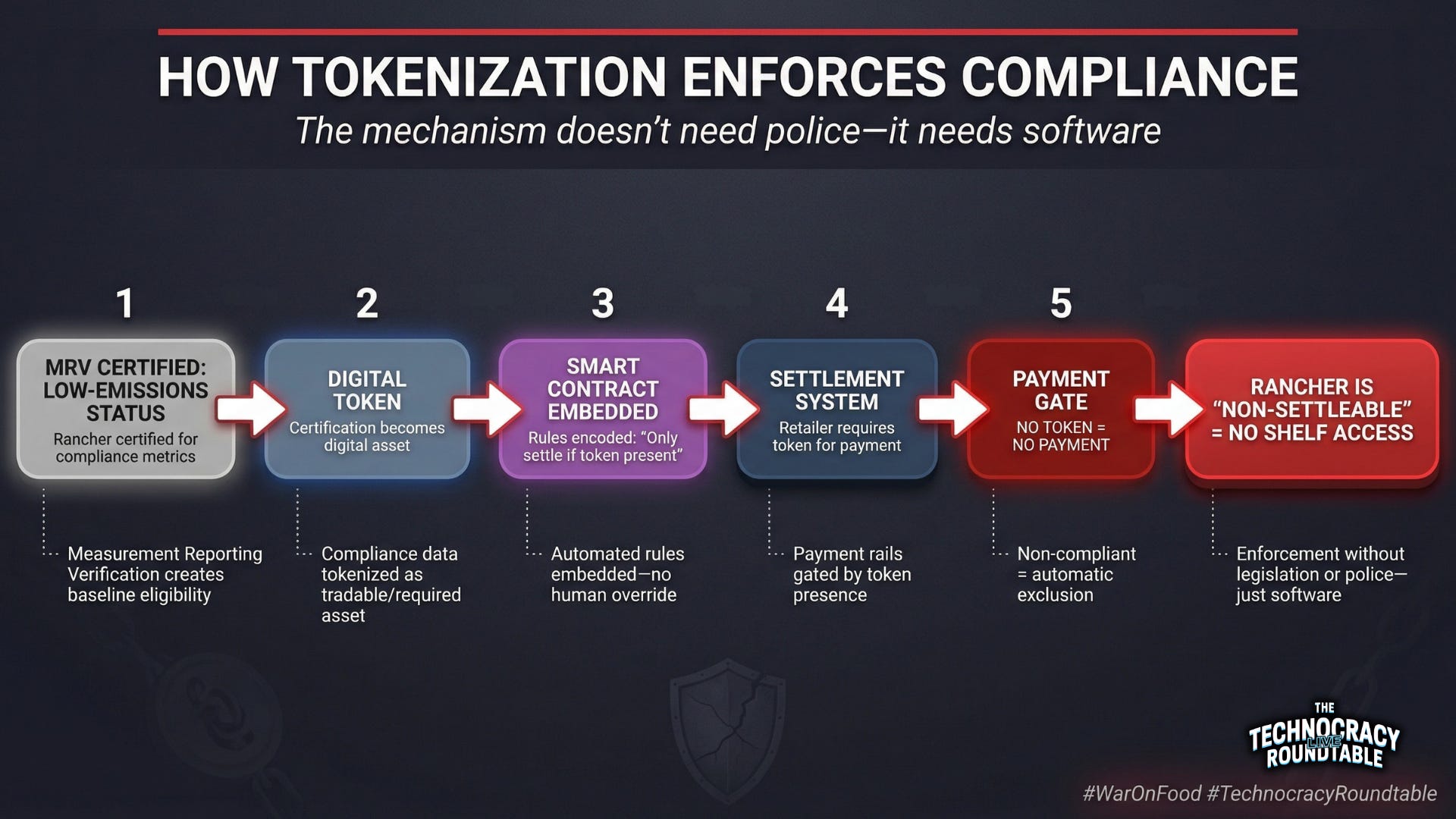
SIDEBAR: Programmable Money Meets Grocery Checkout
When enforcement becomes “settlement,” your choices start failing at checkout—quietly, legally, automatically.
6. The Cattle Squeeze: Engineered Scarcity Sets Up Substitution
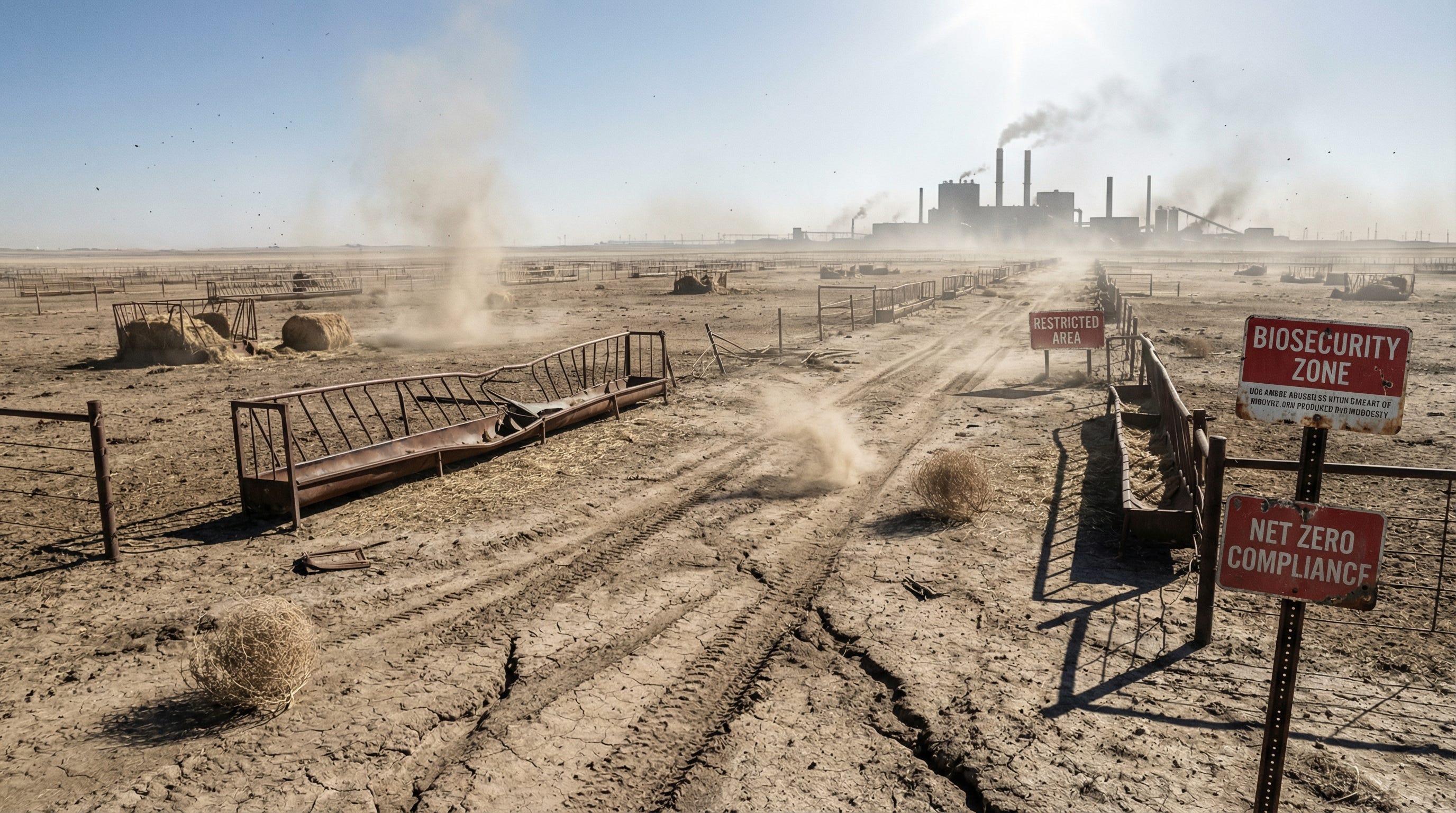
High prices do not mean ranchers are winning. Sometimes it means the system is breaking in a way that creates political permission for replacement.
US cattle inventories have been reported at multi-decade lows, with USDA data showing some of the smallest herd levels since the early 1950s.
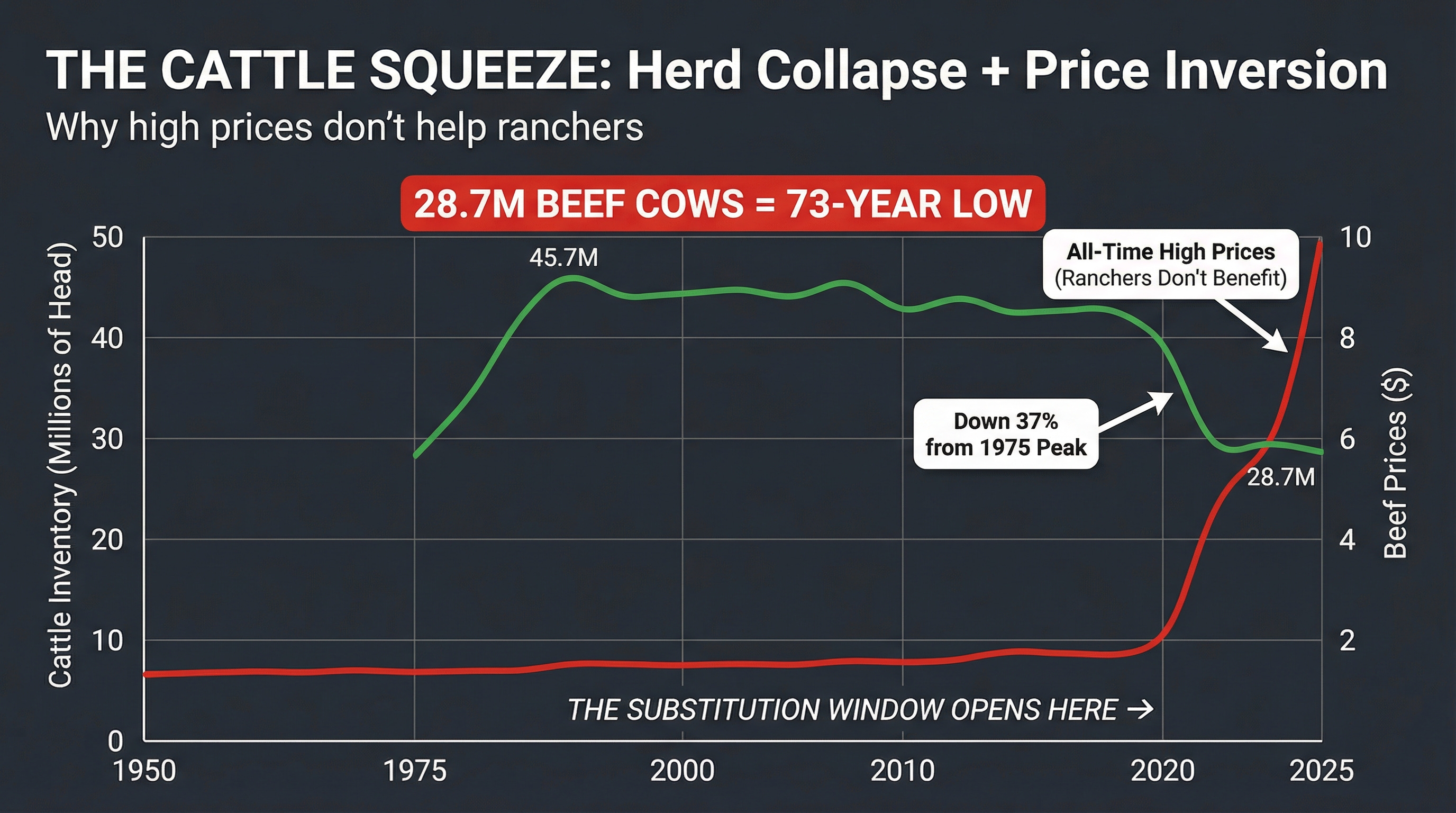
Now add the structure Craig Wenclewicz emphasized on the roundtable: the squeeze isn’t “nature.” It’s market architecture.
Craig’s core point: when a handful of middle layers control packing and distribution, they can squeeze producers and consumers at the same time—creating sticker-shock for the public while profit signals never reach the rancher.
This is the substitution window:
When real food gets scarce/expensive, the “solution” suddenly sounds reasonable: lab proteins, fermented fats, cultivated meat. Not because it’s better—because the system made it “necessary.”
7. The Genetic Baseline: The Quiet Lock-In
The genetic layer is already heavily consolidated through IP, breeding pipelines, and commodity crop systems. Newer techniques (like gene editing) accelerate redesign and normalization.
The key point isn’t debating every statistic—it’s recognizing the trajectory:
Life becomes an editable substrate inside an industrial optimization stack.
8. The Subsidy / Rebrand Shell Game
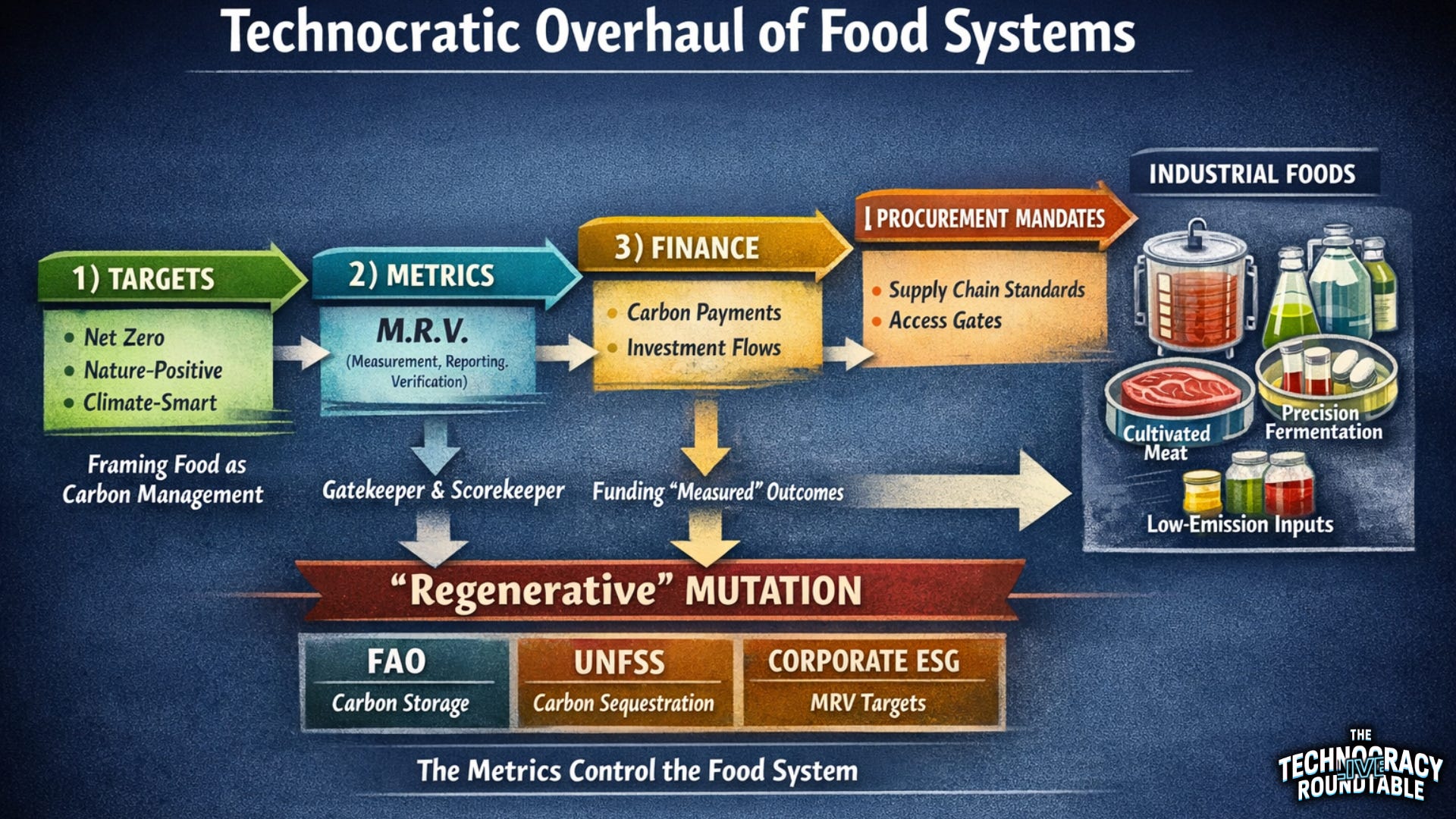
Sometimes the agenda doesn’t end. It migrates.
Programs get renamed. Messaging shifts. The machinery remains.
And the most reliable tell is language capture.
The Rebranding Drift
“Regenerative” used to mean soil life, local resilience, and real ecology.
Now it often means:
Carbon accounting
MRV compliance
Supply-chain eligibility
Financialization
Same word. New operating system.
Patrick Wood nailed the principle: this is the “heartbeat of technocracy”—where bureaucrats and system designers decide how food will be grown and raised, regardless of what farmers actually know works.
9. Narrative Suppression: Why Your Reach Collapses
If you’re wondering why this doesn’t trend, why it doesn’t show up on mainstream feeds, why farmer revolts get minimized—this is the informational control layer.
This is not about one shadowy censor with a mustache. It’s about platform incentives, safety models, and topic throttling—governance by algorithm.
When the conversation threatens the stack, the stack lowers the volume.
10. What Comes Next: Gradual Install + Crisis Activation
Craig raised the key rollout question: gradual, or crisis flip?
Answer: both.
Gradual installation (now)
MRV proliferates. Procurement tightens. Labels drift. Consolidation accelerates.
Crisis activation (when disruption hits)
A real shortage, price shock, disease narrative, or climate emergency framing—and the “alternatives” are ready, cheap, and pre-positioned.
Then the enforcement layer matters:
If tokenized rails + compliance rules are already built, choice becomes theoretical.
11. Resistance That Actually Works
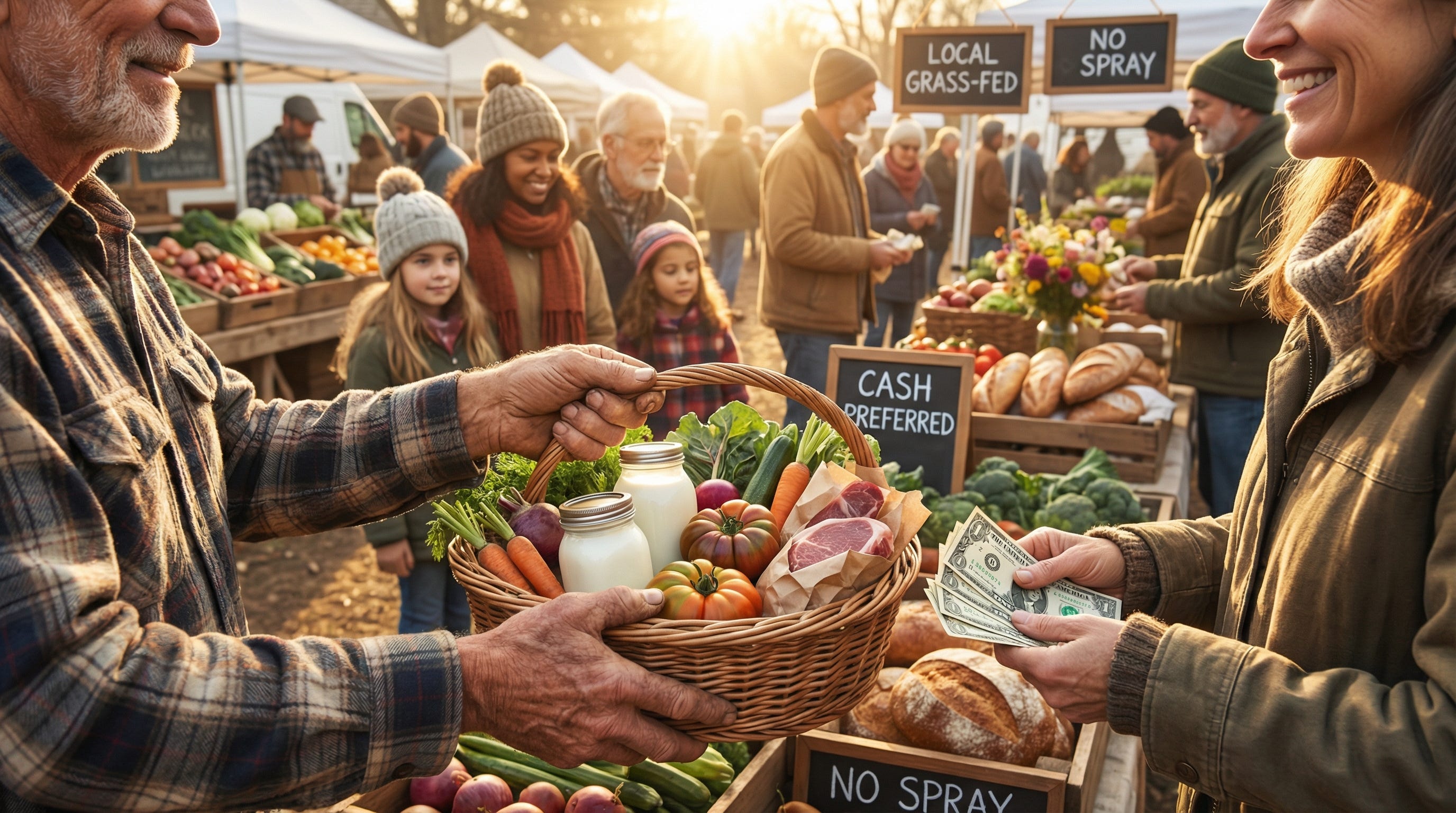
Real sovereignty isn’t aesthetic. It’s logistics.
Action Ladder
Level 1 — This Week
Buy direct from one farmer (meat, dairy, eggs, produce)
Use cash when possible
Start reading labels like a hostile contract
Look for quiet substitution signals (“animal-free,” “precision fermented,” “non-GMO” used as misdirection)
Level 2 — This Month
Join/build a local buying club
Identify and support one local processor (processing is a choke point)
Share the Control Stack graphic (fastest way to wake people up)
Explore privacy tools and uncensorable rails (Aaron’s education at Daylight Freedom; Zano as a subtle on-ramp)
Level 3 — This Year
Help build parallel payment capacity
Support seed resilience and diversity
Build systems that can function even if approved rails tighten
Real-World Proof of Concept
We’re launching clean tallow next month—real fat, real sourcing, outside the industrial additives loop. This isn’t branding. It’s a concrete example of building parallel supply while there’s still margin.
12. The Binary They Don’t Want You to Name
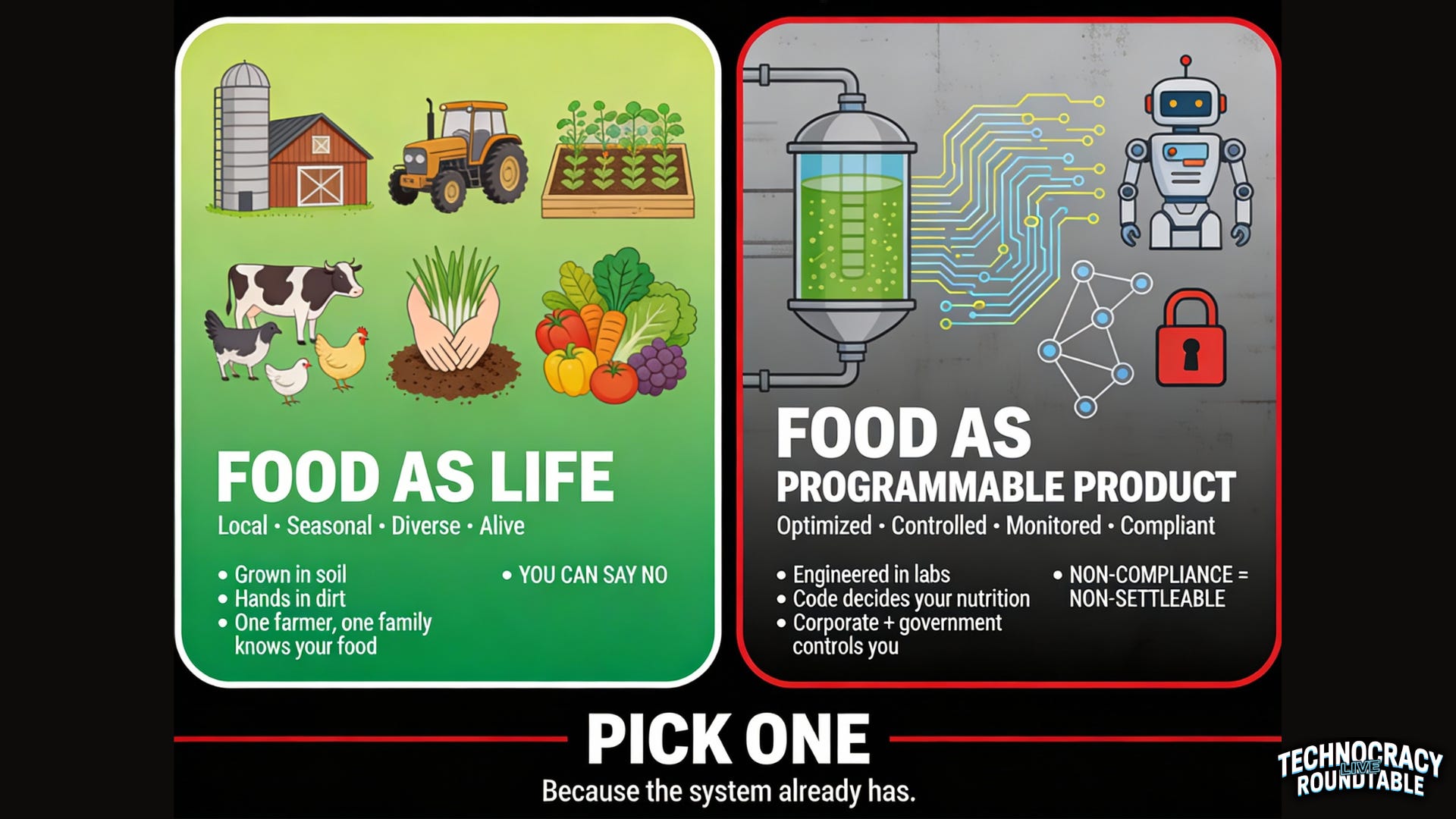
Food as life vs. food as programmable product.
Europe is fighting it visibly.
America is being rolled into it invisibly.
The best time to build parallel systems was yesterday.
The second-best time is now.
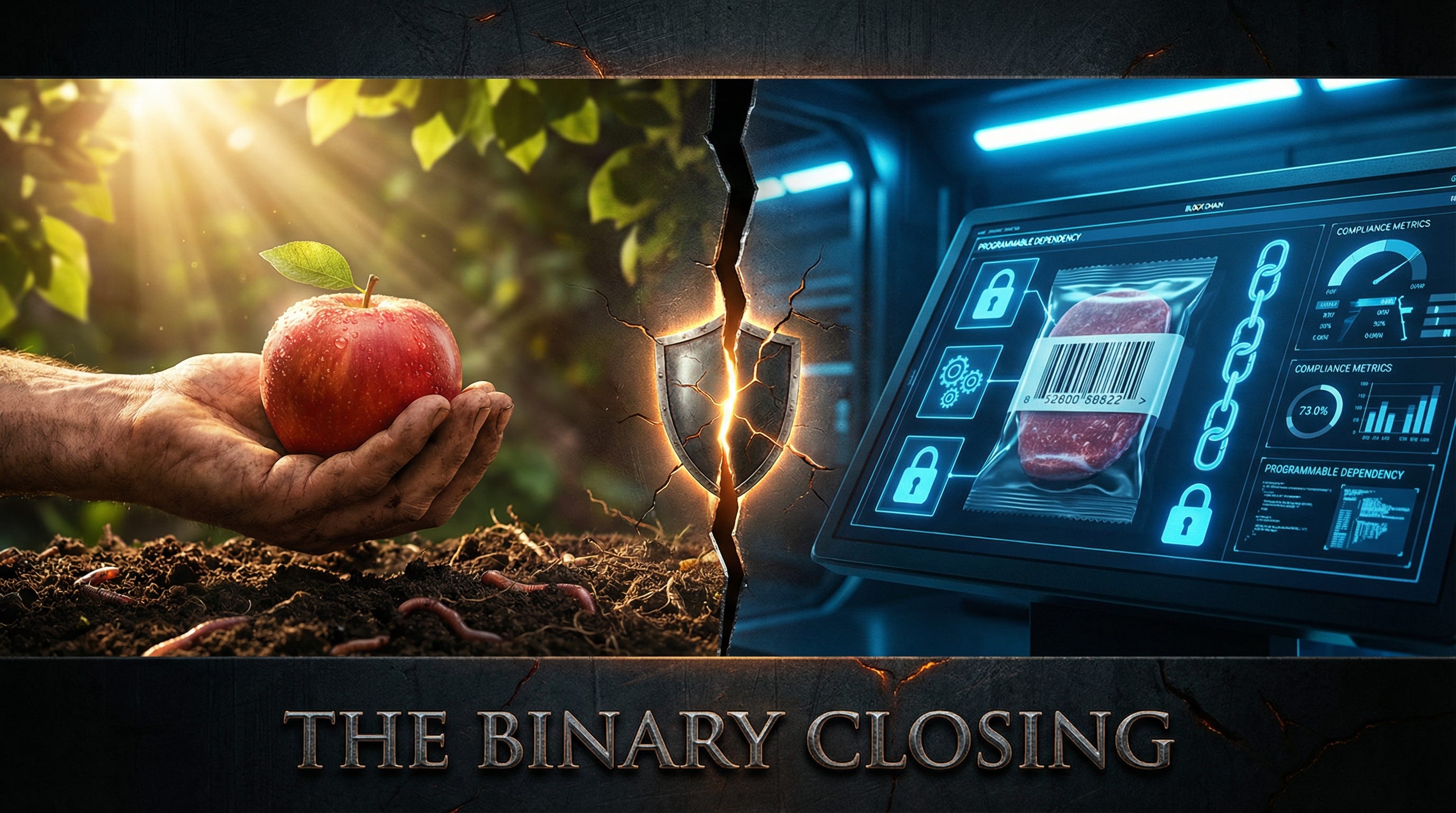
What to Watch For
Watch Window (Q1–Q2 2026 especially—but monitor ongoing):
Herd decline accelerates while prices remain high
Synthetic food products proliferate faster on shelves
Procurement “standards” tighten while governments posture as loosening
Tokenization frameworks move from “pilot” to “required”
Narrative throttling intensifies
Processor consolidation deepens
None of this requires secret meetings. It requires systems thinking.
Subscriber Bonuses
✅ Control Stack Pyramid (PDF) — printable one-pager

✅ Mechanisms Map PDF — MRV → finance → procurement → substitution → tokenization → enforcement
✅ Label Decoder Checklist — what the language actually signals
✅ Resource Map — verified tools + networks for building parallel food systems
Continue the Series
(Previous Episodes)
If this hit you, don’t stop here—these episodes build the wider map.
Episode 1 — August 2025 — The Technocracy Roundtable: Exposing the Global Takeover, Tokenization Threats, and Strategies to Ignite the Resistance
Episode 2 — September 2025 — The Technocracy Roundtable LIVE: Sovereign Siege: Trump's Wealth Fund & the Robotic Onslaught
Episode 3 — October 2025 — Technocracy Roundtable: Bio-Digital Betrayal – AI Medicine, MAHA/MABA, Wearables & Convergence Exposed
Episode 4 — November 2025 — Technocracy Roundtable: Machine “Consciousness,” Sentient Delusion, and the War on the Human Soul
Follow, Connect, and Support the Panelists
If this piece helped you see the stack, take the next step: follow these voices, share their work, and plug into the parallel systems we’re building. Wake one knight at a time.
Patrick Wood —Patrick Wood's Technocracy News: The Quickening Report
Patrick has spent 15+ years documenting the architecture of technocracy and the governance systems being installed “quietly” through standards, metrics, and compliance regimes.
Start here: Technocracy.News and Patrick’s ongoing reporting.
Aaron Day —
Aaron focuses on CBDCs, tokenization, programmable money, and financial escape rails—the enforcement layer most people miss until it’s too late. Start here: DayLightFreedom.org and Aaron’s toolkit for your freedom journey: FreedomForge.io
Craig Wenclewicz —
Craig brings decades of commodity-market and real-world economic plumbing—the “how the squeeze actually works” perspective (and why high prices don’t mean producers are winning). Start here: World-HD and Craig’s deciphering of the harmonics of the systems at play.
Courtenay Turner —
I host these roundtables to map the control architecture clearly, name the mechanisms, and help build real alternatives—logistics, not vibes. If you want to support the work, that support directly fuels the next investigations and panels. Find all of my links HERE and consider becoming a paid subscriber if you’re not already!
🚨 SECURE YOUR COPY:
The Final Betrayal: How Technocracy Destroyed America — the companion to this discussion and a field manual for anyone trying to understand the machine while there’s still time to resist it.

Share This
If this hit you in the gut, don’t keep it there—share it.
Forward this to one person who needs to see the stack. Wake one knight at a time.
Tag a farmer. Tag a rancher. Tag the friend who still thinks “eat the bugs” disappeared.
#WarOnFood #TechnocracyRoundtable #FoodSovereignty #TokenizationExposed
P.S. Next roundtable is Feb 25—Technocracy’s War On Free Speech.
The door is still open. But it’s closing.
Further Reading
Footnotes & References
A) Global food-system governance (frameworks & agendas)
Rockefeller Foundation, “Food System Vision Prize.”
Rockefeller Foundation, “Rockefeller Foundation Food 2050 documentary explores feeding a planet of 10 billion.”
Food and Agriculture Organization of the United Nations (FAO), “Family Farming.”
United Nations, “Food Systems Summit: Action Track 3 – Wave 2 Ideas Paper” (PDF).
B) Synthetic biology & precision fermentation (science + industry)
Frontiers in Industrial Microbiology (2023), article page.
Perfect Day, official site.
Vivici, official site.
SciSpot, “Top 20 Innovative Synthetic Biology Companies in the US.”
Arsenale Bio, official site.
AgroSense, official site.
C) Metrics, MRV, and corporate enforcement in supply chains
Science Based Targets initiative (SBTi), official site.
Walmart disclosures on Project Gigaton framework and program description. (Walmart Sustainability Hub; SEC reference)
D) Biometrics / microbiome + AI personalization
USDA National Agricultural Library (NAL), “Monitoring the gut microbiome: AI and ‘omics…”
Viome, official site (microbiome testing + personalization claims).
E) Tokenization, digital commodities, and regulatory plumbing
H.R. 3633 (Digital Asset Market CLARITY Act of 2025).
F) U.S. cattle inventory & market signals
USDA/NASS Cattle Inventory reporting (national totals via USDA/NASS bulletin format).
G) Reporting & commentary (context / media)
Modernity.news (Jan 22, 2026), “Watch: Davos elites push lab-grown meat despite massive backlash.”
Reporting on Perfect Day litigation allegations. (AgFunderNews).
Reporting on Perfect Day restructuring / The Urgent Company. (The Spoon).
Reuters reporting on EU farmer protests / Mercosur-related developments. (Reuters)
H) Additional links / media
[Levin, Ira. This Perfect Day. Santa Barbara, CA: Start Publishing LLC (reprint edition). https://www.amazon.com/This-Perfect-Day-Ira-Levin/dp/160598129X
YouTube videos (referenced media).
Disclaimer
This is intended to be inspiration & entertainment. We aim to inform, inspire, and empower. Guest opinions/statements are not a reflection of the host or podcast. These are conversational dialogues, and all statements are not necessarily meant to be taken as fact. Do your own research. Thanks for watching!
©2026 All Rights Reserved


